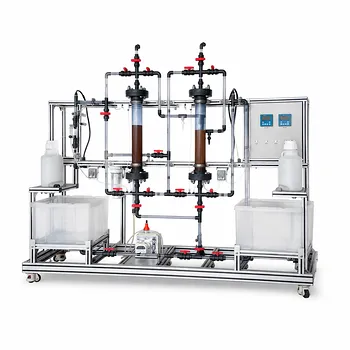
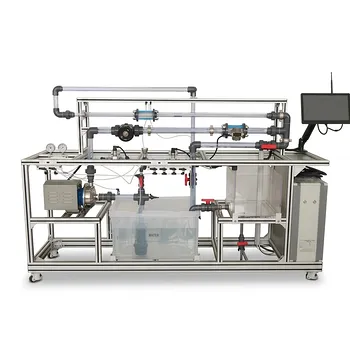
The primary kinetic challenge in a leaching pilot plant when an insoluble solid product layer forms is the creation of a massive internal diffusion resistance. This coating physically separates the leach solution from the unreacted mineral, dramatically slowing the reaction rate as reagents must diffuse through this growing barrier. The path to managing it lies not in a single fix, but in diagnosing the true rate-limiting step and applying targeted adjustments to particle size, chemistry, or mechanical forces.
A solid product layer shifts the kinetic bottleneck from surface reaction to diffusion. Simply cranking up mixer speed will fail if the layer is the main blockade. Success comes from reducing diffusion path lengths through finer grinding and enhancing the driving force with optimized reagent concentration and temperature.
Understanding the Kinetic Bottleneck in Pilot-Scale Leaching
The formation of a solid product layer is not just a visual nuisance—it fundamentally rewrites the rules of your leaching kinetics. In a pilot plant, this shift must be understood quantitatively to avoid wasted time and reagents.
The Formation of a Solid Product Layer
In many hydrometallurgical processes, the chemical reaction itself generates an insoluble solid. A classic example is the formation of calcium sulfate (gypsum) when leaching phosphate rock with sulfuric acid.
This byproduct does not dissolve into the bulk solution. Instead, it precipitates directly onto the surface of the unreacted mineral particle, creating a dense, encapsulating shell. This transforms the particle into a shrinking unreacted core with an ever-thickening ash layer.
A Three-Step Resistance Model
Once a product layer exists, the overall leaching process involves three sequential resistances. The reactant must first overcome the liquid boundary film around the particle, then penetrate the solid product layer via pore diffusion, and finally undergo the chemical reaction at the unreacted core interface.
The total time for complete conversion is the sum of the times required for each step. The slowest of these three—the rate-determining step—dictates the overall kinetics and is the only lever you can effectively pull to improve plant performance.
Identifying the Rate-Determining Step in Your Pilot Plant
Diagnosing the bottleneck is the single most critical act of pilot-plant operation. You can’t manage what you don’t measure. A simple diagnostic is to run a test at different agitator speeds.
If the leaching rate increases sharply with RPM, the boundary film diffusion is limiting. If the rate plateaus and remains stubbornly slow regardless of agitation, diffusion through the solid product layer is in control. Models like Valensi-Carter and Ginstling-Brounshtein describe this latter regime, where conversion has a specific parabolic relationship with time.
Strategic Process Adjustments for Managing Product-Layer Resistance
Once you’ve confirmed that internal diffusion is your enemy, your tactical playbook must shift from mixing to material science and chemistry. The goal is to shorten the diffusion pathway or strengthen the driving force.
Particle Size Reduction: Maximizing Surface Area
This is your most powerful physical lever. The diffusion path length is directly proportional to the particle radius. Grinding the feed to a finer, narrower size distribution will slash the time required for a reactant to diffuse through the product layer.
In pilot-scale operation, this means rejecting over-limit coarse particles with a classifier. A small investment in size reduction can yield a disproportionately large gain in final extraction without changing any chemistry.
Optimizing Reagent Concentration and Temperature
When you can’t make the layer thinner, you must increase the concentration gradient that drives the diffusion. A higher acid concentration in the bulk solution creates a steeper gradient, pushing reactants through the solid layer faster.
Temperature is a dual-purpose tool. It increases the chemical reaction rate constant, but critically, it also increases the diffusion coefficient of species moving through the solid pores. A 10°C rise can meaningfully boost leaching rates even in a diffusion-controlled regime.
The Limited Role of Mechanical Agitation
A common and costly mistake is to fight product-layer resistance with power. If the pilot data confirms the layer is the rate-limiting step, increasing agitator speed will yield negligible benefit.
You will simply waste energy. The hydrodynamic shear from a standard impeller cannot penetrate the microscopic pores of a product shell. Recognizing this futility prevents capital from being wasted on oversized motors and allows you to redirect focus to the variables that truly matter.
Mechanical Shear as an Active Disruption Tactic
While gentle mixing is futile, a deliberate and intense mechanical force is not. This is a separate tactic: applying high-shear forces specifically designed to abrade or fracture the product layer.
This can involve ultrasonic irradiation in a specialized cell or the use of attrition-leaching reactors with dense grinding media. The goal is not mass transfer but physical removal of the coating, continuously exposing fresh surface. This technique requires careful pilot testing to balance wear-and-tear costs against the gain in recovery.
Common Pitfalls to Avoid
The path from bench-scale success to pilot-plant failure is often paved with two specific mistakes when a product layer is present. Objectively acknowledging these trade-offs is essential.
Misdiagnosing the Rate-Limiting Step
The most expensive error is assuming a chemical control regime when diffusion rules. This leads to chasing higher temperatures with diminishing returns. The diagnostic agitation test is simple, cheap, and must be the first experiment run when you see a product layer forming. Skip it, and you risk scaling up with a flawed reactor design.
Overlooking Residence Time Design
A diffusion-controlled reaction does not respond well to a plug-flow reactor profile. Extracting the last 10-20% of value requires a disproportionately long time because the product layer is thickest at the end. Under-designing your pilot plant’s residence time will systematically leave metal behind, producing an overly optimistic economic model that will fail at demonstration scale.
Making the Right Choice for Your Pilot Plant Goal
Your response to a product layer challenge should be directly tied to your primary objective for the pilot campaign. There is no universal best practice, only the right practice for the goal.
- If your primary focus is maximizing final extraction rate: Double down on fine grinding to a demonstrably optimal size and build in the necessary residence time to reach the plateau of the conversion curve.
- If your primary focus is minimizing operational complexity and cost: Avoid exotic high-shear systems. Optimize the acid concentration and temperature to hit your economic break-even point, and accept a slightly longer batch time instead of introducing complex attrition equipment.
- If your primary focus is collecting data for a reliable scale-up model: Run the full matrix of diagnostic tests—agitation, particle size, and temperature—to confirm the diffusion-controlled model. Use the data to fit the Ginstling-Brounshtein equation parameters for a predictive reactor model.
A solid product layer in your pilot plant doesn’t spell failure; it hands you the definitive blueprint for the reaction engineering your commercial plant will require.
Summary Table:
| Rate-Limiting Step | Diagnostic Indicator | Key Management Strategy |
|---|---|---|
| Liquid Boundary Film | Leaching rate increases sharply with agitator RPM | Increase agitation speed |
| Solid Product Layer | Leaching rate plateaus regardless of RPM | Reduce particle size (finer grinding) & raise temperature |
| Chemical Reaction | High sensitivity to temperature, unaffected by RPM | Optimize reagent concentration & reaction temperature |
Optimize Your Unit Operations with LABPARK
Overcoming kinetic and diffusion bottlenecks requires advanced, reliable pilot-scale systems. LABPARK provides state-of-the-art Educational and Vocational Unit Operations Pilot Plants in chemical engineering, bioprocess & biotech, and environmental & water treatment.
Specifically designed for universities, research institutes, and enterprises, our pilot plants enable precise control, accurate data collection, and hands-on learning for complex hydrometallurgical and chemical processes.
Ready to elevate your research and training capabilities? Contact LABPARK today to discuss your project requirements!
Related Products
- Comprehensive Liquid-Liquid Extraction Pilot Plant for Engineering Education
- Rising and Falling Film Evaporation Educational Unit Operations Pilot Plant
- Comprehensive Fluid Mechanics Educational Unit Operations Pilot Plant
- Natural Product Extraction Unit Operations Training Pilot Plant
- Gallium and Indium Selective Extraction Educational Pilot Plant
People Also Ask
- How do pilot plants differentiate physical vs chemical extraction? Enhance Chemical Engineering Training
- In a liquid-liquid extraction pilot plant, how is a ternary-phase diagram utilized to determine solvent feed requirements?
- How are ternary phase diagrams and LLE data applied in extraction experiments? Optimize Pilot Plant Scale-up
- How to Validate BIPs for LLE Pilot Plants? Steps to Align Simulations with Reality
- How Do Selectivity & Distribution Coefficients Influence LLE Pilot Plant Solvent Choice?