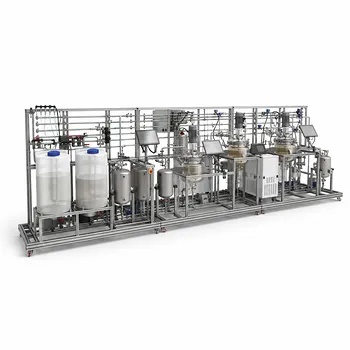
The answer lies in a sequence of tightly controlled thermal zones.
For a continuous esterification pilot plant producing Dioctyl Phthalate (DOP) with a sulfuric acid catalyst, the essential unit operations are monoesterification, catalyzed esterification with azeotropic water removal, neutralization, and thermal decomposition/distillation. The critical temperature parameters are 130°C in the monoesterification reactor, a precise temperature gradient in the esterification column (115°C overhead, 132°C bottoms), 130°C during neutralization, 180°C for thermal decomposition, and 100°C overhead in the distillation step.
A successful DOP pilot plant doesn’t just replicate a recipe—it provides the flexible, multi-zone thermal control needed to explore different plasticizer grades and alcohols while avoiding thermal degradation that ruins product quality. The true value emerges when you can balance reaction kinetics, phase equilibria, and purification all within a single, instrumented flow.
The Core Unit Operations of Continuous DOP Production
The process transforms solid phthalic anhydride and liquid 2-ethylhexanol (octanol) into a high-boiling ester through a series of interconnected physical and chemical steps. Each unit operation presents a distinct temperature control challenge.
Monoesterification: The Foundation Step
The first reactor combines phthalic anhydride with octanol in a 1:2.3 molar ratio without a catalyst. Operating at approximately 130°C, this agitated vessel rapidly forms the half-ester. Because the reaction is moderately exothermic, the pilot plant must remove sufficient heat to prevent a temperature spike that would prematurely boil off the alcohol or promote side reactions.
A jacketed stirred-tank reactor with a recirculating heat transfer fluid loop (often a synthetic fluid like Syltherm capable of reaching 130°C) works well here. The temperature controller should maintain a tight band around the setpoint to keep the reaction rate steady and the alcohol in the liquid phase.
Catalyzed Esterification with Entrainer Distillation
The core of the continuous process is an esterification column that marries reaction and separation. The pre-formed half-ester, octanol, sulfuric acid catalyst, and a cyclohexane entrainer are fed to the column.
The unit operation functions as a reactive distillation: water generated by the esterification is removed overhead as a cyclohexane-water azeotrope, while the reaction progresses in the liquid phase on the trays or in the packing. This requires strict spatial temperature zoning.
- Overhead temperature: 115°C, matching the boiling point of the azeotrope.
- Bottom temperature: 132°C, providing enough thermal energy to push the equilibrium toward the diester without degrading the product.
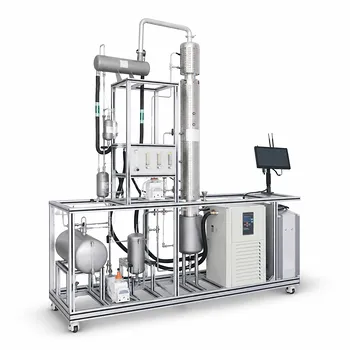
From a pilot plant design perspective, this column must have multiple independently controlled heating zones (bottom reboiler, side heat exchangers, or electrical tracing) and a reliable overhead condensate decanter to return the entrainer while discarding water.
Neutralization: Quenching the Catalyst
The crude ester exiting the column still contains acidic species—sulfuric acid and monoester—that must be destroyed. The stream is mixed with a 10% sodium carbonate solution at 130°C. This temperature keeps the organic phase fluid and accelerates the neutralization reaction while preventing salt crystallization that can foul heat exchangers.
In a pilot plant, a static mixer followed by a small, agitated hold vessel provides intimate contact. Temperature control here is less about driving kinetics and more about maintaining processibility: if the stream cools too much, the sodium sulfate crystals will precipitate as a sticky mass.
Thermal Decomposition and Product Purification
Even after neutralization, sulphate esters formed during side reactions remain dissolved in the organic phase. Heating the liquid under pressure to 180°C cracks these diesters into volatile components and sulfate salts. Immediately after this thermal soak, the stream enters a distillation column.
The purification train uses a distillation setup with an overhead temperature of 100°C to recover unreacted octanol for recycle. The remaining high-boiling DOP is typically finished with steam stripping or vacuum drying to meet color and purity specifications. A pilot plant therefore needs a vacuum system and a high-temperature heat source capable of reaching 180°C—conditions that exceed the range of many standard glycol-based Temperature Control Modules.
Temperature Control: The Decisive Parameter for Pilot Plant Success
Synthesis is only half the story. The pilot plant’s ability to generate meaningful data depends on how accurately it can maintain and adjust these thermal targets.
Precision Zoning as a Scale-Up Tool
Industrial DOP lines achieve high yields because they hold reactions within narrow temperature windows. A pilot plant that allows 5–10°C swings in the esterification column bottom temperature will produce data that cannot predict plant performance. Multi-loop temperature controllers with cascade logic—where the column temperature resets a flow or pressure controller—replicate the stability of a production unit. The goal is to achieve control within 1–2°C of setpoint at critical points like the column bottoms, which directly influences conversion and color.
Managing Exothermic Peaks and Thermal Stability
Even though the main esterification is only mildly exothermic, the initial monoesterification and the thermal decomposition step release heat. The pilot plant design must incorporate sufficient heat transfer area and rapid-response heating/cooling systems. For the high-temperature decomposition step, electric heating elements immersed in a heat transfer loop allow rapid ramping to 180°C without hotspots that can carbonize the product. When cooling is needed (e.g., after thermal decomposition to prepare for distillation), a two-fluid system—hot oil for heating and a separate cold oil quench—provides the necessary responsiveness.
Instrumentation Beyond a Standard Temperature Control Module
A typical TCM (rated -29°C to 120°C with glycol) will cover the monoesterification and neutralization steps, but it falls short for the 132°C esterification bottom and the 180°C decomposition. For those services, the pilot plant must integrate a high-temperature synthetic fluid loop (e.g., Syltherm XLT or similar) with electric or steam heating. The entire facility should be designed with a cold utility loop and a high-temperature hot utility loop, with controlled blending or individual circuits to each unit. Pressure control is equally critical: the column’s temperature zones are only reproducible if the column overhead pressure is tightly regulated, often by an inert gas blanket or vacuum.
Understanding the Trade-offs and Common Pitfalls
A flexible pilot plant is an investment in research throughput, but it introduces inherent tensions.
Throughput vs. Residence Time Distribution
With continuous operation, operators must balance the desire for short residence times (higher throughput) against the need for complete monoesterification. Pushing the temperature above 130°C in the first reactor to speed up the reaction risks volatilizing octanol and shifting the feed ratio. A pilot plant with an oversized reactor jacket and an accurate feed ratio controller lets you safely explore this boundary without producing off-spec material.
The Risk of By-Product Formation from Overheating
Every few degrees above 132°C in the esterification column dramatically increases the formation of ethers, olefins, and color bodies from octanol degradation. These by-products lower yield and make subsequent purification for high-grade specifications (electrical, food-grade) nearly impossible. The pilot plant must therefore include multiple interstage temperature sensors and an automated alarm system to shut off heat input if a zone exceeds its limit. This safety logic is not just for equipment protection—it protects the quality of your data.
Flexibility vs. Complexity
To produce multi-grade plasticizers (general, electrical, medical) or to switch alcohols (e.g., to DINP or DIDP), the pilot plant needs adjustable feed systems, varied neutralization concentrations, and customizable vacuum drying profiles. This versatility adds control valves, bypass lines, and programmable logic that can overwhelm a small operations team. The critical trade-off is designing for a core set of campaigns while using modular, skid-mounted unit operations that can be reconfigured without a full rebuild. For educational or multi-user research settings, a well-documented Recipe Management System within the controls software is as important as the hardware itself.
How to Apply This to Your Pilot Plant Design
The right architecture depends on whether you prioritize fundamental reaction engineering, product development, or direct scale-up.
- If your primary focus is scale-up data for a single DOP process: Replicate the industrial column as faithfully as possible with multi-point temperature sensing and a high-temperature hot oil system. Invest in cascade control for the esterification column and precise feed ratio systems to achieve plant-equivalent yields and impurity profiles.
- If your primary focus is developing multiple plasticizer grades: Build in extra flexibility around the purification train—variable vacuum levels, adjustable wash water temperatures, and the ability to introduce adsorbents. Add a parallel, lower-temperature distillation path for lighter alcohols to accommodate DINP or DIDP production.
- If your primary focus is educational demonstration of unit operations: Choose a TCM-based approach for the low-temperature stages and a separate, instrumented electric heater for high-temperature steps. Emphasize transparent visualization of phase separation, decantation, and temperature control loops, even if this reduces absolute throughput.
The pilot plant becomes a powerful discovery engine—not a miniaturized production machine—when every temperature setpoint and unit boundary is treated as an adjustable variable in your experimental design.
Summary Table:
| Unit Operation | Role in Process | Key Temperature Target |
|---|---|---|
| Monoesterification | Half-ester formation | ~130°C |
| Catalyzed Esterification | Reactive distillation & water removal | 115°C (Overhead) / 132°C (Bottoms) |
| Neutralization | Catalyst quenching & fluidization | 130°C |
| Thermal Decomposition | Cracking sulfate esters under pressure | 180°C |
| Distillation (Purification) | Alcohol recovery & product finishing | 100°C (Overhead) |
Are you looking to design or optimize a pilot plant for your academic or industrial research? LABPARK provides state-of-the-art Educational and Vocational Unit Operations Pilot Plants in chemical engineering, bioprocess & biotech, and environmental & water treatment. We help universities, research institutes, and enterprises achieve precise process control, reliable scale-up, and hands-on learning. Contact LABPARK today to discuss your custom pilot plant configuration!
Related Products
- Continuous Batch Extractive Distillation Educational Pilot Plant
- Continuous Sieve-Plate Distillation Pilot Plant for Unit Operations Laboratory Education
- Ethyl Acetate Synthesis Unit Operations Pilot Plant for Practical Training
- Multi-Functional Special Distillation Educational Pilot Plant
- Ethylbenzene Dehydrogenation Educational Unit Operations Pilot Plant
People Also Ask
- Wilson vs. UNIQUAC: How to Choose the Right Thermodynamic Model for Your Pilot Plant
- How to Configure a Distillation Pilot Plant? Key Steps for Multi-Mode Setup
- Why use non-ideal VLE calculations in distillation pilot plants? Ensure accurate scale-up & purity
- How does the feed thermal state influence distillation pilot plant design and utility consumption?
- How to Integrate Spectroscopy in Distillation Pilot Plants for Advanced Process Control