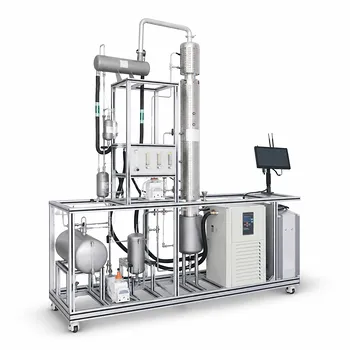
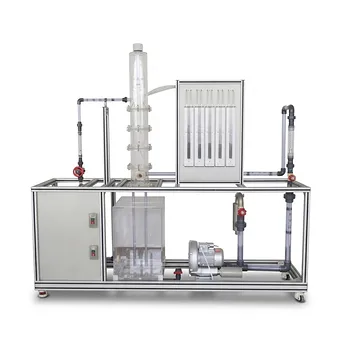
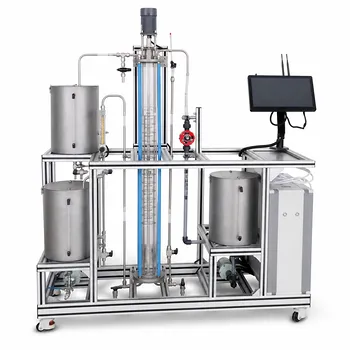
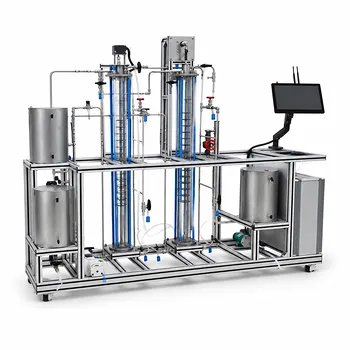
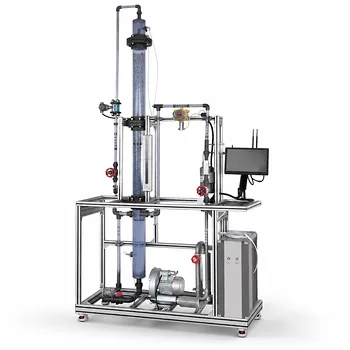
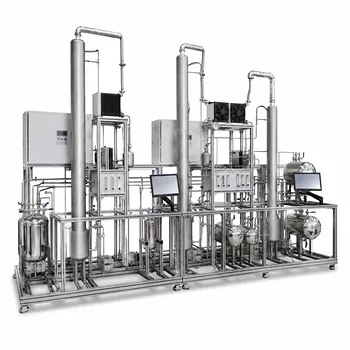
The silent killers of a distillation trainee's experiment are not just the wrong reflux ratio, but invisible hydrodynamic failures. In a pilot-scale plate column, you must monitor weeping, flooding (and its precursors like entrainment and downcomer backup), and the pressure drop, gas velocity, and downcomer liquid level that signal these dangers. These phenomena define the column's stable operating window and, if ignored, will immediately destroy separation performance, damage equipment, and turn a valuable training session into a safety hazard.
The core takeaway: Weeping, entrainment, and flooding are the three hydrodynamic boundaries that bracket the usable operating range of a plate column. Actively monitoring gas velocity, pressure drop, and downcomer level teaches students to recognize and avoid these limits, transforming a simple lab run into a lesson in robust process engineering.
The Three Hydrodynamic Threats to Stable Plate Operation
A plate column works only when vapor and liquid interact intimately on each tray. This balance can collapse in three classic ways.
Weeping: When the Gas Flow Is Too Low
Weeping occurs when the vapor velocity is insufficient to hold the liquid on the tray. Liquid drains through the perforations instead of forming a stable, bubbly froth. The result is a drastic loss of mass transfer efficiency because the liquid bypasses the vapor contact zone. In a training setting, weeping teaches students that a minimum gas velocity—the weep point—is non-negotiable.
Flooding: When Liquid Traps the Vapor
At the opposite extreme, excessive vapor or liquid loads lead to flooding. Flooding is a catastrophic condition where liquid fills the space between trays, causing a sharp, non-linear pressure drop and a complete breakdown of separation. Two distinct mechanisms can cause flooding, and students must learn to tell them apart.
Entrainment: The Invisible Efficiency Killer
Entrainment happens when high vapor velocities carry fine liquid droplets from one tray to the next. This back-mixing of liquid reduces the concentration gradient from stage to stage, eroding separation before the column ever floods visibly. In pilot-scale training, watching for turbid vapor spaces or a declining tray efficiency at high loads is critical—entrainment is often the first warning that you are approaching the flood point.
Downcomer Backup: The Liquid Level That Must Not Rise
Liquid flows from tray to tray through downcomers. If the downcomer cannot handle the liquid rate, its level rises, backing liquid up onto the tray above. Eventually, the clear liquid height reaches the weir and spills the tray, initiating downcomer flooding. Monitoring the downcomer liquid level directly tells students whether the hydraulic capacity of the internal piping is being exceeded, a distinct failure from excessive vapor entrainment.
The Vital Signs: What to Monitor to Prevent Failure
Directly observing every tray is impossible. Instead, you track a few key parameters that indicate the hydrodynamic state of the entire column.
Column Pressure Drop – The Universal Alarm
The pressure drop across the column is the single most telling gauge of hydrodynamic health. A steady, design-typical pressure drop indicates normal froth heights. A sudden, exponential rise almost always signals incipient flooding, while an abnormally low drop may point to weeping. Training students to trend this variable builds a fast diagnostic reflex.
Gas Velocity – Staying Above the Weep Point
Keeping the vapor velocity above the weep point is the first stability condition. In a pilot column, this is often set indirectly via the reboiler duty and monitored through the pressure drop. Deliberately reducing the boil-up rate until weeping is visually observed (or detected by a drop in separation) shows students where their lower operating limit lies.
Downcomer Liquid Level – The Flooding Barometer
Clear liquid level in the downcomer provides a direct measure of downcomer loading. As the level approaches the weir height or the tray spacing, the probability of downcomer flooding skyrockets. Training exercises that vary the liquid rate while watching this level demonstrate the critical interplay between internal hydraulics and column diameter design.
Why This Matters in a Training Laboratory
The real value of pilot-scale training is not just running the column, but seeing how fluid dynamics dictate separation.
Linking Hydrodynamics to Separation Performance
Weeping, entrainment, and flooding are not abstract concepts—they directly cause product impurity. By sampling the top and bottom compositions while a column transitions from weeping into the normal operating range, and then into entrainment, students grasp why the process requires a stable hydrodynamic regime. The lesson crystallizes that separation is impossible without stable contacting.
Building Intuition for the Operating Window
Every plate column has a hydraulic operating window bounded by the weep point at the lower end and the flood point at the upper end. Trainees who have intentionally triggered weeping and flooding learn to feel the column’s safe limits. This intuition prevents future operational guesswork and ingrains the concept that "more boil-up" is not always better.
Avoiding Equipment Damage and Safety Risks
Flooding can cause liquid carryover to the condenser, rapid pressure spikes, and even structural damage in glass pilot units. Weeping, while less dramatic, can lead to misleading data that wastes hours. Monitoring the right phenomena therefore directly prevents physical breakage and dangerous pressure excursions, making the lab safe and the data reliable.
Common Pitfalls and Trade-offs in Monitoring
Even when parameters are measured, misinterpretation can lead to failure.
Over-reliance on a Single Parameter
Pressure drop alone can be ambiguous. A rising pressure drop may also indicate a partially plugged distributor, not flooding. Students should corroborate with downcomer level and visual observation. Trusting only one indicator risks missing the real failure mode.
Mistaking Entrainment for Normal Operation
Entrainment often develops gradually without a dramatic pressure spike. Trainees may see a slight drop in tray efficiency and erroneously attribute it to an insufficient reflux ratio. Without monitoring high-load efficiency directly and checking the vapor space for mist, entrainment goes undetected until the column floods.
The Pressure Drop-Flooding Paradox
In some systems, the pressure drop can rise linearly even while the column is flooding badly. Relying on a simple “flood point” threshold can be deceptive. Training must emphasize the shape of the pressure drop curve—a deviation from linearity, not just an absolute value—to catch the onset of flooding accurately.
Making Hydrodynamic Monitoring a Training Success
Your monitoring strategy should match the educational goal. Tailor your emphasis based on what you want students to learn.
- If your primary focus is building fundamental understanding: Design experiments where students deliberately generate weeping, entrainment, and flooding. Have them log pressure drop versus gas velocity and draw the full operating window themselves.
- If your primary focus is safe, failure-free operation: Emphasize continuous trending of pressure drop and downcomer level. Teach them to set alarm points based on the pre-flood region and to reduce boil-up immediately when a rapid rise is detected.
- If your primary focus is uncovering design limits: Use a system with known physical properties and challenge students to predict the weep and flood points from correlations, then verify them operationally. The comparison between theory and observed hydrodynamics makes the lessons stick.
Mastering these hydrodynamic observations turns a pilot column from a black box into a transparent teaching tool—one that reveals exactly where the process fails and why robust operation is a delicate balance, not a set of fixed numbers.
Summary Table:
| Hydrodynamic Phenomenon | Key Indicator | Operational Impact on Separation |
|---|---|---|
| Weeping | Low gas velocity & low pressure drop | Liquid bypasses vapor contact; drastic loss of mass transfer efficiency. |
| Entrainment | Droplets in vapor space & gradual efficiency drop | Liquid back-mixing; erodes concentration gradient before visible flooding. |
| Downcomer Backup | Rising clear liquid level in downcomer | Liquid backs up to tray above; initiates downcomer flooding. |
| Flooding | Rapid, non-linear pressure drop spike | Liquid fills inter-tray space; complete breakdown of separation & safety risk. |
Equip Your Lab with Safe, Reliable Training Systems
At LABPARK, we design and manufacture premium Educational and Vocational Unit Operations Pilot Plants in chemical engineering, bioprocess & biotech, and environmental & water treatment. Our state-of-the-art plate distillation columns are engineered with clear visual indicators and precise sensors to help students safely master complex hydrodynamics like weeping and flooding without risking equipment damage.
Partner with LABPARK to elevate practical training at your university, research institute, or enterprise. Contact us today to discuss your lab's pilot plant requirements!
Related Products
- Continuous Sieve-Plate Distillation Pilot Plant for Unit Operations Laboratory Education
- Dual-Mode Rectification Pilot Plant for Practical Training Unit Operations
- Multi-Functional Special Distillation Educational Pilot Plant
- Multi-Modal Distillation Unit Operations Training Pilot Plant
- Continuous Batch Extractive Distillation Educational Pilot Plant
People Also Ask
- What are the primary reflux ratio control strategies? Master Distillation Unit Operations
- Why is vacuum operation capability an essential feature for a distillation unit operations pilot plant? Unlock Efficiency
- How does catalyst water concentration affect distillation pilot plant design? Key separation train choices.
- How can real-time carbon number prediction improve distillation pilot plants? Optimize control.
- How to select the right activity coefficient model (Wilson, NRTL, UNIQUAC) for distillation pilot plants?