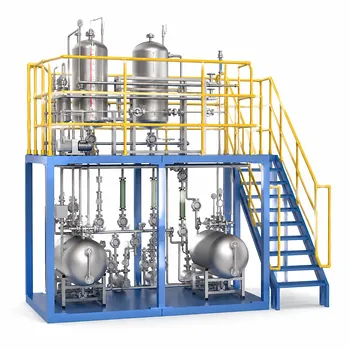
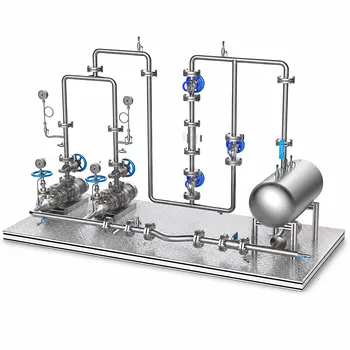
Fluid transport and storage pilot plants do more than just demonstrate flow—they forge the critical connection between textbook theory and practical engineering judgment.
The key educational objectives center on calculating frictional pressure drops in pipes, fittings, and valves; selecting and sizing pumps or compressors for liquid and gas service; and matching control valve characteristics to system hydraulics for stable flow control. These objectives are rounded out by an essential grounding in the safe storage of fluids under varying pressure and temperature conditions.
Pilot plants transform abstract fluid dynamics equations into hands-on skills. They teach not just "what" the pressure drop is, but "how" to handle it through intelligent piping layout, precise equipment selection, and a safety-first mindset.
From Theory to Tangible Skills
A textbook provides the formula for pressure loss. A pilot plant provides the conviction that comes from measuring it yourself.
Mastering Pressure Drop Calculations
Students directly measure pressure drops across straight pipe runs and through various fittings and valves. This reinforces the practical application of the Darcy-Weisbach equation or empirical methods.
The experience teaches that a seemingly small change in pipe diameter or a poorly chosen elbow can have an outsized impact on system energy costs. Learning to quantify these losses builds an intuitive grasp of system curves.
Pump and Compressor Selection
Moving fluid requires prime movers matched to the system, not just the process need. Students learn to plot system curves against pump or compressor performance curves to identify the operating point.
This objective goes beyond catalog selection. It instills the understanding of Net Positive Suction Head (NPSH) margins for liquids and surge conditions for compressors. Without this, a pump simply will not work, regardless of its pedigree.
Control Valve Sizing and Flow Stability
This is often the most nuanced objective. A pilot plant demonstrates that an incorrectly sized control valve, or one with the wrong inherent characteristic, leads to unstable flow or poor control resolution.
Students learn to calculate the valve's pressure drop at maximum flow and verify it is a sufficient fraction of the total dynamic system loss. They see firsthand why a linear valve fails in a centrifugal pump system and why an equal-percentage trim works.
The Critical Role of Piping Layout and Safety
Fluid transport is not just about hydraulics; it is about safe, maintainable, and logical physical design.
Designing for Real-World Constraints
Pilot plants introduce the concepts of pipe routing, thermal expansion, and accessibility. More importantly, they are often designed to ASME B31.3 Process Piping standards.
This standard dictates material selection, wall thickness, and joint integrity for the pressures and temperatures involved. Students learn that a piping layout is a safety system, not just a connection between two vessels.
Storage Pressure and Temperature Management
The storage component teaches engineering principles beyond simple tank sizing. Students address the effects of thermal expansion, vapor pressure, and the need for pressure relief devices.
Managing a liquefied gas cylinder or a volatile liquid receiver moves the lesson from theory to high-stakes reality. Overlooking a relief valve sizing scenario becomes an unforgettable lesson in a safe environment.
Understanding the Trade‑offs
Pilot plants are powerful teachers, but educators and trainees should be aware of their boundaries.
The Gap Between Pilot‑Scale and Industrial Scale
A ½‑inch pipe teaches the same principles as a 24‑inch header, but not the same economics or construction methods. Steel thicknesses, flange ratings, and structural supports are often simplified for laboratory modularity.
The educational objective is the underlying physics and logic, not full‑scale replication. Assuming the pilot plant's exact layout scales linearly is a trap.
Overlooking Safety in Education
The greatest risk is treating safety as a footnote. When students focus only on achieving a flow rate, pressure relief paths and material compatibility can be forgotten.
The pilot plant's true educational value in safety emerges only when instructors deliberately integrate hazard analysis into the curriculum. Without it, the session becomes a plumbing exercise, not an engineering one.
How to Apply This to Your Curriculum
Focus your pilot‑plant exercises based on your students' primary learning outcome.
- If your primary focus is building calculation confidence: Design experiments that isolate single variables—like swapping a globe valve for a gate valve—so students can directly compare measured and calculated pressure drops.
- If your primary focus is control system engineering: Require students to size a control valve for a given system, then test it across the full operating range, noting where controllability degrades.
- If your primary focus is fundamental safety: Incorporate pre‑lab hazard reviews tied directly to the plant's piping code, storage vessel requirements, and relief path demonstrations.
A well‑run pilot plant turns a student into a problem‑solver, not a pipefitter.
Summary Table:
| Key Educational Objective | Core Focus Area | Practical Skill Gained |
|---|---|---|
| Pressure Drop Calculation | Pipes, fittings, and valves | Measuring friction loss & building system curves |
| Pump & Compressor Selection | Performance curves & NPSH | Matching prime movers to hydraulic systems |
| Flow Control & Valve Sizing | Valve characteristics & trims | Ensuring flow stability and loop resolution |
| Piping Layout & Safety | ASME B31.3 & relief devices | Designing safe storage and piping systems |
Elevate Engineering Education with LABPARK
Bridge the gap between textbook theory and practical engineering judgment. LABPARK provides high-quality Educational and Vocational Unit Operations Pilot Plants in chemical engineering, bioprocess & biotech, and environmental & water treatment, tailored specifically for universities, research institutes, and enterprises.
Help your students and trainees master piping layout, pump sizing, and process safety under real-world conditions. Contact LABPARK today to discuss how our pilot plants can enhance your engineering curriculum!
Related Products
- Multi Pump Fluid Transport Process Piping Unit Operations Training Pilot Plant
- Fluid Transport and Piping Dynamics Practical Training Unit Operations Pilot Plant
- Chemical Pipeline Assembly and Fluid Transport Practical Training Unit Operations Pilot Plant
- Two-Dimensional Fluidization Hydrodynamics Educational Pilot Plant for Unit Operations Training
- Comprehensive Fluid Mechanics Educational Unit Operations Pilot Plant
People Also Ask
- Why distinguish Newtonian & non-Newtonian fluids in pilot plants? Prevent design errors.
- How do steady-state and dynamic simulations complement pilot plants? Validate scale-up and controllability
- How can unit operations pilot plants demonstrate simultaneous removal of light and heavy impurities? Configure a modular setup
- Why Does a Pilot Plant Solver Return a Singular Matrix Error, and How Can You Resolve It?
- How can chemical engineering students use unit operations pilot plants to study kinetics? Master reactor scale-up!