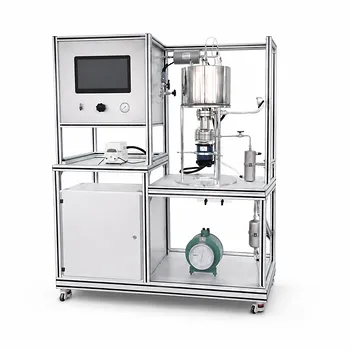
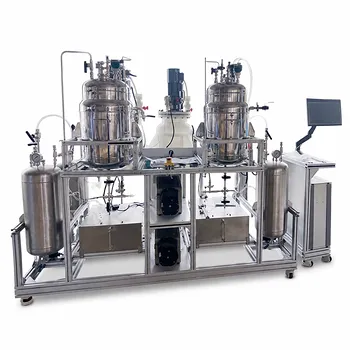
The answer is not a single dimension, but a hierarchy of interdependent parameters. When you size and configure a reactor for an educational pilot plant, you must first define the reaction kinetics, operating temperature, and operating pressure. These drive the vessel’s mechanical classification as a pressure vessel, dictating its wall thickness, head type, and nozzle orientation. Only then do you specify the agitation rate, heat transfer surface, and fill volume—all of which must be selected not only to run the reaction but to create a safe, instrumented, and pedagogically rich environment.
Designing a pilot-plant reactor sits at the intersection of process performance and safety code. The most impactful parameters are those that allow students to explore heat and mass transfer, conversion yields, and scale-up principles under controlled, real-world conditions—all while the equipment rigidly adheres to pressure-vessel regulations and allows flexible reconfiguration.
Beyond the Reaction: The Educational Design Mandate
An educational pilot plant is not a miniaturized factory floor. It is a teaching instrument. Every parameter you specify must serve two masters: the chemistry inside the vessel and the learning outside it.
Why a Pilot Plant Is Not a Scaled-Down Production Unit
In industry, you optimize for yield, uptime, and cost. In academia, you must optimize for visibility, flexibility, and safe experimentation. This forces you to select parameters that let students relate cause to effect. A vessel with fast dynamics but opaque walls teaches little; one with abundant instrumentation ports but unsafe pressure envelopes is non‑negotiable. The design must make the invisible—reaction kinetics, mass transfer, heat effects—visible through data and safe, repeatable operation.
The Non‑Negotiables: Safety-Driven Mechanical Parameters
Before you decide on impeller diameter or feed rate, you must establish the physical enclosure. For all but strictly low‑pressure, ambient‑temperature systems, the reactor becomes a coded pressure vessel.
Classifying the Reactor as a Pressure Vessel
If your educational experiments involve non‑isothermal or pressurized reactions—and nearly all meaningful ones do—the vessel must be designed to an appropriate code. You begin by setting the design pressure at least 10% above the maximum expected operating pressure (for example, scaling a 50-bar operation to 53.9 bar). Alongside the maximum operating temperature (often up to 300°C for high‑temperature studies), these parameters define the mechanical boundary.
Wall Thickness: Making Design Codes Tangible
With design pressure and temperature fixed, you calculate the minimum wall thickness. The formula incorporates the allowable stress of the chosen material (chrome‑moly steel is a common exemplar), a joint efficiency factor that accounts for welded seams, and a corrosion allowance. For students, stepping through this calculation transforms an abstract code into a concrete engineering decision.
Head Types and Nozzle Orientation
Head types (hemispherical, ellipsoidal, torispherical) are not cosmetic. They affect stress distribution, volume, and cost. In a pilot plant, the head choice also influences how easily the vessel drains or how sensors can be inserted. Nozzle orientation determines accessibility for thermowells, pressure transmitters, feed lines, and gas purge connections. A poorly oriented nozzle can create a dead zone that distorts conversion data or makes cleaning a nightmare between student groups. Every opening must be thoughtfully placed for both process integrity and educational utility.
Process Parameters that Define the Reactor Core
Once the mechanical shell is safe, you turn to the parameters that dictate the reaction environment itself.
Reaction Kinetics, Temperature, and Pressure as the Foundation
The core design begins with the reaction system. You must specify the temperature and pressure operating envelope because they determine reaction rate constants, equilibrium limitations, and phase behavior. In a pilot plant using a modeling approach, you start with trial geometric dimensions and these operating parameters, then iterate using material, equilibrium, and enthalpy balances to self‑adjust hydrodynamics and mass‑transfer rates. The resulting volume and residence time are derived from kinetics, not from a default tank size.
Agitation and Impeller Selection
Agitation transforms a static vessel into a reactor. The choice of impeller is governed by fluid rheology and what you want students to observe:
- Low‑viscosity, turbulent fluids (high Reynolds numbers): Use radial flow impellers like flat‑blade turbines when you need high shear and gas dispersion, or axial flow impellers (propellers, pitched‑blade turbines) for bulk blending and solid suspension.
- High‑viscosity fluids: Switch to anchor or helical ribbon impellers that scrape the wall and provide gentle, laminar mixing. This parameter directly determines the power input per volume, which in turn controls heat and mass transfer coefficients—key teaching points.
Volume Utilization and Fill Ratio
For stirred tank reactors (CSTRs), you must define the liquid fill ratio. Operating at 60–70% of total vessel volume is standard. This leaves adequate gas headspace for pressure control, prevents foam‑over into vent lines, and ensures the impeller remains properly submerged. Exceeding this range compromises safety and data reliability.
Designing for Educational Depth: Scalability and Flexibility
The true value of a pilot plant emerges when students can manipulate parameters and see the consequences across scales.
Scaling Laws and Dimensional Analysis
When scaling up a reaction from lab to pilot scale, the total mass flow rate and volumetric flow rate increase significantly. To maintain target residence time, you often need to increase the number of reactor tubes per shell and the overall reactor length. Most critically, the heat load grows disproportionately. The pilot plant must therefore be specified with robust heat‑transfer configurations—jacketed vessels, internal coils, or external heat exchangers—and precise temperature control to manage reaction stream temperatures. These scale‑up factors become a central curriculum module.
Integrating the Control and Safety System
A reactor without sensors is a black box. The control hardware must mirror the process complexity:
- Specify the exact type and number of I/O modules (analog inputs for temperature/pressure, digital outputs for solenoid valves) and always include a safety margin for future sensor additions.
- For chemical pilot plants handling solvents or gases, integrate intrinsically safe barriers and explosion‑proof designs.
- Use clearly labelled terminal boards and relay modules to facilitate quick troubleshooting and maintenance between lab sessions.
Bioreactor-Specific Considerations
If the pilot plant bridges bioprocessing and chemical engineering, parameter selection shifts toward cellular needs:
- Shear sensitivity guides the choice between a mechanically stirred vessel (possibly with low‑shear impellers) and an airlift loop fermenter that circulates liquid via gas density differences without damaging cells.
- Mass transfer requirements dictate whether you use a packed bed bioreactor with immobilization carriers for continuous perfusion, or a fluidized bed for excellent contact between immobilized enzymes and fluid.
- For photosynthetic organisms, a mechanically stirred photobioreactor with integrated internal or external light sources is essential. Specifying sparger design, membrane separation (hollow fiber), and mixing strategy becomes as important as impeller speed in a chemical reactor.
Understanding the Trade-offs
No pilot plant design is perfect; every choice is a compromise. Recognizing these trade-offs is itself an educational outcome.
Cost vs. Fidelity
A high‑spec pressure vessel with multiple nozzles and exotic materials teaches authentic industrial design but consumes a large portion of the budget. A simpler glass vessel with limited pressure rating offers stunning visual insight into fluid dynamics but restricts the operating envelope. You must balance the learning objectives against the available funding.
Safety Margin vs. Experimental Range
A design pressure set well above the maximum anticipated condition adds safety but may thicken the wall so much that heat transfer coefficients become orders of magnitude different from industrial reactors. The educational takeaway on thermal dynamics can be distorted. Deliberately choosing a margin that is safe yet minimally obscuring is a critical design judgement.
Specialization vs. Multi‑Purpose Use
A highly specialized bioreactor with an integrated hollow‑fiber module is ideal for teaching perfusion culture but near‑useless for a classic gas‑phase chemical reaction. Conversely, a general‑purpose CSTR may struggle to demonstrate shear‑sensitive bioprocessing. Many successful pilot plants employ interchangeable internals—swapping impellers, adding draft tubes, or inserting immobilization matrices—to broaden the curriculum without duplicating entire vessels.
Making the Right Choice for Your Educational Goal
The specific parameters you emphasize must align with what your pilot plant is meant to achieve. Below are focused recommendations based on different program priorities.
- If your primary focus is maximizing student hands‑on learning: Specify a modular vessel with easily swappable impellers, clear sight glasses (if pressure allows), and robust safety interlocks. Keep the mechanical design code‑compliant but not overly complex, so students can safely reconfigure nozzles and sensors.
- If your primary focus is scalable research and industry preparation: Invest in a fully coded pressure vessel with precise instrumentation, high turndown‑ratio heating/cooling, and multi‑tube reactors that replicate industrial aspect ratios. Design the control system with true industrial I/O modules and safety barriers.
- If your primary focus is bridging bioprocess and chemical engineering: Incorporate at least two bioreactor types—such as a stirred‑tank and an airlift—alongside a chemical CSTR. Specify sparger options, low‑shear impellers, and a control architecture that handles both aerobic and anaerobic operations with equal fidelity.
By treating these parameters not as a checklist but as a deliberately integrated set, you create a pilot plant that is simultaneously a safe industrial simulator, a flexible research platform, and an unforgettable teaching instrument.
Summary Table:
| Parameter Category | Key Parameters | Educational & Operational Impact |
|---|---|---|
| Mechanical Safety | Design pressure/temperature, wall thickness, nozzle orientation | Ensures code compliance (ASME/PED) and safe hands-on student operation. |
| Process Core | Reaction kinetics, temperature/pressure envelope, impeller selection | Determines mixing efficiency, heat/mass transfer, and yield observation. |
| Scale-Up & Control | Flow rates, heat-transfer surface area, I/O control modules | Teaches industrial scalability, thermal dynamics, and automation. |
| Bioprocess Specific | Shear sensitivity, sparger design, cell immobilization | Supports yeast, bacterial, and photosynthetic culture learning. |
Bring Industrial-Scale Learning to Your Laboratory
Are you looking to enhance your engineering curriculum with hands-on, industry-aligned equipment? LABPARK provides premium Educational and Vocational Unit Operations Pilot Plants in chemical engineering, bioprocess & biotech, and environmental & water treatment.
We specialize in helping universities, research institutes, and enterprises build safe, modular, and highly instrumented reactor systems that bring complex processes to life.
Ready to configure the ideal pilot plant for your institution? Contact our engineering experts today to discuss your custom project requirements!
Related Products
- Multi-Reactor Educational Pilot Plant for Reaction Engineering Unit Operations
- Fixed Bed Gas Solid Catalytic Reaction Educational Pilot Plant
- Residence Time Distribution and Reactor Flow Characteristics Determination Educational Pilot Plant
- Methane Cracking Educational Unit Operations Pilot Plant
- 100L Continuous Loop Hydrogenation Educational Unit Operations Pilot Plant
People Also Ask
- How do educational unit operations pilot plants address safety and waste management when scaling up?
- How do educational unit operations pilot plants bridge theory and design? Bridge the Engineering Gap
- Why Compare Predicted and Experimental Excess Enthalpy? Key to Accurate Pilot Plant Scale-up
- How to study gasification in pilot plants? Compare exit gas composition & efficiency
- Why Use PTFE & Hastelloy in Chemical Pilot Plants? Prevent Corrosion & Ensure Safety