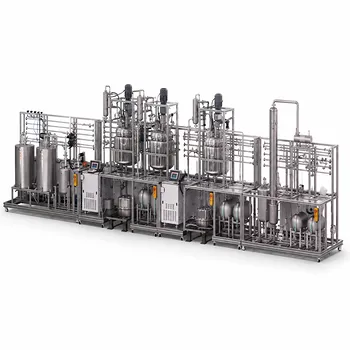
The critical significance of residence time control in ethylene oxychlorination is that it governs a precise 10-second window where hydrogen chloride (HCl) conversion approaches 100% without destroying the product you just made. This isn't just a theoretical concept; it's the fundamental lever that balances perfect reactant usage against the catastrophic loss of selectivity. In a unit operations pilot plant, this is demonstrated by systematically varying feed flow rates to change the reactor's space time, then analyzing the output to map the exact trade-off curve between conversion and yield.
The entire ethylene oxychlorination process hinges on a temporal knife-edge. A residence time of ~10 seconds is optimal because it allows the reaction to reach near-total completion. Straying too far on either side—too short or too long—immediately punishes you with either wasted reactants or a destroyed product. The pilot plant's core educational value is in making this invisible, dynamic trade-off visible and measurable through controlled experimentation.
The Central Conflict: Conversion vs. Selectivity
The surface goal is to convert corrosive, waste HCl gas back into a valuable product. The deep goal is to do this with maximum efficiency, which requires understanding a fundamental conflict in chemical reaction engineering.
Why 10 Seconds is the "Goldilocks" Zone
The primary reference identifies a very specific target: a residence time of about 10 seconds. This is not an arbitrary number; it represents the point where the primary reaction is essentially complete.
If you fall short of this mark, the conversion of HCl is incomplete. Your reactor output still contains valuable, unreacted raw material, in addition to your product. This is a direct economic loss, as the HCl must be separated and recycled, requiring more energy and larger equipment.
The Danger of Overstaying Your Welcome
The more counterintuitive and critical danger lies on the other side. If the residence time is too long, the desired product, 1,2-dichloroethane (EDC), does not simply sit idle.
At reactor operating temperatures, it undergoes a secondary, undesired reaction: thermal cracking. This breaks EDC down into vinyl chloride monomer (VCM) and HCl. You are literally destroying your target product to create a new impurity and regenerate the starting reactant, which drastically reduces the overall process selectivity and yield.
Demonstrating the Principle in a Pilot Plant
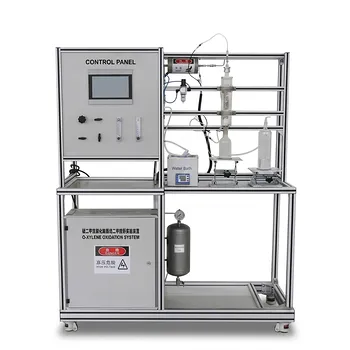
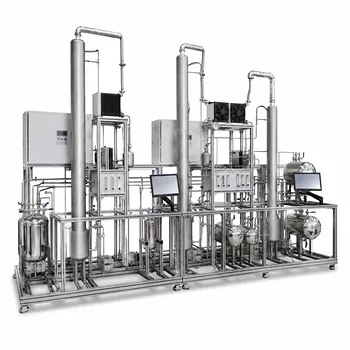
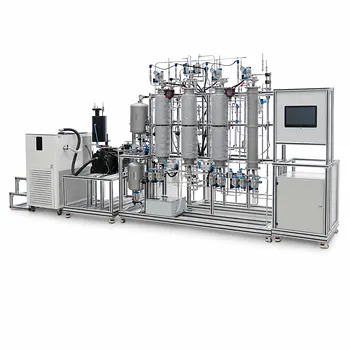
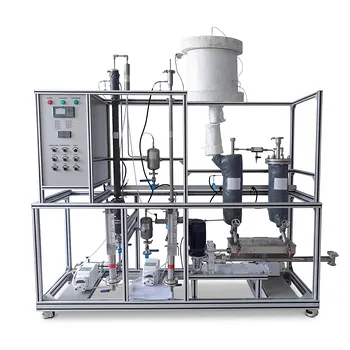
A chemical engineering unit operations pilot plant transforms this kinetic principle from a textbook equation into a tangible, data-driven learning experience. The demonstration relies on creating a controllable, measurable system.
The Essential Hardware for a Safe Demonstration
Before any kinetic study, the physical system must safely contain the notoriously aggressive chemistry. The supplementary references outline three non-negotiable requirements for the pilot plant.
First, the reactor itself—whether a fluidized bed or a fixed-bed design—must have active heat removal. The reaction over a cupric chloride (CuCl₂/KCl) catalyst is strongly exothermic, and the temperature must be tightly controlled between 250°C and 350°C to study kinetics without initiating thermal cracking from hotspots.
Second, the feed system requires precise gas metering. Ethylene, oxygen, and highly corrosive hydrogen chloride must be mixed safely and accurately, keeping their ratios outside the explosive envelope. This inherently teaches process safety as a core part of unit operations.
Third, every wetted part, from the feed lines to the reactor body, must be constructed of specialized, corrosion-resistant materials. Wet HCl gas at high temperature will rapidly destroy standard steel, making material science a non-optional part of the demonstration.
The Core Experimental Protocol: Altering the τ = V / Q Ratio
The practical demonstration revolves around the definition of mean residence time (τ). As the supplementary references note, for a constant-density system, this is simply the active reactor volume (V) divided by the volumetric flow rate (Q): τ = V/Q.
Students directly manipulate this equation. By holding the reactor volume constant and precisely increasing or decreasing the total feed flow rate (Q), they systematically shorten or lengthen the residence time.
At each steady-state set point, a sample of the reactor effluent is analyzed, typically via gas chromatography. The resulting data set—a series of HCl conversion percentages and EDC selectivity percentages plotted against their corresponding residence times—makes the 10-second optimum visually and quantitatively obvious.
Verifying the Data's Integrity: The Three Pillars of RTD
To ensure the collected data is a true reflection of the reactor's performance and not an artifact, a rigorous residence time distribution (RTD) experiment must be validated against three conditions outlined in the supplementary references.
- System Stationarity: The reactor must be at a true steady state before data is collected. The step-response curve from a tracer injection must be monotonic, and the experiment must be repeatable, producing the same result on consecutive runs.
- Tracer Response Linearity: The relationship between the input stimulus and the detected response must be linear. By running two identical experiments with different tracer concentration step sizes, students can confirm linearity if the normalized response curves overlap perfectly.
- Tracer Behavior Match: In a multiphase, catalytic environment like oxychlorination, the tracer must accurately mimic the reactant gas. An inert tracer that freely flows through the fluidized bed without adsorbing onto the catalyst will give a false, idealized picture of the true gas residence time.
Understanding the Trade-offs and Pitfalls
A superficial demonstration only highlights the optimum. A true, deep educational experience comes from understanding the limits of the model and the real-world constraints.
The Scale-Up Trap: Diluting Phase Effects
One of the most valuable insights a pilot plant can teach is the danger of simple scale-up heuristics. The supplementary references highlight a critical limitation: in fluidized-bed reactors, you cannot independently keep both gas residence time and gas-catalyst contact time constant during scale-up.
A pilot plant operating in a dilute-phase regime will have a different solid-to-gas ratio than a commercial, high-solids-recirculation riser. Data gathered in the pilot plant directly measures the combined effect under a specific set of conditions, teaching the student that empirical data at relevant phase densities is irreplaceable for accurate reactor design.
The Temptation of Ultra-Short Residence Times
While the data will clearly show the catastrophic selectivity loss from a 20-second residence time, the industrial trend in other processes (like thermal cracking) is toward millisecond contact times. A student might then ask if a 2-second residence time for oxychlorination would be even better.
The pilot plant can physically prove why not. Running the reactor with such a high flow rate would show a dramatic crash in HCl conversion long before any hypothetical gain in selectivity could be realized. The unreacted feedstock pouring out of the reactor would demonstrate that the primary reaction’s kinetics require that full ~10 seconds to reach completion, making ultra-short times a non-starter for this specific chemistry.
Making the Right Choice for Your Learning Objective
The experimental run plan on the pilot plant should be defined by the core learning objective. The exact same equipment can teach different, powerful lessons depending on the starting conditions and the variable being manipulated.
- If your primary focus is reaction optimization: Start with a very long residence time to demonstrate the severe selectivity loss from thermal cracking, then systematically decrease the flow rate until you bracket the 10-second window. Map the complete trade-off curve.
- If your primary focus is process control and safety: Set the reactor at the optimal 10-second residence time, then introduce a deliberate disturbance, such as a drop in feed temperature or a change in catalyst activity, and task students with manipulating the flow rate to maintain both conversion and selectivity close to the peak.
- If your primary focus is the science of scale-up: Run the reactor at its physical limits by varying both flow rate and catalyst bed height. Compile the data to show how the effective gas-solid contact time deviates from the simple τ = V/Q calculation, reinforcing the limits of idealized models.
Mastering residence time control is not about memorizing a 10-second rule; it is about using a pilot plant to witness the fundamental, unforgiving conflict between driving a reaction to completion and preserving the product it creates.
Summary Table:
| Residence Time | HCl Conversion | Product Selectivity (EDC) | Reactor Outcome & Demonstration Method |
|---|---|---|---|
| Too Short (<10s) | Low (incomplete) | High | Wasted reactants; demonstrated by increasing feed flow rate ($Q$). |
| Optimal (~10s) | Near 100% | High | Peak efficiency and yield; the baseline for process optimization. |
| Too Long (>10s) | Near 100% | Low (thermal cracking) | Product degradation into VCM; demonstrated by decreasing feed flow rate ($Q$). |
Ready to bring advanced chemical kinetics and process control to life in your laboratory?
LABPARK provides premium Educational and Vocational Unit Operations Pilot Plants in chemical engineering, bioprocess & biotech, and environmental & water treatment. Specifically designed for universities, research institutes, and enterprises, our pilot plants empower students and researchers to safely analyze real-world chemical reactions, validate scale-up kinetics, and master process safety.
Contact LABPARK today to discover how our tailored pilot plant solutions can elevate your educational and research capabilities!
Related Products
- O-Xylene Oxidation to Phthalic Anhydride Educational Unit Operations Pilot Plant
- Green Anhydrous Ethanol Refining Practical Training Pilot Plant
- Ethyl Acetate Synthesis Unit Operations Pilot Plant for Practical Training
- Bio-fermentation Ethanol Production Practical Training Unit Operations Pilot Plant
- Green Anhydrous Ethanol Purification Extractive Distillation Unit Operations Training Pilot Plant
People Also Ask
- Why determine reaction order & activation energy in pilot plants? Key to safe scale-up.
- What materials fit high-temp oxidation pilot plants? Key Hastelloy & Titanium Requirements
- Under what conditions can axial diffusion be neglected? Reactor Simulation Guide
- What limitations exist in high-temp pilot reactor design? Key Material & Safety Rules
- What pressure parameters ensure pilot plant safety? Analyze reactor profiles & gas evolution.