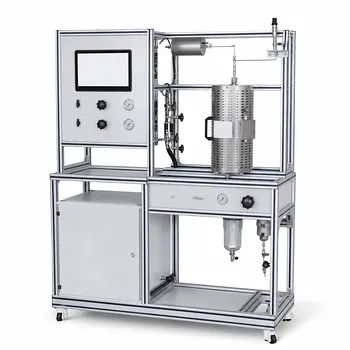
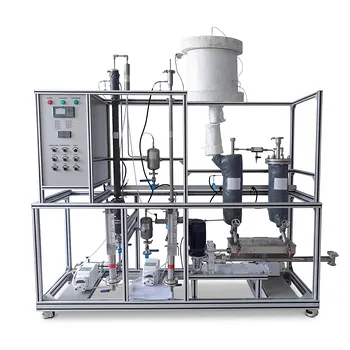
Yield is not a standalone measurement—it is the mathematical product of conversion and selectivity. In a pilot-scale chemical reactor, conversion rate tells you how much of your raw material reacted, selectivity tells you how much of that reacted material went toward your desired product, and yield combines the two to show your real efficiency in turning feed into value. Without understanding their interdependence, you risk optimizing one metric at the expense of another, leading to a pilot plant that appears efficient on paper but fails economically.
The fundamental relationship Yield = Conversion × Selectivity governs pilot reactor performance. But this equation is just the starting point. The true challenge—and the key to process optimization—lies in managing the inherent trade-off between conversion and selectivity, especially when recycle streams and downstream separations come into play.
Defining the Three Core Performance Indicators
Before you can balance them, you must see each metric for what it truly measures.
What Conversion Rate Actually Tells You
Conversion measures the extent of reaction. It is the proportion of raw material fed that undergoes chemical change, regardless of what it turns into. A high conversion means your feed isn't leaving the reactor unreacted, but it says nothing about whether it became a valuable product or costly waste.
Selectivity: The Purity of Intent
Selectivity measures the efficiency of that reaction toward your target product. It quantifies how much of the reacted feed goes into the desired molecule versus byproducts. A process with excellent selectivity but terrible conversion still wastes most of the feed in separation and recycle loops, making it commercially unviable even if the chemistry is “clean.”
Yield: The Bottom-Line Metric
Yield is the combination of those two realities. It represents the actual amount of desired product you obtain relative to the total feed introduced. This is the number that connects directly to raw material costs and plant profitability—but it derives its meaning entirely from the other two.
The Inescapable Trade-off Between Conversion and Selectivity
The simple formula Yield = Conversion × Selectivity hides a difficult dynamic: pushing one often hurts the other.
Why Pushing Conversion Too Far Backfires
In many reaction systems, chasing near-complete conversion creates conditions that favor side reactions. High product concentrations, low reactant concentrations, or excessive residence times can all trigger pathways that destroy selectivity. You might convert 99% of your feed, but if half of it becomes a worthless byproduct, your yield—and your economics—collapse.
The Pilot Plant as a Balancing Tool
A pilot-scale reactor gives you the control needed to find the optimum, not the maximum. You aren't trying to push conversion to its limit. You're identifying the operating point where the product of conversion and selectivity yields the highest economic return, even if that means leaving some reactant unreacted per pass.
Single-Pass vs. Overall Metrics: What Changes with a Recycle Loop
Your analysis shifts significantly when you introduce a separation unit and recycle stream, as is common in realistic pilot plant configurations.
Redefining Conversion and Yield in a Recycle Flowsheet
Once you recycle unreacted material, the "single-pass" numbers based on the mixed feed entering the reactor differ from the "overall" numbers based on the fresh feed to the plant.
- Single-pass conversion tells you what the reactor itself achieves in one trip.
- Overall conversion accounts for the recycle loop, showing that virtually all fresh feed eventually reacts, even if per-pass conversion is low.
Overall yield then reflects the true plant-level efficiency, factoring in both reactor selectivity and recovery losses in downstream separations. In a system with a highly efficient recycle, the reactor selectivity target becomes the primary design driver, because unreacted material is not lost—it's returned. The cost shifts from raw material loss to energy and capital for separation and recycling.
Calculating the Right Metrics
For a pilot plant with a recycle stream, you must distinguish between:
- Single-pass yield = mass of reactant consumed for the desired product / mass of reactant in the mixed feed
- Overall yield = mass of reactant consumed for the desired product / mass of reactant in the fresh feed
These formulas show clearly that if your recycle loop captures nearly all unreacted feed, your overall yield approaches your reactor's selectivity, provided downstream recovery isn't lossy.
Beyond the Reactor: Reaction Yield vs. Overall Plant Yield
Too many pilot-plant analyses stop at the reactor outlet. That is a costly mistake.
Chemical Losses vs. Physical Losses
Reaction yield (or chemical yield) only accounts for losses due to side reactions—the selectivity problem. Overall plant yield also includes physical losses from evaporation, leaks, separation inefficiencies, and sampling. In a pilot plant, even a perfectly selective reactor can deliver a disappointing overall yield if the downstream unit operations are not properly integrated.
The Separation Penalty
Low per-pass conversion inevitably means you must separate product from unreacted feed. Distillation columns, membranes, or extraction units each have a recovery efficiency below 100%. The system yield target must therefore be set higher than the desired overall yield, dividing by the recovery efficiency. This is how pilot-plant data guides the setting of raw material cost targets, often around 80% of production cost in early estimates.
How Equilibrium and Feed Ratios Complicate the Picture
Performance indicators are not solely a function of kinetics and mixing. Thermodynamics and stoichiometry also pull the strings.
The Unmoving Border: Chemical Equilibrium
The equilibrium constant K is fixed by temperature. You cannot push conversion past this thermodynamic limit, no matter how you tune residence time or mixing. Attempting to do so wastes energy and may degrade selectivity. The pilot plant lets you identify the temperature and pressure regime where equilibrium favors high conversion without triggering side reactions.
Leveraging Excess Reactants
You can shift the apparent conversion of a limiting reactant by flooding the reactor with a cheap excess of another reactant. This does not alter equilibrium, but it drives the reaction further toward products, effectively increasing the single-pass conversion of the valuable component. Selectivity, however, can still suffer if excess conditions promote new side reactions, making this a delicate optimization.
Understanding the Trade-offs
Failing to recognize the inherent tensions between these metrics leads to flawed conclusions and poor scale-up decisions.
- High conversion, low selectivity: You'll over-design downstream separation to handle mountains of byproduct, and raw material costs will still bleed your margin.
- High selectivity, low conversion: Your reactor makes a clean product but at a miserably low rate. Separation and recycle costs explode, and throughput suffers.
- The recycle trap: A recycle loop can mask poor selectivity by hiding byproduct purge losses. Track the selectivity independently, because a low selectivity process with a recycle will eventually accumulate inerts or byproducts, demanding a costly purge stream.
- Ignoring physical losses: Focusing solely on reactor metrics blinds you to losses in sampling, transfers, and separation inefficiencies that can sink overall yield.
Making the Right Choice for Your Goal
Your pilot-plant analysis should align metrics to your specific development objective, not chase all numbers simultaneously.
- If your primary focus is minimizing raw material cost: Prioritize overall yield and reactor selectivity. A high selectivity process with an efficient recycle loop turns almost all fresh feed into product, minimizing the feed bill, which often dominates production cost.
- If your primary focus is maximizing throughput or reducing capital expenditure: Look to increase single-pass conversion within an acceptable selectivity window. Higher per-pass conversion reduces the volume flowing through the reactor and separation train, shrinking equipment size—but only if selectivity doesn't crash and create a separation nightmare.
- If your primary focus is process robustness and easy scale-up: Identify the operating window where selectivity is most stable, even if conversion is moderate. A process with forgiving selectivity is easier to control at larger scales where mixing and heat transfer are seldom as perfect as in the pilot plant.
Your pilot plant is your truth-teller. Let conversion, selectivity, and yield tell you not just if the chemistry works, but where it works best in the full context of an integrated, economically viable process.
Summary Table:
| Metric | What It Measures | Focus | Key Relationship / Formula |
|---|---|---|---|
| Conversion | Proportion of raw material that reacts. | Extent of reaction | Affected by residence time & equilibrium. |
| Selectivity | Proportion of reacted feed turned to target product. | Purity & waste reduction | High selectivity minimizes byproducts. |
| Yield | Real efficiency of turning feed into target product. | Profitability & cost | Yield = Conversion × Selectivity |
Optimize Your Process Scale-Up with LABPARK
Balancing conversion, selectivity, and yield is critical to transitioning from lab-scale chemistry to viable industrial processes. LABPARK provides state-of-the-art Educational and Vocational Unit Operations Pilot Plants in chemical engineering, bioprocess & biotech, and environmental & water treatment tailored for universities, research institutes, and enterprises.
Our pilot-scale systems are designed to help you accurately model recycle loops, analyze separation efficiency, and optimize reaction kinetics.
Contact LABPARK today to discuss how our pilot plants can elevate your research, training, and development programs!
Related Products
- Fixed-Bed Chemical Reaction and Gas Dust Tar Removal Unit Operations Pilot Plant
- Fixed Bed Gas Solid Catalytic Reaction Educational Pilot Plant
- Residence Time Distribution and Reactor Flow Characteristics Determination Educational Pilot Plant
- Methanol Synthesis and Catalyst Performance Evaluation Educational Unit Operations Pilot Plant
- Multi-Reactor Educational Pilot Plant for Reaction Engineering Unit Operations
People Also Ask
- When to transition from PID to adaptive control in pilot plants? Key process indicators.
- How do deviations in estimating latent heat impact pilot plant thermal systems? Avoid hardware mis-sizing.
- Why Compare Predicted and Experimental Excess Enthalpy? Key to Accurate Pilot Plant Scale-up
- How to study gasification in pilot plants? Compare exit gas composition & efficiency
- Why Use PTFE & Hastelloy in Chemical Pilot Plants? Prevent Corrosion & Ensure Safety