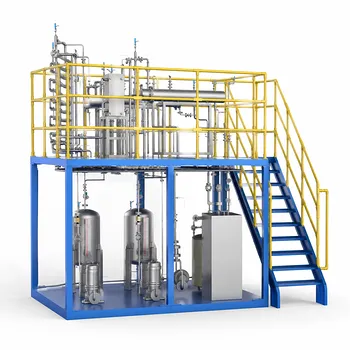
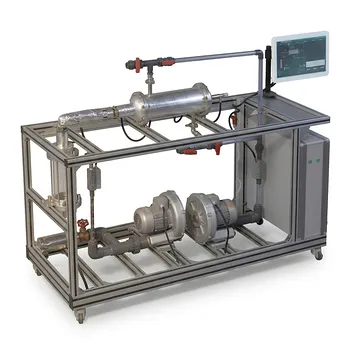
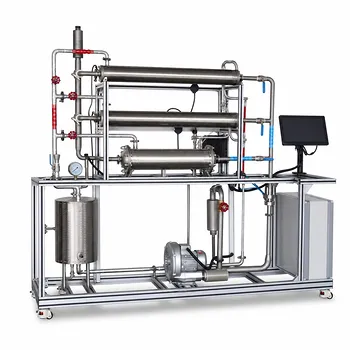
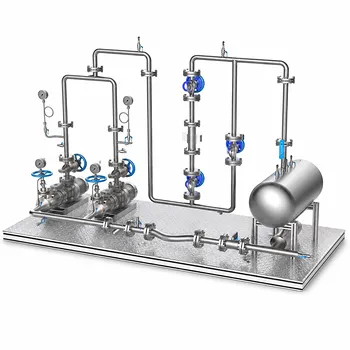
Stream splitting is a deliberate design intervention used in heat exchanger unit operations training systems to overcome thermodynamic incompatibilities—specifically when heat capacity flow rate (CP) constraints prevent a feasible match at the pinch. By dividing a single process stream into parallel branches, students can independently manipulate branch flow rates through manual valves, directly altering local CP values. This hands-on adjustment enforces the critical pinch rule (CPh ≥ CPc below the pinch) and maintains the minimum approach temperature (ΔTmin) without resorting to external utility heating or cooling.
Stream splitting transforms an abstract pinch analysis constraint into a tangible control exercise. Its core purpose is to demonstrate how selective manipulation of branch mass flow rates—and therefore local heat capacity flow rates—rebalances CP inequalities at the pinch, securing feasible, energy-efficient heat matches while keeping the exchanger network tight against ΔTmin.
What Stream Splitting Solves in a Training Context
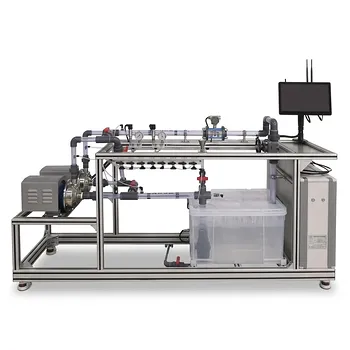
In a teaching environment, the physical manifestation of a stream split—two or more parallel heat exchangers fed from a single source—immediately illustrates the why behind the pinch design method.
The CP Inequality at the Pinch
Below the pinch, the fundamental rule is that the hot stream’s CP must be less than or equal to the cold stream’s CP (CPh ≥ CPc for a feasible match). If the original whole-stream CP violates this rule, a direct match would lead to a temperature cross or a violation of ΔTmin.
How Splitting Resolves the Mismatch
Dividing the stream reduces the mass flow rate in each branch. Since CP = (mass flow) × (specific heat), each branch now carries a lower CP. The split ratio can be tuned until the CPh in a particular branch satisfies the inequality for a specific cold stream.
This lets students see that the network is no longer constrained by the “average” CP of the whole stream—they can match segments of hot streams with different cold streams precisely at the pinch.
The Direct Effect on Process Parameters
Manipulating a stream split valve immediately changes several interconnected parameters, making the concept concrete for learners.
Mass Flow and CP per Branch
Turning a valve alters the flow fraction going to each leg. A higher fraction increases the local mass flow and CP in that branch, while reducing them in the other branch. Students observe that CP is a locally adjustable variable, not a fixed property.
Temperature Profiles and Approach Temperatures
As CP values shift, the temperature-enthalpy curves inside the exchangers change slope. This directly impacts the internal approach temperature at the hot or cold end of each unit. The training system’s instrumentation reveals whether a match drifts too close to ΔTmin or creates an unfeasible temperature cross.
Utility Loads and Energy Recovery
When a stream split rectifies a CP mismatch, the network can exchange more heat internally. The total utility consumption (hot and cold) drops. Students quantify this by comparing utility flow rates before and after the split, reinforcing the link between incremental flow adjustments and overall energy cost.
Common Pitfalls and Trade-offs When Using Stream Splits
While stream splitting is a powerful pedagogical tool, it introduces practical challenges that mimic real-world design constraints.
Added Hydraulic Complexity and Pressure Drop
Each branch requires piping, valves, and at least one heat exchanger. Higher pressure drop across the parallel legs can demand more pump work, eroding some of the thermal savings. In the training system, students note how valve throttling increases differential pressure readings.
Controllability and Flow Maldistribution
Multiple valves give many degrees of freedom, but they also make the system harder to stabilize. Slight misadjustments can push one branch into a temperature cross. This teaches that operational reliability often trades off against maximum energy recovery.
Instrumentation Density and Cost
A fully instrumented training system must measure flow, temperature, and pressure in each branch. The extra sensors and data acquisition points increase system cost—mirroring the economic considerations in a real plant where adding exchangers and controls must be justified by energy savings.
How to Apply This to Your Training Goals
Whether you are an instructor using the unit or an engineer designing a training module, you can tailor the exercise to different learning outcomes.
- If your primary focus is teaching pinch analysis fundamentals: Use stream splitting to make the CPh ≥ CPc rule visible. Have students plot composite curves and then physically adjust valves to watch the pinch move or ΔTmin shrink.
- If your primary focus is process control and operability: Emphasize the dynamic response. Ask learners to find a stable split ratio that maintains ΔTmin under a step change in inlet temperature, illustrating real-time constraint management.
- If your primary focus is design optimization: Set a multi-objective challenge—minimize total utility consumption while keeping pumping power and capital cost (number of branches) within a budget. Stream splitting becomes a design variable, not just an operational fix.
Ultimately, stream splitting in a training system turns an elegant thermodynamic rule into a tangible, trial-and-error experience that cements the connection between mass flow adjustment and energy efficiency.
Summary Table:
| Aspect | Process Effect | Educational/Training Value |
|---|---|---|
| Stream Splitting | Reduces branch mass flow and local $CP$ | Demonstrates pinch rule feasibility ($CP_h \ge CP_c$) |
| Valve Adjustment | Shifts flow fraction and temperature slopes | Visualizes real-time temperature profile changes |
| Utility Load | Lowers overall hot and cold utility consumption | Quantifies efficiency gains vs. pumping costs |
| System Complexity | Increases pressure drop and control variables | Teaches design trade-offs and operational stability |
Bring Thermodynamics to Life in Your Lab
Looking to enhance your practical training curriculum or research capabilities? LABPARK provides state-of-the-art Educational and Vocational Unit Operations Pilot Plants across chemical engineering, bioprocess & biotech, and environmental & water treatment.
Designed specifically for universities, research institutes, and enterprises, our highly instrumented pilot plants—including advanced heat exchanger training systems—turn complex thermodynamic theories like stream splitting into hands-on, intuitive learning experiences.
Ready to upgrade your lab's training capabilities? Contact LABPARK today to explore our pilot plant solutions and request a custom quote!
Related Products
- Comprehensive Multi-Modal Heat Transfer Unit Operations Pilot Plant for Engineering Training
- Three-Tube Heat Transfer Educational Pilot Plant for Unit Operations Training
- Dual Mode Heat Transfer Pilot Plant for Unit Operations Training
- Shell and Tube Heat Exchanger Heat Transfer Coefficient Determination Educational Pilot Plant
- Multi-Reactor Educational Pilot Plant for Reaction Engineering Unit Operations
People Also Ask
- When is ε-NTU preferred over LMTD in pilot plants? Predict heat exchanger performance without iteration.
- How can a heat transfer pilot plant demonstrate waste heat recovery? Learn to optimize industrial thermal systems.
- How to configure heat transfer pilot plants for pinch analysis? Teach energy recovery.
- How does cascade control achieve superior disturbance rejection in heat transfer pilot plants?
- Why is emissivity critical in heat transfer pilot plants? Bridge the Gap Between Theory & Industrial Design