The drift factor quantifies the physical phenomenon of bulk flow augmenting molecular diffusion—it is the multiplier that corrects a mass transfer coefficient to account for the convective drift of the entire gas mixture toward the liquid interface. In a gas absorption experiment where a solute diffuses through a stagnant inert gas, the drift factor (the ratio of total pressure to the logarithmic mean partial pressure of the stagnant gas, (p/p_{Bm})) directly measures the enhancement of transport beyond what pure diffusion would achieve. When the solute concentration is very low, this factor approaches unity and can be safely ignored, but as concentration rises, it grows larger than one, reflecting a significant increase in the total molar flux.
The drift factor is not a mathematical artifact—it is the physical manifestation of Stefan flow, the bulk movement of the mixture that inevitably occurs whenever one component is preferentially removed at an interface. Its magnitude depends entirely on the concentration of the absorbing solute: in dilute streams the effect vanishes and calculations simplify dramatically; in concentrated gases it dominates and must be integrated into every design equation to avoid dangerous underestimation of column size.
The Physical Meaning of the Drift Factor
Understanding the drift factor begins with recognizing that gas absorption involves two simultaneous transport mechanisms: pure molecular diffusion and convective bulk flow. The drift factor expresses how much the actual flux exceeds the flux predicted by diffusion alone.
The Two Mechanisms Working Together
In a stagnant gas film adjacent to a liquid surface, the solute molecules move down their concentration gradient by molecular diffusion. But as those molecules are absorbed into the liquid, a net void is left behind.
This void draws the entire gas mixture, including the stagnant component, toward the interface. That convective motion—called bulk flow or drift—carries additional solute along with it, accelerating the transfer.
Why the Factor Takes Its Specific Form
The drift factor is defined as (p/p_{Bm}), the total pressure divided by the logarithmic mean partial pressure of the stagnant (non-absorbing) component. The denominator, (p_{Bm}), is the effective partial pressure of that stagnant gas across the diffusion path.
When the stagnant gas’s partial pressure is nearly uniform, (p_{Bm}) is high and the ratio is close to 1. But when the solute takes up a large mole fraction, the stagnant component’s partial pressure changes dramatically, reducing (p_{Bm}) and inflating the factor—directly quantifying how much harder the bulk flow works.
Connecting to the Stefan Flow Concept
The drift factor is the gas-phase equivalent of Stefan’s law for diffusion through a stagnant film. It arises from integrating the total molar flux equation, where the flux of the stagnant component is zero, forcing a counterbalancing bulk velocity.
That velocity pushes the solute towards the interface. So the factor (p/p_{Bm}) is essentially the reciprocal of the logarithmic mean inert mole fraction, (1/(1-y)_m)—a frequent representation in height-of-column calculations.
Why Bulk Flow Matters in Gas Absorption
Ignoring the drift factor is not a matter of precision; it is a matter of physics. In concentrated systems, bulk flow constitutes a substantial fraction of the total mass transfer, and overlooking it leads to flawed results.
The Hidden Acceleration in High-Concentration Streams
When a gas stream carries a significant amount of absorbable solute, each mole absorbed causes a noticeable drop in the total molar flow rate along the column. This continuous shrinkage generates a continuous inward bulk motion.
That bulk motion sweeps additional solute toward the liquid, creating a positive feedback loop. The drift factor captures exactly how much faster the process becomes compared to a system where only molecular diffusion acts.
Consequences of Neglecting the Drift Factor
If the drift factor is omitted, the calculated mass transfer coefficient is effectively an underestimation. In column design, this translates directly into under-prediction of the required packing height.
Pilot-plant experiments confirm that when intermediate sampling ports track the concentration profile, only the drift-corrected height equation matches the observed gradient. The uncorrected equation systematically underestimates the transfer rates and thus the necessary column dimensions.
How Solute Concentration Dictates the Drift Factor’s Importance
The central variable that moves the drift factor away from unity is the mole fraction of the absorbing solute. The transition from dilute to concentrated conditions is where the calculation’s complexity changes radically.
The Limiting Case: Dilute Systems
In dilute gas absorption, the solute mole fraction is so small (typically below a few percent) that the partial pressure of the stagnant gas stays nearly constant across the film. Consequently, the logarithmic mean (p_{Bm}) is essentially equal to the total pressure (p).
Under these conditions, the drift factor reduces to approximately 1, and the bulk flow enhancement becomes negligible. This simplification justifies using constant molar flow rates, linear operating and equilibrium lines, and straightforward equations like (K_Y \approx K_G \cdot p).
Teaching laboratories and educational pilot plants deliberately exploit this regime. Students can focus on fundamental concepts—HTU, NTU, and mass transfer coefficients—without the mathematical overhead of variable total flow and non-linear relationships.
The Real-World Scenario: Concentrated Systems
Once the solute concentration becomes substantial, the inert gas partial pressure drops significantly from the bulk to the interface. The logarithmic mean (p_{Bm}) shrinks relative to (p), and the drift factor rises well above 1.
Physically, a large portion of the transfer is now driven by the bulk flow that accompanies the rapid absorption. The relationship between mole fractions and mole ratios ceases to be linear, and the simplification (K_Y \approx K_G \cdot p) is no longer valid.
High-quality pilot plants with multiple sample points along the column height let researchers directly observe this gradient. The drift factor must be woven into the integrated height equation, often using the log-mean inert mole fraction ((1-y)_m), to correctly reflect how flow rates vary with position.
Impact on Column Design and Height Calculations
When the drift factor is included correctly, the equation for packing height (Z) becomes an integral over the changing gas-phase conditions. The effective transfer unit height (HTU) itself may need correction if the coefficients are expressed in terms of driving forces based on mole fractions rather than ratios.
Omitting the factor leads to under-designed columns. An industrial absorber handling a concentrated feed could be grossly undersized if designed using the dilute-system shortcuts, resulting in failure to meet outlet specifications. Conversely, over-conservatism from misapplied correction can waste capital—so understanding the true concentration dependence is a key engineering skill.
Understanding the Trade-offs
The decision to include or exclude the drift factor is a classic engineering trade-off between model complexity and practical necessity. Recognizing when each approach is appropriate builds both educational clarity and industrial rigor.
Simplicity vs. Accuracy
Dilute assumptions yield linear, scalable equations that are easy to teach, easy to program, and sufficient for low-concentration applications. The trade-off is that they become progressively inaccurate as concentrations rise.
The drift factor introduces non-linearity and requires iterative or graphical techniques, especially when combined with non-linear equilibrium curves. The reward, however, is a physically truthful model that prevents dangerous under-sizing.
Pitfalls in Educational and Industrial Contexts
A common mistake is to teach the simplified approach without instilling a sense of its domain of validity. Students may erroneously assume that gas absorption design is always linear, struggling later with real industrial problems.
In industry, the opposite error—mental inertia from always using the full drift factor—can overcomplicate situations where a dilute assumption is perfectly safe. The key is to benchmark: if the solute mole fraction exceeds roughly 5–10% in the inlet gas, the drift factor should almost certainly be evaluated.
Role of Well-Designed Pilot Plants
Pilot units with intermediate sample ports and precise flow measurement are the ultimate arbiters. They allow direct measurement of concentration profiles, enabling validation of both the dilute and the drift-corrected models on the same data set.
Such experiments reveal that the drift factor is not an academic nuance but a directly observable physical reality. They empower engineers to confidently select the right level of model sophistication for each project.
Making the Right Choice for Your Absorption Analysis
Your approach to the drift factor should align with your specific goal—whether it’s education, preliminary screening, or detailed industrial design. Here is a goal-oriented guide based on the physics of the process:
- If your primary focus is teaching fundamentals or analyzing a clearly dilute stream: Use the assumption that mole ratios equal mole fractions, treat flow rates as constant, and set the drift factor to 1. This allows students or quick studies to master HTU and NTU concepts without distortion.
- If your primary focus is rigorous pilot-plant data interpretation or designing a column for a high-concentration feed: Integrate the drift factor—whether as (p/p_{Bm}) or (1/(1-y)_m)—into your height equation. Validate the model with intermediate concentration samples and account for the variation of total molar flow along the column.
- If your primary focus is transitioning from a simple to a complex model: Start with the dilute framework to build intuition, then introduce the bulk flow physics step by step. Use a pilot plant that spans both dilute and concentrated regimes to demonstrate exactly where the deviation becomes significant.
The drift factor is a gatekeeper: it opens the door from idealized, textbook absorption to the full complexity of industrial separation, and knowing when to walk through that door is what separates a novice from a confident practitioner.
Summary Table:
| Feature / Parameter | Dilute Systems (Low Concentration) | Concentrated Systems (High Concentration) |
|---|---|---|
| Solute Concentration | Typically < 5% | Typically > 5% - 10% |
| Drift Factor Value ($p/p_{Bm}$) | Approaching 1.0 (Negligible) | Greater than 1.0 (Significant) |
| Dominant Transport Mechanism | Pure molecular diffusion | Molecular diffusion + Convective bulk flow (Stefan Flow) |
| Molar Flow Rate | Assumed constant | Variable along the column |
| Design Equation Complexity | Linear, simplified calculations | Non-linear, requires integration of concentration gradients |
| Impact of Omitting Factor | Minimal error | Severe underestimation of required column packing height |
Bring Mass Transfer Theory to Life with LABPARK
Are you looking to help your students or researchers bridge the gap between idealized textbook equations and real-world chemical engineering?
LABPARK provides state-of-the-art Educational and Vocational Unit Operations Pilot Plants designed for universities, research institutes, and enterprises. Our systems span key engineering disciplines, including:
- Chemical Engineering (including gas absorption, distillation, and extraction columns)
- Bioprocess & Biotech
- Environmental & Water Treatment
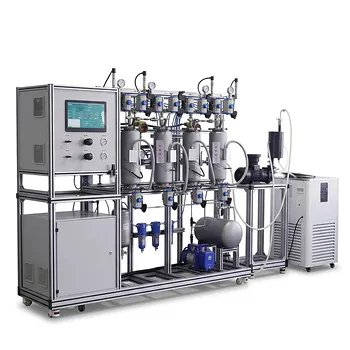
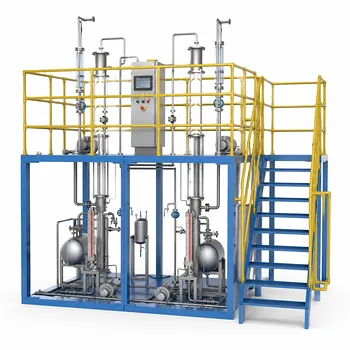
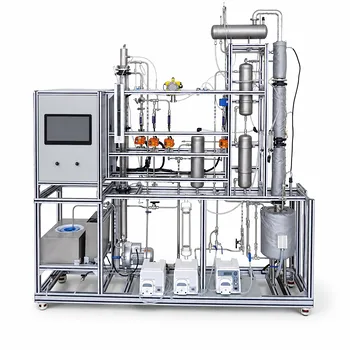
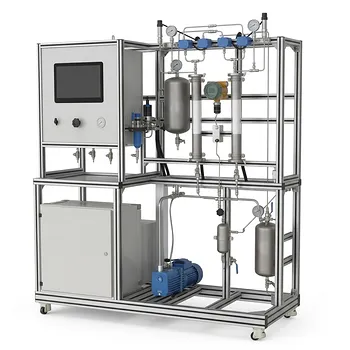
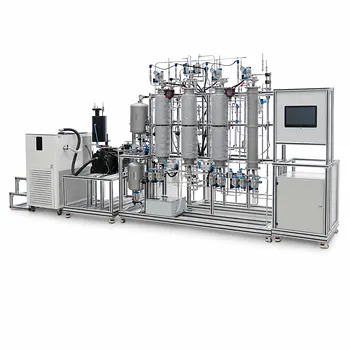
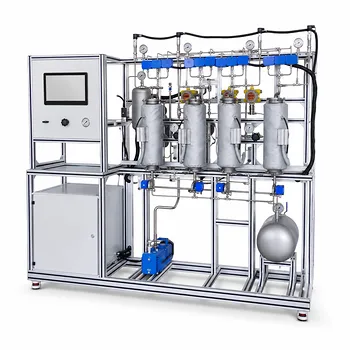
Our gas absorption pilot plants feature multiple sampling ports and high-precision instrumentation, allowing students and researchers to directly measure concentration profiles and physically validate the drift factor in real time.
Ready to upgrade your laboratory capabilities? Contact our team of experts today to find the perfect pilot plant configuration for your curriculum or research goals.
Related Products
- Multi-Component Gas Pressure Swing Adsorption Pilot Plant for Unit Operations Education
- Dual-Mode Gas Absorption and Desorption Unit Operations Training Pilot Plant
- Absorption and Desorption Educational Unit Operations Pilot Plant
- Carbon Dioxide Absorption and Desorption Educational Pilot Plant for Carbon Capture Studies
- Pressure Swing Adsorption Educational Unit Operations Pilot Plant
People Also Ask
- How does Pressure Swing Adsorption (PSA) technology operate? Optimize gas separation with pilot plants.
- How do two-film & penetration theories apply to gas absorption pilot plant teaching? Key pedagogical insights.
- How is the direction and driving force of mass transfer determined in a gas absorption unit operations pilot plant?
- How does partial pressure behavior influence gas absorption pilot plants? Master Mass Transfer
- What are the limitations of Henry's Law in gas absorption pilot plants? Avoid critical lab errors.