Knowledge Chemical Engineering Education Why Distinguish Static vs. Operating Holdup in Packed Bed Reactor Pilot Plants? Key Scale-Up Tips
Author avatar

Tech Team · LABPARK

Updated 1 month ago

Why Distinguish Static vs. Operating Holdup in Packed Bed Reactor Pilot Plants? Key Scale-Up Tips


The core operational challenge in packed bed reactor pilot plants isn’t just total liquid inventory—it’s knowing how much of that liquid is actually participating in the reaction. Distinguishing between static and operating liquid holdup gives you that critical insight. Static holdup is the liquid physically trapped inside catalyst pores and packing interstices after flow stops, while operating holdup is the dynamic liquid flowing outside the particles. In a pilot plant, this separation directly determines how you interpret residence time, calculate true reaction rates, and predict what will happen at industrial scale.

In packed bed pilot plants, static holdup acts as a stagnant reservoir that does not contribute to active mass transfer, while operating holdup governs the reaction’s contact time and wetting efficiency. Mistaking one for the other leads to kinetic models that are wrong at the core — and scale‑up predictions that fail in the plant.

The Two Components of Liquid Holdup

Defining Static and Operating Holdup

Total liquid holdup is the sum of two fundamentally different fractions. Static holdup is the liquid that clings inside catalyst pores and narrow packing voids even after flow is cut off. It is strongly influenced by particle diameter, fluid density, surface tension, and packing porosity — smaller, more porous particles trap significantly more. Operating holdup is the continuously renewed film flowing over the external packing surfaces, driven by gas and liquid velocities.

Why Simple Total Holdup Isn’t Enough

Measuring only the total liquid volume hides a dangerous averaging. A reactor might show 15% total holdup, but if 12% is static and trapped inside fine‑pore catalyst, only 3% is actively exchanging material. Using that 15% to compute a residence time would overestimate the fraction of liquid that truly participates in the reaction — skewing kinetic constants and creating a false picture of catalyst utilization.

Operational Significance in Pilot Plants

Accurate Residence Time Distribution and Kinetic Analysis

For any researcher trying to extract intrinsic reaction kinetics from pilot‑plant data, the active flow volume defines real residence time. The operating holdup — not the total — dictates how long reactants are truly exposed to the catalyst surface. By subtracting static holdup, you remove the stagnant pool that merely dilutes tracer response and distorts RTD curves. This separation is what allows pilot‑scale data to produce kinetic parameters that remain valid when you scale up.

Catalyst Wetting Efficiency and Performance Prediction

Catalyst performance hinges on how well the liquid contacts the solid. Wetting efficiency is directly tied to operating holdup, because only the flowing film reaches reaction sites on the pellet exterior. Static liquid trapped in pores may barely renew, creating zones of diffusion limitation or even reactant starvation. Distinguishing the two lets you quantify what fraction of the bed is truly “active” and predict how catalyst aging, flow maldistribution, or changes in liquid rate will impact conversion — long before you commit to a larger reactor.

Scale‑Up and Flow Regime Interpretation

Pilot plants often explore multiple flow regimes — trickling, pulsing, or near‑flooding. Each regime redistributes the split between static and operating holdup in a different way. In trickle flow, static holdup can dominate; in pulsing flow, operating holdup surges. Recognizing these shifts from pilot data gives you the hydrodynamic map you need to avoid reactor flooding at scale, size pumps correctly, and set operating windows that maintain the same contact pattern you validated in the pilot.

Understanding the Trade‑offs

Measurement Challenges and Uncertainty

Separating static and operating holdup is not trivial. The common method — draining the column and measuring the liquid that remains — can overestimate static holdup if drainage is slow or incomplete. Fluid properties like viscosity and surface tension further blur the distinction. If your pilot study demands high precision, you’ll need to invest in robust draining protocols or tracer techniques, accepting that the measurement itself becomes a source of experimental uncertainty.

Impact of Fluid Properties and Packing Characteristics

Small catalyst particles and high‑porosity packings boost static holdup, which sounds benign but can hurt. A bed that holds 25% static holdup behaves very differently from one holding 5%. The “active” liquid volume shrinks, giving you less operating flexibility and longer stabilization times. In pilot‑plant education, this stark sensitivity teaches a lasting lesson: the same total holdup number can mean entirely different reactor dynamics depending on where the liquid resides.

When Overlooking Static Holdup Leads to Costly Errors

The most expensive mistake is treating a pilot‑scale reactor as if all liquid is useful. You might conclude that a reaction needs 20 minutes residence time based on total holdup, when the true active residence time is only 5 minutes. The full‑scale design would then be grossly oversized — or worse, under‑performing. Similarly, misinterpreting wetting efficiency hides the onset of dry spots that can cause hot spots and catalyst deactivation in operation.

Making the Right Choice for Your Pilot Plant Study

Your approach to holdup characterization must match your pilot plant’s purpose.

  • If your primary focus is intrinsic kinetic parameter estimation: Isolate operating holdup rigorously. Use tracer tests and drainage protocols to subtract static holdup, ensuring your rate constants reflect only the actively contacted liquid volume.
  • If your primary focus is catalyst screening or wetting studies: Track the static/operating split under every flow condition. A catalyst that appears excellent in a poorly wetted bed (high static, low operating) will disappoint in a well‑irrigated full‑scale reactor.
  • If your primary focus is education and demonstrating flow effects: Make the distinction visible. Have students drain the bed and measure the retained liquid, then compare that to the instantaneous inventory during flow — the “aha” moment bridges theory to real reactor design.
  • If your primary focus is scale‑up prediction: Maintain the same static‑to‑operating holdup ratio between pilot and proposed full‑scale conditions. This is the hydrodynamic similarity that preserves wetting and residence time, far more reliable than matching total holdup alone.

What you measure is what you model. Distinguishing static from operating holdup turns a rough inventory number into the genuine measure of active reaction volume — and that is the foundation every successful packed bed scale‑up is built on.

Summary Table:

Feature Static Holdup Operating Holdup
Definition Liquid trapped in catalyst pores and voids after flow stops Dynamic liquid film flowing over external packing surfaces
Key Drivers Particle size, surface tension, packing porosity Gas & liquid flow velocities, fluid viscosity
Impact on RTD Acts as a stagnant pool; distorts tracer response Dictates active flow volume & true residence time
Scale-up Role Determines catalyst utilization & dead zones Governs wetting efficiency & reactor heat/mass transfer

Achieving accurate hydrodynamic scaling is crucial for successful research and teaching. LABPARK provides state-of-the-art Educational and Vocational Unit Operations Pilot Plants across chemical engineering, bioprocess & biotech, and environmental & water treatment. Tailored for universities, research institutes, and enterprises, our equipment delivers the precision needed to master complex kinetics and scale-up dynamics.

Ready to elevate your lab's capabilities? Contact us today to discuss your project!

Related Products

People Also Ask

Related Products

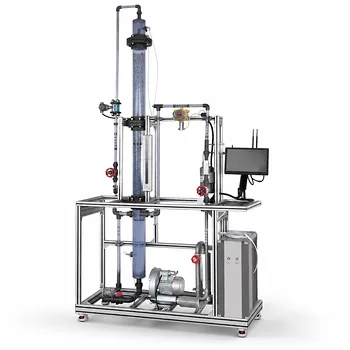
Packed Bed Absorption Educational Unit Operations Pilot Plant

Packed Bed Absorption Educational Unit Operations Pilot Plant

Study gas-liquid absorption, pressure drop, flooding, and mass transfer coefficients with this pilot plant. Transparent packed column, industrial touchscreen, real-time sensor data, automated analysis. Investigate two-phase flow, loading points, column efficiency. Comprehensive data logging and assessment software included.

Micro-Scale Gas-Solid Catalytic Reaction Educational Pilot Plant

Micro-Scale Gas-Solid Catalytic Reaction Educational Pilot Plant

Explore heterogeneous catalysis with this micro-scale gas-solid catalytic reaction educational pilot plant. Designed for university labs, it enables hands-on study of reaction kinetics and transport phenomena in a benchtop packed bed reactor with high-precision flow control and touchscreen automation.

High-Gravity Emulsification and Mass Transfer Educational Pilot Plant

High-Gravity Emulsification and Mass Transfer Educational Pilot Plant

This integrated educational pilot plant utilizes rotating packed bed technology to demonstrate high-gravity emulsification and mass transfer, providing engineering students with hands-on experience in process intensification and unit operations through a modular, customizable design with digital monitoring.

Fixed-Bed Chemical Reaction and Gas Dust Tar Removal Unit Operations Pilot Plant

Fixed-Bed Chemical Reaction and Gas Dust Tar Removal Unit Operations Pilot Plant

Integrated educational pilot plant for studying catalytic gas-solid reactions and downstream gas purification. Features dual fixed-bed reactor, three-stage heating, and touchscreen control for hands-on engineering training. Ideal for chemical and environmental engineering curricula.

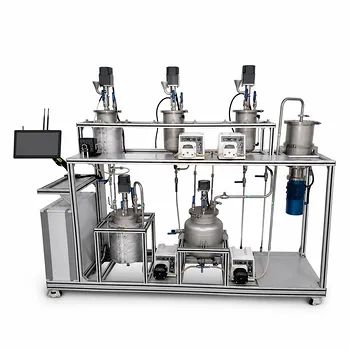
Multi-Reactor Educational Pilot Plant for Reaction Engineering Unit Operations

Multi-Reactor Educational Pilot Plant for Reaction Engineering Unit Operations

Integrated bench-scale educational pilot plant for chemical engineering teaching featuring fixed bed fluidized bed and stirred tank reactors with web-based digital twin controls and safety interlocks for hands-on unit operations and reaction engineering comparative studies in one compact system.

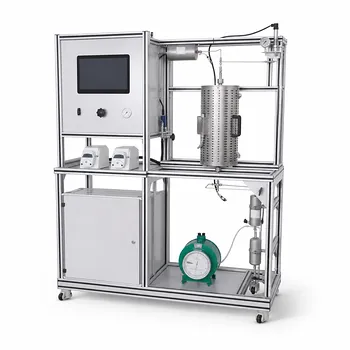
Fixed Bed Gas Solid Catalytic Reaction Educational Pilot Plant

Fixed Bed Gas Solid Catalytic Reaction Educational Pilot Plant

Fixed-bed gas-solid catalytic reaction unit operations pilot plant for chemical engineering education. Features split-furnace, mass flow controllers, PID control, safety interlocks. Ideal for heterogeneous catalysis, reactor dynamics, catalyst evaluation studies. Fully customizable configurations for university laboratories and academic research.

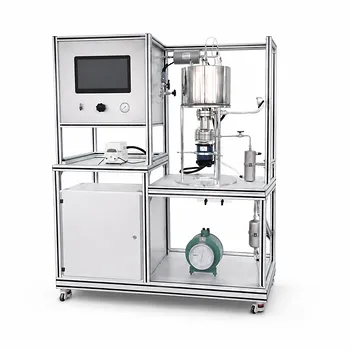
Fluidized Bed Gas Solid Catalytic Reaction Educational Pilot Plant

Fluidized Bed Gas Solid Catalytic Reaction Educational Pilot Plant

Our educational fluidized bed gas-solid catalytic reaction pilot plant is ideal for chemical engineering labs. Students study fluidization dynamics, catalyst evaluation, and process control hands-on. Features include a customizable reactor, touchscreen HMI, and safety interlocks for safe, curriculum-aligned experiments.

Ethylbenzene Dehydrogenation Educational Unit Operations Pilot Plant

Ethylbenzene Dehydrogenation Educational Unit Operations Pilot Plant

Ethylbenzene dehydrogenation educational pilot plant replicates industrial styrene production, offering hands-on experience with fixed-bed reactors, catalyst activation, regeneration, automated process control. Designed for university chemical engineering labs, it enables study of gas-solid catalysis, catalyst deactivation, steam regeneration, and safety interlocks.

Multi Functional Catalytic Reaction and Reactor Evaluation Educational Unit Operations Pilot Plant

Multi Functional Catalytic Reaction and Reactor Evaluation Educational Unit Operations Pilot Plant

Bench-scale educational pilot plant for catalytic reaction and reactor evaluation, integrating fixed bed, fluidized bed, and stirred tank reactors. Students compare reactor designs, evaluate catalysts, and study reaction kinetics and hydrodynamics. Perfect for unit operations labs in chemical engineering curricula.

Educational Unit Operations Pilot Plant for Intraparticle Diffusion Effective Factor Measurement

Educational Unit Operations Pilot Plant for Intraparticle Diffusion Effective Factor Measurement

Designed for chemical engineering university labs, this pilot plant allows hands-on determination of catalyst particle intraparticle diffusion effective factors and gas-solid reaction kinetics using a fixed-bed tubular reactor with industrial touchscreen control, bridging theory and practical reactor design.

Methanol Synthesis and Catalyst Performance Evaluation Educational Unit Operations Pilot Plant

Methanol Synthesis and Catalyst Performance Evaluation Educational Unit Operations Pilot Plant

Bench-scale methanol synthesis and catalyst evaluation educational pilot plant for chemical engineering labs to study catalytic kinetics, high-pressure operations, process control, and unit operations under realistic conditions with industrial safety features, precision gas delivery, data acquisition, and intelligent monitoring.

Internal Circulation Gradient Free Catalytic Reaction Educational Pilot Plant

Internal Circulation Gradient Free Catalytic Reaction Educational Pilot Plant

Internal circulation gradient free catalytic reaction educational pilot plant for chemical engineering unit operations. Provides isothermal gradient free operation and hands on study of heterogeneous catalysis kinetics and mass transfer with precise control. Ideal for academic labs.

Residence Time Distribution and Reactor Flow Characteristics Determination Educational Pilot Plant

Residence Time Distribution and Reactor Flow Characteristics Determination Educational Pilot Plant

This versatile educational pilot plant is designed for comprehensive study of residence time distribution and reactor flow characteristics, featuring multiple CSTRs in series, a tubular reactor, variable recycle loop, and automated real-time data acquisition, perfect for hands-on chemical engineering education.

100L Continuous Loop Hydrogenation Educational Unit Operations Pilot Plant

100L Continuous Loop Hydrogenation Educational Unit Operations Pilot Plant

This 100L continuous loop hydrogenation pilot plant is designed for chemical engineering education, featuring 316 stainless steel construction, advanced gas-liquid mass transfer components, explosion-proof safety systems, and a 15.6-inch touchscreen with 5G connectivity, cloud data logging, bridging theory and industry.

Tubular Reactor Flow Characteristics Determination Educational Unit Operations Pilot Plant

Tubular Reactor Flow Characteristics Determination Educational Unit Operations Pilot Plant

Educational pilot plant for investigating tubular reactor flow characteristics and residence time distribution Features adjustable recycle for plug flow and backmixing studies industrial touchscreen interface and real-time data acquisition Ideal for chemical engineering unit operations laboratory training and education

Methane Cracking Educational Unit Operations Pilot Plant

Methane Cracking Educational Unit Operations Pilot Plant

This bench-scale methane cracking educational pilot plant provides hands-on catalytic conversion training with a 1000°C furnace, seven mass flow controllers, and real-time automation for safe, curriculum-aligned experiments. Designed for university teaching of unit operations and reaction engineering.

Crude Benzene Hydrogenation Educational Unit Operations Pilot Plant

Crude Benzene Hydrogenation Educational Unit Operations Pilot Plant

Advanced pilot plant for higher education, enabling hands-on study of crude benzene hydrogenation and gas-liquid catalytic reactions. Triple-stage reactor system with precision flow and temperature control, AI-driven PID, remote monitoring, and comprehensive safety interlocks. Customizable for curriculum integration.

Multi-Stage Stirred Tanks in Series Residence Time Distribution and Mixing Performance Determination Educational Pilot Plant

Multi-Stage Stirred Tanks in Series Residence Time Distribution and Mixing Performance Determination Educational Pilot Plant

Explore residence time distribution and mixing performance in series stirred tanks with this educational pilot plant. Real-time conductivity sensors, interactive 3D simulation, and industrial-grade PC for chemical engineering lab training. Customizable to curricula.

Rising and Falling Film Evaporation Educational Unit Operations Pilot Plant

Rising and Falling Film Evaporation Educational Unit Operations Pilot Plant

Hands-on educational pilot plant for studying rising and falling film evaporation, flow regimes, and heat transfer. Customizable for university labs with industrial instrumentation and data acquisition. Enables comparative evaluation of evaporation modes and energy efficiency.

Supercritical High-Gravity Flash Evaporation Educational Unit Operations Pilot Plant

Supercritical High-Gravity Flash Evaporation Educational Unit Operations Pilot Plant

Bench-scale integrated teaching system for advanced separation and mass transfer, combining supercritical high-gravity flash evaporation with heating, chemical reaction, and material collection, featuring modular design, Stainless Steel 316L construction, transparent visualization, touchscreen control, and safety systems for chemical engineering education.


Leave Your Message