The difference between a standard three-phase separator and an electric-grid desalter is not just a matter of size—it’s a fundamental shift in separation physics. A standard separator relies on gravity alone to settle water droplets from the oil phase, a slow process limited by the tiny size of dispersed droplets. An electric-grid desalter injects an electric field into the oil, which rapidly coalesces water droplets into much larger ones. This acceleration allows the desalter to achieve extremely low remaining water content—typically 0.05% to 0.1% by volume—far beyond the capability of simple gravity settlers.
Both units aim to separate oil, water, and gas, but the desalter’s electric field is the critical upgrade that turns a slow, incomplete settling process into a fast, high‑efficiency purification step. In pilot plants, this contrast can be vividly demonstrated by comparing the two methods under identical conditions, while adjusting variables like dilution water, temperature, and electric grid voltage.
The Core Process Difference: A Tale of Two Forces
Gravity: The Passive, Size-Dependent Settler
Gravity settling relies on the density difference between oil and water droplets. The settling velocity follows Stokes’ law, meaning it depends strongly on the droplet radius squared.
In a three-phase separator, the residence time is designed to allow droplets to travel down to the water layer. However, droplets smaller than a few hundred microns settle so slowly that they remain entrained in the oil.
This is why gravity alone often leaves a Base Sediment and Water (BS&W) level of 0.5% to a few percent—too high for refinery tolerances. To improve it, you’d need impractical vessel lengths or extremely long residence times.
Electric Field: The Active, Coalescing Accelerator
An electric-grid desalter places an energized grid inside the oil phase. When the crude oil passes through, the electric field polarizes water droplets.
The polarized droplets experience attractive forces, causing them to move towards each other and collide. This electric-field-induced coalescence grows droplets from microns to millimeters in size.
Once the droplets are large enough, gravity takes over and they settle rapidly—within seconds rather than hours. The result is a far lower BS&W (0.05–0.1%) and, critically, a dramatic reduction in dissolved salts that would otherwise cause corrosion and fouling downstream.
Demonstrating This in a Chemical Engineering Pilot Plant
The Side‑by‑Side Setup: A Powerful Teaching Tool
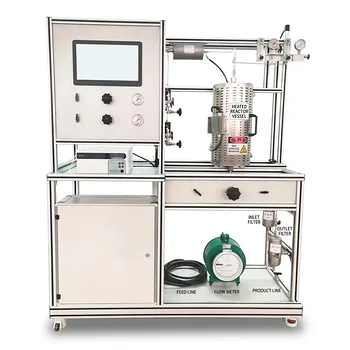
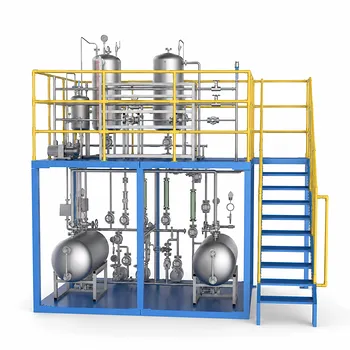
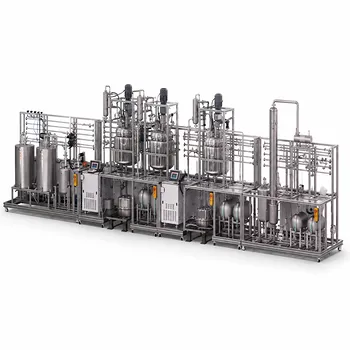
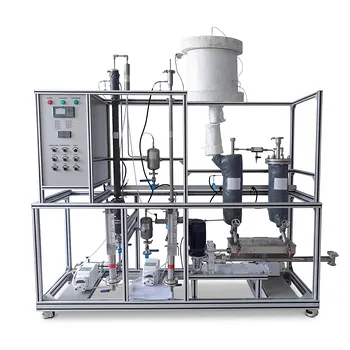
A skid‑mounted pilot plant can house both a gravity‑only separator and an electric desalter, fed from the same crude oil inlet. This allows students to directly observe the performance gap.
The gravity separator’s oil outlet will appear hazy or dark due to microscopic water droplets still entrained. The desalter’s oil outlet, after passing through the electric field, will be notably clearer—a visual testament to coalescence.
Sampling and measuring BS&W via centrifuge or Karl Fischer titration quantifies the difference. Students instantly grasp why industry invests in electrostatic technology.
Key Variables to Manipulate
Dilution Water Injection
Raw crude is often already a water‑in‑oil emulsion. By injecting fresh, low‑salinity dilution water, the desalter can extract more salt. In a pilot plant, varying the wash‑water ratio (e.g., 3–10 vol%) shows how dilution improves desalting efficiency.
Impact demonstration: Plotting salt content in the treated oil (PTB—pounds per thousand barrels) versus wash‑water rate reveals a minimum. Too little water doesn’t dissolve enough salt; too much overloads the grid or causes short‑circuiting.
Temperature‑Induced Viscosity Drops
Oil viscosity decreases with temperature, making droplet movement easier. Pilot plants with heated feed lines can test crude at, say, 25°C versus 80°C.
Observation: At low temperatures, even the desalter may struggle because high viscosity retards both coalescence and settling. As temperature rises, the electric field’s effect becomes more pronounced, and the achieved BS&W plummets.
Electric Grid Settings
The grid voltage and frequency directly control the field strength. In a pilot unit, you might adjust from a few hundred to several thousand volts.
Caution: Too high a voltage can cause arcing or short‑circuiting, especially if the water cut is high. Students can map the relationship between voltage, coalescence speed, and energy consumption, learning the operational window.
Understanding the Trade‑offs
Not Every Separator Should Be a Desalter
While electric grids dramatically improve separation, they are not a universal upgrade. Desalters introduce complexity, cost, and safety concerns.
Capital and operating costs are higher due to the transformers, grid assembly, and explosion‑proof enclosures. In pilot plants, this translates to more expensive instrumentation and stricter safety protocols.
Electrical short‑circuiting is a constant risk. If the emulsion is too tight, or if free water reaches the grid, the electric field collapses. A pilot plant operator must carefully control the interface level between oil and water.
Oil conductivity matters. Highly conductive crudes (e.g., heavy oils with high metal content) can draw excessive current, reducing the field’s effectiveness or even tripping the power supply. This limitation is quickly exposed in a test environment.
Scale‑up pitfalls: A pilot desalter that works perfectly at 1 L/min may behave differently at industrial flow rates. The demonstration should include discussions of residence time distribution and electrode fouling, as these are scale‑sensitive.
Making the Right Choice for Your Pilot Demonstration
The specific goal of the pilot exercise will dictate how you configure and operate the two units.
- If your primary focus is fundamental education: Use the side‑by‑side setup to illustrate the physics of coalescence. Have learners measure droplet size distributions before and after each unit, and relate the data to Stokes’ law and the electric field’s dipole‑dipole attraction.
- If your primary focus is process optimization: Vary dilution water, temperature, and voltage systematically, then apply a response‑surface model to find the minimum residual salt and BS&W. Discuss the economic trade‑offs between chemical injection (demulsifiers) and electrical power.
- If your primary focus is troubleshooting or emulsion research: Introduce challenging crudes—those with high asphaltene content or produced from enhanced oil recovery—and document how the electric grid’s performance degrades compared to a pristine crude. This reveals the real‑world limits of electrostatic desalting.
A well‑designed pilot plant demonstration does more than simply show that desalters are better—it quantifies how much better, under precisely what conditions, and at what cost. That understanding is what transforms a curious student into an informed practitioner.
Summary Table:
| Feature | Standard Three-Phase Separator | Electric-Grid Desalter |
|---|---|---|
| Primary Force | Gravity settling (Stokes' Law) | Electrostatic coalescence + gravity |
| Separation Speed | Slow (requires long residence times) | Rapid (droplets grow and settle in seconds) |
| Efficiency (BS&W) | High residual water (0.5% - 2%) | Extremely low water content (0.05% - 0.1%) |
| Salt Removal | Low efficiency | High efficiency (prevents downstream corrosion) |
Bring Industrial-Scale Separation Physics to Your Laboratory
To effectively teach and research advanced separation processes, students and researchers need hands-on access to realistic systems.
LABPARK provides premium Educational and Vocational Unit Operations Pilot Plants in chemical engineering, bioprocess & biotech, and environmental & water treatment. Specifically designed for universities, research institutes, and enterprises, our customizable skids enable safe, precise control over complex variables like voltage, temperature, and flow rates.
Ready to elevate your engineering lab with state-of-the-art pilot systems? Contact LABPARK today to discuss your laboratory's custom requirements!
Related Products
- Fixed Bed Gas Solid Catalytic Reaction Educational Pilot Plant
- Multi Pump Fluid Transport Process Piping Unit Operations Training Pilot Plant
- Carbon Dioxide Hydrogen Methanol Synthesis Educational Unit Operations Pilot Plant
- Ethyl Acetate Synthesis Unit Operations Pilot Plant for Practical Training
- Natural Product Extraction Unit Operations Training Pilot Plant
People Also Ask
- How do reactor pilot plants safely study gas-solid reactions? Master kinetics with thermal & flow control.
- How does the Mears criterion evaluate transport resistance? Key Guide to Intrinsic Kinetics
- Why is a multibed configuration necessary for exothermic reactions? Optimize your pilot plant trajectory.
- Fluidized vs. Fixed Bed Reactors: Comparing Heat & Complexity in Pilot Plants
- How is the friction factor determined for fixed-bed pilot plants? Select the best pressure drop correlation.