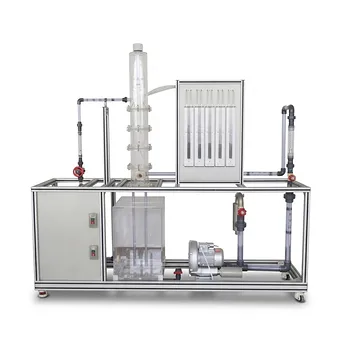
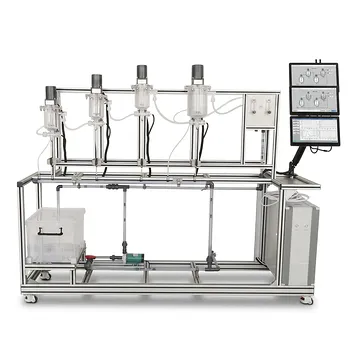
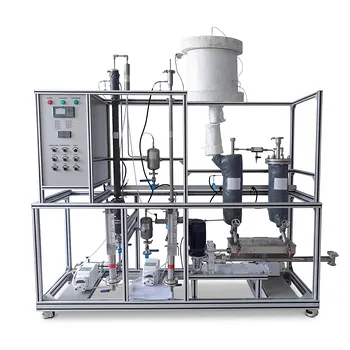
Single-stage versus multi-stage separation is the fundamental operational difference. A simple distillation unit in a chemical engineering teaching lab vaporizes a liquid mixture and immediately condenses the vapor once—it is a transient, single equilibrium stage process where purity steadily declines as the more volatile component boils off. A fractional rectification column pilot plant, by contrast, uses a reflux system to return a portion of the condensed overhead liquid back down the column, creating a counter-current flow of liquid and vapor that executes dozens of theoretical equilibrium stages inside the column. This turns a one-shot separation into a continuous, high-purity rectification.
The core operational distinction is the deliberate creation of multiple, counter-current vapor-liquid equilibrium stages through a controlled reflux stream. Simple distillation condenses immediately after the single stage; fractional rectification recycles condensed liquid to contact rising vapor, multiplying the separation effect and enabling students to tune product purity by adjusting the reflux ratio.
The Single-Stage Limit: Simple Distillation
A simple distillation pilot plant is designed to demonstrate the most basic vapor-liquid separation.
How It Operates
The unit consists of a boiling flask or reboiler connected directly to a condenser. Vapor leaves the boiling liquid, travels through a short path, and is immediately condensed to become the distillate.
Why It’s a Transient Process
No liquid is returned to the flask. The composition inside the reboiler continuously changes—the volatile component depletes over time, so the vapor composition and distillate purity drop as the experiment continues.
Where It Fits in Education
It is an excellent first-step demonstration of Raoult’s law and phase change. Students can clearly see that boiling point and composition are linked, but they also quickly observe that a single equilibrium step cannot produce both high purity and high recovery simultaneously.
The Reflux Revolution: Fractional Rectification
A fractional rectification column pilot plant adds the hardware and flow path that transforms separation results.
The Addition of a Rectification Column
Between the reboiler and the condenser sits a tall column filled with trays or packing. The vapor from the reboiler rises through this column, while liquid falls downward, meeting the vapor at every tray or packing layer.
The Role of Reflux
At the top, the condenser splits the condensate into two streams: distillate product and reflux, which is pumped or gravity-fed back into the column. This reflux creates the downward liquid flow necessary for multiple equilibrium contacts. Without reflux, the column would simply act as a long pipe, not a rectification device.
Counter-Current Mass Transfer
On each tray, hot vapor contacts cooler down-flowing liquid. Volatile components transfer from liquid to vapor; less volatile components move from vapor to liquid. With many such stages, the vapor reaching the top condenser becomes highly enriched in the lightest component, while the bottom stream concentrates the heaviest.
Adjusting the Separating Power
Educational pilot plants feature a reflux control system—often a timed solenoid valve or a reflux splitter. Students adjust the reflux ratio (R = L/D) and directly see how increasing R raises product purity because a larger liquid flow improves the operating line slope for mass transfer.
Why the Operational Difference Matters in a Teaching Lab
The shift from one stage to many stages is the gateway to understanding industrial distillation.
Bridging Theory and Reality
Students learn equations for the McCabe-Thiele method. A rectification pilot plant lets them set a reflux ratio, measure the resulting distillate composition, and compare it to the theoretical operating line. The physical presence of temperature probes along the column makes the equilibrium-stage concept concrete.
Observing Separation Efficiency
Fractional columns can be packed with structured packing or filled with sieve plates. Students measure the Height Equivalent to a Theoretical Plate (HETP) for a packed column by sampling along the height. With plate columns, they calculate actual plate efficiency and compare it to textbook assumptions.
Demonstrating Real-World Constraints
Boiling point differences often determine column choice. If two components boil within 25 °C of each other (e.g., acetone-water), a simple distillation cannot achieve a clean split. The fractional column with multiple stages becomes essential, showing students why close-boiling mixtures demand rectification.
Understanding the Trade-offs
Both setups have their place, and pilot plant selection involves real compromises.
Simplicity vs. Performance
A simple distillation rig is cheaper, faster to run, and easier to clean. It is perfect for illustrating basic volatility concepts or separating components with a boiling-point gap greater than 25 °C. Its educational weakness is that it cannot reveal the power of staging and reflux.
Plate Columns vs. Packed Columns
Even within fractional rectification, there is a trade-off:
- Plate columns provide stable efficiency over a wide operating range, are easier to inspect and clean, and make the liquid-vapor interaction visible—ideal for student labs.
- Packed columns offer higher separation efficiency and lower pressure drop, but they suffer from poor wetting at low liquid loads, have higher packing costs, and are harder to clean when solids or sticky polymers are involved.
Operational Complexity
Fractional rectification pilot plants require careful heat balance at the reboiler and condenser. Students must stabilize the reflux ratio, manage column pressure drop, and avoid flooding. These added steps teach essential process control but demand more lab time and troubleshooting.
Energy Consumption and Comparison to Other Processes
Because rectification requires boiling, it is energy-intensive. Comparing the pilot plant with a gas absorption column (which uses a solvent without boiling) shows students that distillation is a heat-driven, mass-transfer-opposite-directions process, while absorption relies on a liquid solvent at temperatures far from its boiling point—an entirely different operating principle and cost profile.
Making the Right Choice for Your Educational Goal
Which pilot plant to deploy depends entirely on the learning objective you want to emphasize.
- If your primary focus is introducing phase equilibrium and basic volatility: A simple distillation unit allows students to observe how vapor composition relates to liquid composition in a single stage without the complexity of a column.
- If your goal is to demonstrate the power of reflux and multiple equilibrium stages: You need a fractional rectification pilot plant with adjustable reflux control, so students can vary the reflux ratio and watch product purity change in real time.
- If you want students to measure mass transfer performance (HETP, plate efficiency) and compare internals: Choose a modular fractional column that accepts both packed and plate sections, enabling direct experimentation with hydrodynamics and separation efficiency.
- If you want to compare energy consumption or process integration (e.g., different heating methods, entrainer use): A multifunctional rectification pilot plant that can switch between direct steam injection and indirect reboiler heating, or that can accept an entrainer feed for azeotropic distillation, provides the richest learning experience.
A simple distillation unit introduces the basics; a fractional rectification column builds the deep understanding of staging, reflux, and real-world separations that chemical engineers must master.
Summary Table:
| Feature | Simple Distillation Unit | Fractional Rectification Pilot Plant |
|---|---|---|
| Equilibrium Stages | Single-stage (transient) | Multi-stage (continuous) |
| Reflux System | None (immediate condensation) | Yes (adjustable reflux ratio) |
| Boiling Point Gap | Best for > 25 °C differences | Efficient for close-boiling (< 25 °C) |
| Key Learning Value | Phase change & Raoult's law | Mass transfer, HETP, & process control |
Bring Industry-Grade Distillation to Your Students with LABPARK
Enhance your chemical engineering department with LABPARK’s premium Educational and Vocational Unit Operations Pilot Plants. Specially designed for universities, research institutes, and enterprises, our advanced platforms cover chemical engineering, bioprocess & biotech, and environmental & water treatment to give students the ultimate hands-on training.
Contact our engineering specialists today to find the perfect pilot plant setup for your lab.
Related Products
- Multi-Modal Distillation Unit Operations Training Pilot Plant
- Dual-Mode Rectification Pilot Plant for Practical Training Unit Operations
- Plate Column Hydrodynamics Tray Demonstration Educational Pilot Plant
- Absorption and Desorption Educational Unit Operations Pilot Plant
- Comprehensive Liquid-Liquid Extraction Pilot Plant for Engineering Education
People Also Ask
- How can energy balance equations for condensers & reboilers be validated experimentally? Guide
- Why is vacuum operation capability an essential feature for a distillation unit operations pilot plant? Unlock Efficiency
- How can real-time carbon number prediction improve distillation pilot plants? Optimize control.
- What are the primary reflux ratio control strategies? Master Distillation Unit Operations
- How does catalyst water concentration affect distillation pilot plant design? Key separation train choices.