Knowledge Vocational Chemical Engineering Education Desalting & Dehydration in a Wash Tank: How Pilot Plants Replicate It
Author avatar

Tech Team · LABPARK

Updated 1 month ago

Desalting & Dehydration in a Wash Tank: How Pilot Plants Replicate It


Desalting and dehydration happen in the same wash tank because of a simple, inseparable relationship. Since salt exists only in the water phase, removing water from crude oil also removes salt—but only if the water’s salinity is kept low enough. If the brine is too salty, the oil can be bone-dry and still fail refinery salt specifications. Training pilot plants mirror this by forcing operators to calculate and inject fresh dilution water exactly as a real process would.

The core principle is that dehydration is the physical method, but dilution is the chemical requirement. A single wash tank works when you control the salt content of the water it's about to remove, not just the water volume. Pilot plants teach this by making the dilution step the central hands-on exercise.

The Immiscibility Principle: Why One Tank Handles Two Tasks

The logic is rooted in the physical chemistry of crude oil. Salt will not dissolve in oil; it will only dissolve in water. Therefore, any salt present in the crude is hitching a ride inside microscopic water droplets or a brine layer.

Salt Lives in the Water

Salt is an inorganic solid that partitions entirely into the aqueous phase. It does not stay behind in the oil when water separates. This means the process of eliminating water simultaneously eliminates salt—a two-for-one physical separation.

Dehydration as the Physical Mechanism

The wash tank is fundamentally a settling chamber that uses gravity (and often heat and chemicals) to dewater the oil. As water droplets coalesce and sink, they carry all dissolved salts with them. The tank itself doesn’t need a separate “salt removal” device.

The Dilution Crux: Controlling Inlet Salinity

However, the tank can only remove salt down to the concentration of the water it releases. If the inlet water’s salinity is extremely high, even a tiny residual water fraction (say, 0.1%) can leave salt levels above the 10 lb per 1000 barrels standard. The design principle demands diluting the feed water to 1.0 lb of salt per barrel of water or less before it enters the tank, so the final oil meets spec even if a trace of water remains.

The Single-Tank Synergy

Combining both steps in one vessel transforms a linear, two-step process into an integrated operation. The wash tank doesn't just settle; it acts as a controlled dilution reactor.

From Two-Step to One-Step Process

Without this synergy, you would need a separate desalter to wash the oil with fresh water, then a dehydrator to remove it. By injecting fresh water directly upstream, the single wash tank becomes both the mixing point and the separator.

The Wash Tank as a Dilution and Settling Device

The tank’s design implicitly includes a mixing junction (often a simple pipe tee or static mixer) before the settling chamber. This is where fresh water is injected to slash the brine salinity. Inside the tank, the diluted brine separates, leaving oil with a salt content low enough to meet refinery specs.

Understanding the Trade-offs

While elegant, the single-tank approach isn't free of operational tensions. Managing them is what separates stable operation from an off-spec product.

Emulsion Stability Risks

Over-mixing at the dilution point can shear water droplets into such fine dispersions that they won't settle, creating a stable emulsion. The operator must balance sufficient mixing for dilution against the risk of overtreating, which defeats the tank’s dehydration purpose.

The Freshwater Cost Equation

Diluting to 1.0 lb of salt per barrel of water requires massive freshwater volumes if the inlet brine is extremely saline. This adds a direct procurement cost and increases the water-handling load on downstream treatment facilities. In some fields, water availability becomes a hard constraint.

Replicating the Operation in Training Pilot Plants

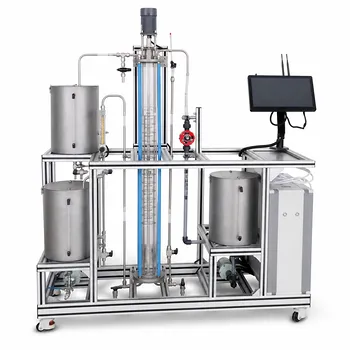
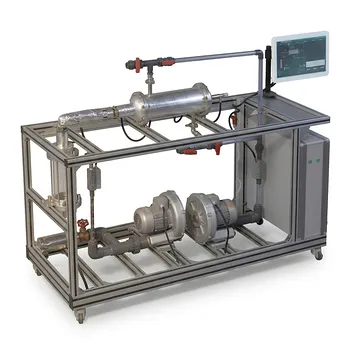
Vocational pilot plants compress this entire principle into a teachable, observable loop. The equipment is simplified, but the control logic is identical to a refinery unit.

The Mixing Junction: Where the Lesson Begins

Training units feature a dedicated injection point for fresh water immediately before the settling chamber. Trainees see, physically, where the dilution stream enters the oil line, reinforcing that salt control is a pre-tank step.

Hands-On Calculations: From Salinity Input to Dilution Ratio

The core exercise requires trainees to calculate dilution water requirements based on measured inlet salinity. If the oil arrives with brine at 5 lb of salt per barrel, they compute how much fresh water to add to bring the mixture below 1.0 lb/bbl. This drives home the math behind the standard.

Monitoring Separation Efficiency in Real Time

By sampling the outlet oil and measuring both water content and salt content, trainees verify their work. They learn that achieving dry oil doesn’t guarantee clean oil—only the salt assay tells the true story. This closes the loop between theory, calculation, and hands-on process control.

How to Apply This to Your Training Program

Your specific training goals will determine how you emphasize the pilot plant steps.

  • If your primary focus is teaching the design principle: Start with a visual demonstration of a simple mixing tee and a gravity settler. Have trainees measure inlet salinity, calculate the required dilution water, and observe the salt reduction in the separated water.
  • If your primary focus is troubleshooting upset conditions: Intentionally overmix the oil-water stream to create an emulsion, then task trainees with restoring separation by adjusting mixing energy or adding a demulsifier while still meeting the salt spec.
  • If your primary focus is economic optimization: Introduce variable freshwater costs and disposal limits. Challenge trainees to find the minimum dilution water needed to achieve the 10 lb/1000 bbl spec, teaching them the trade-off between desalting effectiveness and operating expense.

A thorough understanding of this single-tank synergy transforms a simple settling exercise into a masterclass in process integration and constraint management.

Summary Table:

Process Aspect Industrial Principle Pilot Plant Replication
Dehydration Gravity settling to coalesce and remove water droplets. Visual separation monitoring & water-cut analysis.
Desalting (Dilution) Mixing fresh water to reduce brine salinity to < 1.0 lb/bbl. Trainees calculate and inject exact dilution water volume.
Emulsion Control Balancing mixing energy to prevent stable emulsion formation. Hands-on adjustment of mixing intensity & demulsifiers.

Elevate Your Chemical Engineering Training with LABPARK

LABPARK provides premier Educational and Vocational Unit Operations Pilot Plants in chemical engineering, bioprocess & biotech, and environmental & water treatment. We help universities, research institutes, and enterprises bridge the gap between theory and practice with realistic, hands-on training systems that simulate industrial processes like desalting and dehydration.

Ready to enhance your lab's training capabilities? Contact LABPARK today to find the ideal pilot plant solution for your program!

Related Products

People Also Ask

Related Products

Ion Exchange Water Purification Educational Pilot Plant for Engineering Unit Operations

Ion Exchange Water Purification Educational Pilot Plant for Engineering Unit Operations

This bench-scale ion exchange pilot plant trains engineering students in water purification. Dual transparent columns simulate industrial softening and demineralization. Students observe fluid dynamics, perform resin regeneration, and analyze breakthrough curves. The corrosion-resistant frame ensures durability in unit operations experiments.

Water Electrolysis Hydrogen Production and Storage Educational Pilot Plant

Water Electrolysis Hydrogen Production and Storage Educational Pilot Plant

Integrated pilot-scale training system for higher education engineering labs. Features AWE/PEM electrolysis, adjustable DC power, PLC controls, gas-liquid separation, and pressurized hydrogen storage. Hands-on learning in green hydrogen, process control, and safety, ideal for chemical and energy departments.

Multi-Stage Stirred Tanks in Series Residence Time Distribution and Mixing Performance Determination Educational Pilot Plant

Multi-Stage Stirred Tanks in Series Residence Time Distribution and Mixing Performance Determination Educational Pilot Plant

Explore residence time distribution and mixing performance in series stirred tanks with this educational pilot plant. Real-time conductivity sensors, interactive 3D simulation, and industrial-grade PC for chemical engineering lab training. Customizable to curricula.

Electrolytic Hydrogen Production Educational Unit Operations Pilot Plant

Electrolytic Hydrogen Production Educational Unit Operations Pilot Plant

Bench-scale electrolytic hydrogen production pilot plant designed for university engineering labs. Provides hands-on training in water electrolysis, gas-liquid separation, and process safety. Fully customizable system with digital PID control, corrosion-resistant components, and hydrogen gas detector. Ideal for chemical engineering curricula.

Centrifugal Pump Performance and Orifice Flowmeter Calibration Educational Pilot Plant

Centrifugal Pump Performance and Orifice Flowmeter Calibration Educational Pilot Plant

This versatile educational pilot plant enables engineering students to conduct centrifugal pump performance tests, orifice flowmeter calibration, and fluid mechanics experiments using a transparent flow loop, industrial HMI, and 3D virtual simulation for a comprehensive hands-on learning experience.

Multi-Functional Membrane Separation Educational Pilot Plant for Unit Operations Lab

Multi-Functional Membrane Separation Educational Pilot Plant for Unit Operations Lab

The Multi-functional Membrane Separation Educational Unit Operations Pilot Plant is an integrated bench-scale laboratory system designed for teaching undergraduate engineering education. It features Ultrafiltration, Nanofiltration, and Reverse Osmosis modules in a compact, mobile unit for practical hands-on learning.

Centrifugal Pump Performance Determination Educational Unit Operations Pilot Plant

Centrifugal Pump Performance Determination Educational Unit Operations Pilot Plant

This lab system determines centrifugal pump performance curves for unit operations. Students configure dual pumps in series or parallel for hands-on learning. Includes industrial controls, clear piping, and data logging. Customizable for chemical, mechanical, and environmental engineering programs.

Tubular Reactor Flow Characteristics Determination Educational Unit Operations Pilot Plant

Tubular Reactor Flow Characteristics Determination Educational Unit Operations Pilot Plant

Educational pilot plant for investigating tubular reactor flow characteristics and residence time distribution Features adjustable recycle for plug flow and backmixing studies industrial touchscreen interface and real-time data acquisition Ideal for chemical engineering unit operations laboratory training and education

Electrolyte Distillation Purification and Formulation Educational Pilot Plant

Electrolyte Distillation Purification and Formulation Educational Pilot Plant

Integrated bench-to-pilot scale educational pilot plant for electrolyte distillation, purification, and formulation with borosilicate glass construction, PLC automation, touchscreen HMI, and advanced industrial safety features for hands-on chemical process training, ideal for chemical engineering and materials science curricula.

Rising and Falling Film Evaporation Educational Unit Operations Pilot Plant

Rising and Falling Film Evaporation Educational Unit Operations Pilot Plant

Hands-on educational pilot plant for studying rising and falling film evaporation, flow regimes, and heat transfer. Customizable for university labs with industrial instrumentation and data acquisition. Enables comparative evaluation of evaporation modes and energy efficiency.

Multi Functional Catalytic Reaction and Reactor Evaluation Educational Unit Operations Pilot Plant

Multi Functional Catalytic Reaction and Reactor Evaluation Educational Unit Operations Pilot Plant

Bench-scale educational pilot plant for catalytic reaction and reactor evaluation, integrating fixed bed, fluidized bed, and stirred tank reactors. Students compare reactor designs, evaluate catalysts, and study reaction kinetics and hydrodynamics. Perfect for unit operations labs in chemical engineering curricula.

Electrochemical Water Treatment Educational Unit Operations Pilot Plant

Electrochemical Water Treatment Educational Unit Operations Pilot Plant

Enhance engineering education with this pilot-scale electrochemical water treatment plant. Designed for hands-on learning of efficient salt removal, electrolytic reactions, and real-time data acquisition. Features multi-mode control, corrosion-resistant PVC, low-voltage safety, and wireless connectivity for modern teaching labs.

Alkaline Membrane Water Electrolysis Educational Pilot Plant Unit Operations Training System

Alkaline Membrane Water Electrolysis Educational Pilot Plant Unit Operations Training System

Hands-on educational pilot plant for alkaline membrane water electrolysis hydrogen production, integrating unit operations training with industrial PLC control, real-time data logging, customizable design, durable 316L stainless steel construction, explosion-proof safety, and modern 5G connectivity for university laboratories.

Constant Pressure Filtration Educational Unit Operations Pilot Plant

Constant Pressure Filtration Educational Unit Operations Pilot Plant

Hands-on educational pilot plant for constant pressure filtration. Classic plate and frame filter press allows students to study kinetics, determine specific cake resistance, perform cake washing and evaluate washing rates. Ideal for chemical engineering curriculum. Mobile, customizable, safety-compliant design.

Fluid Friction Resistance Determination Educational Unit Operations Pilot Plant

Fluid Friction Resistance Determination Educational Unit Operations Pilot Plant

Engineered bench-scale system for university engineering labs. Provides hands-on fluid mechanics experience: quantitative energy loss analysis, flow regime observation, friction coefficient determination. Features four-point pressure measurement, transparent sections, industrial touchscreen PLC, 3D virtual simulation. Ideal for chemical, mechanical, civil engineering.

Multifunctional Membrane Separation Educational Pilot Plant with Ultrafiltration, Nanofiltration, Reverse Osmosis

Multifunctional Membrane Separation Educational Pilot Plant with Ultrafiltration, Nanofiltration, Reverse Osmosis

An integrated laboratory bench-scale membrane separation system for higher education engineering labs combining Ultrafiltration, Nanofiltration, and Reverse Osmosis processes. Features industrial PLC control with touch-screen HMI, transparent piping, and academic assessment software. Ideal for chemical and environmental engineering curricula.

General Purpose Cosmetics Production Unit Operations Training Pilot Plant

General Purpose Cosmetics Production Unit Operations Training Pilot Plant

Integrated pilot-scale cosmetics production training plant for chemical engineering education featuring utility supply emulsification blending and filtration modules with dual touchscreen manual control customizable mobile design ideal for practical hands-on unit operations and advanced process control learning.

Bernoulli Equation Demonstration Unit Operations Pilot Plant

Bernoulli Equation Demonstration Unit Operations Pilot Plant

Laboratory pilot plant for Bernoulli's equation demonstration with transparent PVC pipes, 23 piezometer tubes for pressure measurement, and hands-on experiments. Designed for engineering education to study energy conservation, hydraulic grade line, and localized losses in fluid steady-flow systems.

Educational Rotary Disc Liquid-Liquid Extraction Pilot Plant

Educational Rotary Disc Liquid-Liquid Extraction Pilot Plant

A transparent rotary disc column for educational liquid-liquid extraction experiments. This pilot plant enables students to study mass transfer, droplet dynamics, and flooding behavior, bridging theory and practice in chemical engineering unit operations education. Features variable-speed agitation and PLC control.

Shell and Tube Heat Exchanger Heat Transfer Coefficient Determination Educational Pilot Plant

Shell and Tube Heat Exchanger Heat Transfer Coefficient Determination Educational Pilot Plant

LABPARK's shell and tube heat exchanger pilot plant enables students to investigate heat transfer coefficients, LMTD, co-current vs counter-current flow, bridging theory and industrial practice. Customizable for chemical, mechanical, environmental engineering curricula. Ideal for unit operations and process engineering labs.


Leave Your Message