Knowledge Chemical Engineering Education What is cake cracking in filtration pilot plants, and how can operators prevent it from compromising wash efficiency?
Author avatar

Tech Team · LABPARK

Updated 1 month ago

What is cake cracking in filtration pilot plants, and how can operators prevent it from compromising wash efficiency?


Cake cracking is a silent thief of purity in pilot plant filtration. It’s the formation of fissures and channels across a filter cake after the liquid has been drained, creating fast-flow pathways that allow wash solvents to bypass the solid bed entirely. The surest way to prevent those cracks from ruining wash efficiency is to perform a cake-smoothing action — closing the gaps before the wash sequence begins.

The problem is straightforward: cracks create paths of least resistance that divert wash liquid away from the bulk of the cake, leaving impurities trapped. The fix is equally direct — physically close those cracks by smoothing the cake surface, restoring the uniform flow resistance that forces solvent through every part of the solid.

The Anatomy of Cake Cracking

What Causes Cracks to Form?

Cracking is most common after the deliquoring phase, especially when the cake has high porosity and the residual liquid is being pulled out rapidly. As the cake loses volume, internal stresses build.

These stresses are released by the formation of fissures — much like the cracks in a dry lakebed. The result is a compromised, non-uniform structure that will channel wash solvent straight to the filtrate port.

The Domino Effect on Wash Efficiency

Once cracks appear, the cake no longer acts as a homogeneous porous plug. Wash solvent follows the path of highest permeability, traveling down those openings and bypassing huge portions of the cake.

The consequences are severe: significant parts of the solid bed remain untouched, leaving behind soluble impurities. In a pilot plant, where product purity data is scrutinized for scale-up, this can derail an entire campaign.

Spotting the Problem Before It’s Too Late

Visual Cues Through the Sight Glass

The first line of defense is a simple visual check through the vessel’s sight glass. Look for telltale fissures, grooves, or a “broken” appearance on the cake surface after deliquoring.

Even hairline cracks can cause major bypass. Train operators to treat any visible discontinuity as a trigger for a smoothing intervention.

Data-Driven Clues: Flow and Purity

If visual access is limited, the process data will betray the problem. Watch for abnormally fast deliquoring flow rates — a sign that open channels are present and lowering resistance.

Later, elevated levels of washable impurities in the final cake serve as a lagging indicator that wash efficiency was compromised. Catching the issue through flow rate monitoring gives you a chance to correct it before the wash begins, not just lament it afterward.

The Operator’s Primary Tool: Cake Smoothing

How Smoothing Restores Uniform Washing

Smoothing the cake is exactly what it sounds like: physically reclosing cracks and leveling the surface to re‑establish a uniform bed. This eliminates the short-circuit paths and forces wash liquid to percolate evenly through the entire solid mass.

The action must be performed after deliquoring but before the wash step. It can be a manual operation — using a rake or tool through a manway — or a controlled mechanical action via an internal agitator designed for cake conditioning.

Manual vs. Agitator-Based Smoothing

In smaller pilot setups, manual smoothing is common and gives the operator direct tactile feedback on bed condition. The key is to be gentle enough not to crush the cake into an impermeable plug, but firm enough to seal all fissures.

Larger or more automated units may use a slow-speed agitator or a dedicated cake-conditioning blade. The principle remains identical: eliminate channeling by restoring a smooth, continuous surface.

Understanding the Trade-offs

When Smoothing Alone Isn’t Enough

Smoothing is a corrective action, not a root-cause fix. If the cake is excessively dry and brittle before smoothing, cracks may immediately reappear when wash liquid hits the bed, or the smoothing may fail to bind the granules. In such cases, you may need to adjust upstream deliquoring parameters — such as gas pulse intensity or vacuum level — to leave a slightly wetter, more pliable cake that can be smoothed effectively.

Risk of Over-Compaction and Contamination

Bearing down too hard during smoothing compacts the cake and reduces its permeability, which can increase cycle time or even force an unplanned filtration pressure adjustment. Additionally, with manual smoothing, the tool itself becomes a contamination vector — a serious concern in pharmaceutical or high-purity pilot work. A well-defined procedure with dedicated, clean tools is essential.

Making the Right Choice for Your Goal

After you’ve identified cracking and committed to smoothing, your execution should be guided by your primary pilot objective.

  • If your primary focus is maximizing product purity: Prioritize a thorough smoothing pass over cycle speed. A few extra minutes here can prevent a wash failure that ruins the batch.
  • If your primary focus is process development and scale-up: Document every smoothing method used, recording the effect on wash efficiency and cake resistance so that the final scaled design includes the equivalent conditioning step.
  • If your primary focus is automation and repeatability: Invest in an integrated, slow-speed agitator for cake conditioning, with torque feedback to detect surface uniformity and prevent over-compaction.

A flawless wash doesn’t start when the solvent hits the cake — it starts when you close the cracks. Master that moment, and you lock in the purity your pilot plant was built to prove.

Summary Table:

Aspect Key Cause / Indicator Prevention & Solutions
Causes Internal stress from rapid liquid removal Adjust upstream parameters (gas pulse / vacuum)
Detection Visible surface fissures & fast flow rates Visual checks via sight glass & flow rate monitoring
Prevention Solvent bypass & uneven wash distribution Perform cake-smoothing (manual/mechanical) before washing
Risks Over-compaction & contamination Use dedicated, clean tools & apply controlled force

Achieve Process Precision with LABPARK Pilot Plants

Mastering filtration variables like cake cracking is critical for accurate scale-up, academic research, and industrial training. LABPARK provides state-of-the-art Educational and Vocational Unit Operations Pilot Plants in chemical engineering, bioprocess & biotech, and environmental & water treatment.

Designed specifically for universities, research institutes, and enterprises, our systems deliver the precise control and reliable data required to optimize wash efficiency and process outcomes.

Ready to upgrade your laboratory’s capabilities? Contact our engineering team today to find the perfect pilot plant solution for your needs.

Related Products

People Also Ask

Related Products

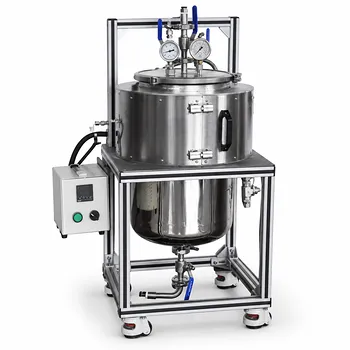
Hot Filtration Educational Unit Operations Pilot Plant Laboratory System

Hot Filtration Educational Unit Operations Pilot Plant Laboratory System

This integrated laboratory bench-scale hot filtration pilot plant enables students to study solid-liquid separation under thermal conditions, featuring a stainless steel vessel, removable heating jacket, and multi-layer filter plates for unit operations education, ideal for chemical engineering laboratory curriculum.

Constant Pressure Filtration Educational Unit Operations Pilot Plant

Constant Pressure Filtration Educational Unit Operations Pilot Plant

Hands-on educational pilot plant for constant pressure filtration. Classic plate and frame filter press allows students to study kinetics, determine specific cake resistance, perform cake washing and evaluate washing rates. Ideal for chemical engineering curriculum. Mobile, customizable, safety-compliant design.

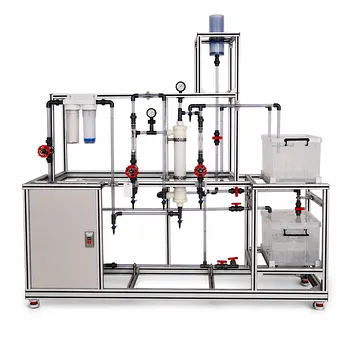
Ultrafiltration Membrane Separation Educational Pilot Plant

Ultrafiltration Membrane Separation Educational Pilot Plant

This ultrafiltration membrane separation educational pilot plant enables undergraduate students to process PVA solutions, study hollow fiber membrane dynamics, and perform quantitative analysis with spectrophotometry for hands-on learning of unit operations and industrial maintenance and membrane cleaning protocols.

Multifunctional Membrane Separation Educational Pilot Plant with Ultrafiltration, Nanofiltration, Reverse Osmosis

Multifunctional Membrane Separation Educational Pilot Plant with Ultrafiltration, Nanofiltration, Reverse Osmosis

An integrated laboratory bench-scale membrane separation system for higher education engineering labs combining Ultrafiltration, Nanofiltration, and Reverse Osmosis processes. Features industrial PLC control with touch-screen HMI, transparent piping, and academic assessment software. Ideal for chemical and environmental engineering curricula.

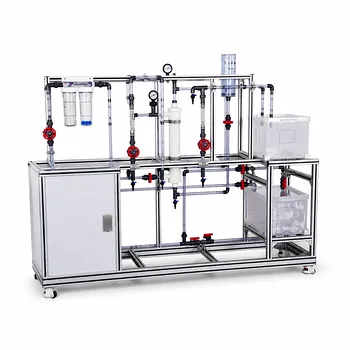
Hollow Fiber Ultrafiltration Membrane Separation Educational Pilot Plant

Hollow Fiber Ultrafiltration Membrane Separation Educational Pilot Plant

Explore our hollow fiber ultrafiltration membrane separation educational pilot plant for hands-on learning of industrial ultrafiltration processes, flux analysis, fouling mitigation, and process control. Compact, customizable, and built for engineering labs.

Multi-Functional Membrane Separation Educational Pilot Plant for Unit Operations Lab

Multi-Functional Membrane Separation Educational Pilot Plant for Unit Operations Lab

The Multi-functional Membrane Separation Educational Unit Operations Pilot Plant is an integrated bench-scale laboratory system designed for teaching undergraduate engineering education. It features Ultrafiltration, Nanofiltration, and Reverse Osmosis modules in a compact, mobile unit for practical hands-on learning.

Gas-Solid Heterogeneous Separation Demonstration Educational Unit Operations Pilot Plant

Gas-Solid Heterogeneous Separation Demonstration Educational Unit Operations Pilot Plant

Comprehensive visual transparent gas-solid separation pilot plant for chemical engineering labs. Demonstrates gravity settling inertial settling cyclone and bag filter technologies. Enables real-time analysis of fluid-particle mechanics pressure drop and collection efficiency. Ideal for undergraduate unit operations courses.

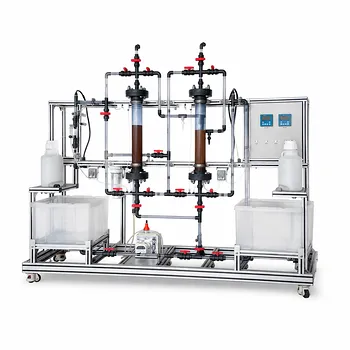
Ion Exchange Water Purification Educational Pilot Plant for Engineering Unit Operations

Ion Exchange Water Purification Educational Pilot Plant for Engineering Unit Operations

This bench-scale ion exchange pilot plant trains engineering students in water purification. Dual transparent columns simulate industrial softening and demineralization. Students observe fluid dynamics, perform resin regeneration, and analyze breakthrough curves. The corrosion-resistant frame ensures durability in unit operations experiments.

Continuous Batch Extractive Distillation Educational Pilot Plant

Continuous Batch Extractive Distillation Educational Pilot Plant

Versatile pilot plant for continuous, batch, and extractive distillation training. High-borosilicate glass column for visualizing hydraulics, 15.6-inch touchscreen with data logging, precise reflux ratio control 1-99, and durable corrosion-resistant frame. Ideal for chemical engineering education and process research.

Dual-Mode Rectification Pilot Plant for Practical Training Unit Operations

Dual-Mode Rectification Pilot Plant for Practical Training Unit Operations

Industrial-scale dual-mode rectification pilot plant for chemical engineering practical training. Features real-material and simulated-material operation modes, sieve-plate column with sight glasses for visual observation of hydrodynamics, and customizable SCADA control for safe, hands-on learning of unit operations and mass transfer.

Multi-Functional Special Distillation Educational Pilot Plant

Multi-Functional Special Distillation Educational Pilot Plant

Versatile multi-functional special distillation pilot plant for chemical engineering education. Supports continuous, vacuum, azeotropic, reactive, extractive distillation. Transparent glass columns enable real-time visual observation of hydrodynamics and separation processes.

Electrolyte Distillation Purification and Formulation Educational Pilot Plant

Electrolyte Distillation Purification and Formulation Educational Pilot Plant

Integrated bench-to-pilot scale educational pilot plant for electrolyte distillation, purification, and formulation with borosilicate glass construction, PLC automation, touchscreen HMI, and advanced industrial safety features for hands-on chemical process training, ideal for chemical engineering and materials science curricula.

Green Anhydrous Ethanol Refining Practical Training Pilot Plant

Green Anhydrous Ethanol Refining Practical Training Pilot Plant

Advanced integrated pilot plant for university labs demonstrating extractive distillation to produce high-purity absolute ethanol from crude feedstock, featuring multi-column continuous operation, closed-loop solvent recycling, and customizable controls for hands-on engineering education, ideal for chemical engineering training and research.

Multi Functional Membrane Crystallization Educational Unit Operations Pilot Plant

Multi Functional Membrane Crystallization Educational Unit Operations Pilot Plant

Integrated bench-scale membrane crystallization pilot plant for engineering education. Provides hands-on training in advanced separation technologies, combining membrane distillation crystallization and process intensification. Features variable scaling vessels, industrial-grade flow control, and interactive digital data acquisition. Customizable for university labs.

Bio-fermentation Ethanol Production Practical Training Unit Operations Pilot Plant

Bio-fermentation Ethanol Production Practical Training Unit Operations Pilot Plant

Bio-fermentation ethanol production pilot plant for hands-on training in unit operations: fermentation, solid-liquid filtration, membrane separation, and distillation. Bridges theory with industrial practice using industrial-grade components, customizable for university labs. Hybrid automated and manual control for comprehensive learning.

Fixed-Bed Chemical Reaction and Gas Dust Tar Removal Unit Operations Pilot Plant

Fixed-Bed Chemical Reaction and Gas Dust Tar Removal Unit Operations Pilot Plant

Integrated educational pilot plant for studying catalytic gas-solid reactions and downstream gas purification. Features dual fixed-bed reactor, three-stage heating, and touchscreen control for hands-on engineering training. Ideal for chemical and environmental engineering curricula.

Natural Product Extraction Unit Operations Training Pilot Plant

Natural Product Extraction Unit Operations Training Pilot Plant

Integrated natural product extraction pilot plant for chemical engineering training bridges theory and industrial practice with modular extraction and evaporation/concentration units, hybrid touchscreen and manual control, realistic process simulation, and self-contained softened water and vacuum utilities.

Centrifugal Pump Performance and Orifice Flowmeter Calibration Educational Pilot Plant

Centrifugal Pump Performance and Orifice Flowmeter Calibration Educational Pilot Plant

This versatile educational pilot plant enables engineering students to conduct centrifugal pump performance tests, orifice flowmeter calibration, and fluid mechanics experiments using a transparent flow loop, industrial HMI, and 3D virtual simulation for a comprehensive hands-on learning experience.

Orifice and Venturi Flowmeter Calibration Educational Pilot Plant for Fluid Mechanics Laboratory

Orifice and Venturi Flowmeter Calibration Educational Pilot Plant for Fluid Mechanics Laboratory

Enhance fluid dynamics education with the Orifice and Venturi Flowmeter Calibration Educational Unit Operations Pilot Plant, featuring transparent orifice and Venturi meters, industrial sensors, touchscreen interface for real-time data analysis and automatic coefficient calculations in engineering student laboratories.

Ethyl Acetate Synthesis Unit Operations Pilot Plant for Practical Training

Ethyl Acetate Synthesis Unit Operations Pilot Plant for Practical Training

Modular and customizable pilot plant for ethyl acetate synthesis practical training. Integrates esterification reaction, liquid-liquid extraction, neutralization, and sieve-plate distillation unit operations. Bridging theory and real-world industrial processes. Designed for university chemical engineering labs


Leave Your Message