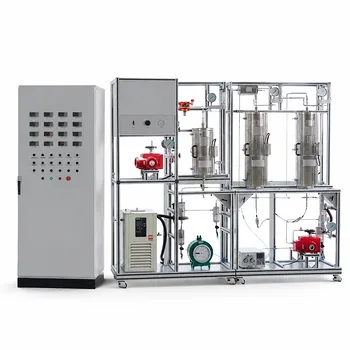
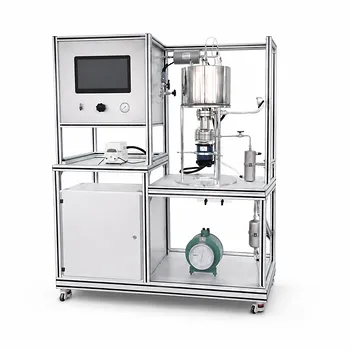
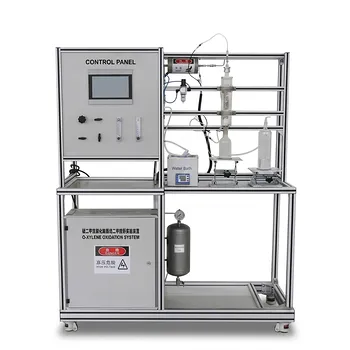
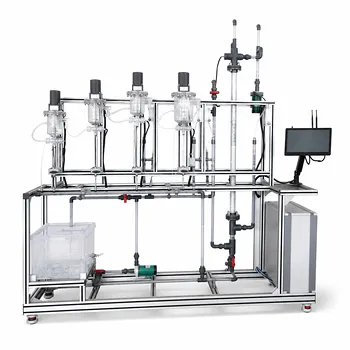
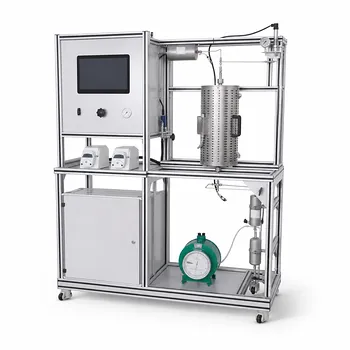
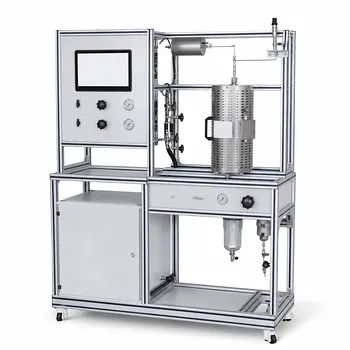
Selecting the right reactor for nitration training is fundamentally about reconciling the most demanding safety hazards with your core educational goals. For a unit operations pilot plant dedicated to nitration reactions, the choice between batch and continuous reactors hinges on three decisive factors: thermal safety, training flexibility, and modern industrial relevance. Continuous reactors, such as multi-stage CSTRs, tubular, or loop reactors, offer superior heat dissipation and minimize the online volume of explosive materials, making them the safest and most directly transferable demonstration of current industrial best practices. Batch reactors, while posing a greater inherent risk due to the accumulation of reactants, provide an irreplaceable platform for teaching critical safety strategies like semi-batch feeding control and reaction kinetics that are essential for any process engineer to master.
When choosing a reactor for nitration training, safety is not just a priority—it is the filter that eliminates dangerous options. The best choice is rarely a single mode; it is a calculated combination that uses continuous systems to instill a safety-first culture and modern engineering habits, while leveraging batch capabilities to teach the profound dangers of runaway reactions and the nuanced techniques used to control them.
Understanding the Critical Hazard: Nitration’s Exothermic Nature
Why Heat Management Dictates Your Reactor Choice
Nitration reactions are notoriously fast and highly exothermic, routinely releasing over 100 kJ/mol. This immense heat generation means that the ability to remove heat from the reacting mass is the single greatest determinant of a safe operation. A failure in heat removal can lead to a rapid temperature rise, decomposition of products, and a catastrophic thermal runaway.
The Inventory Problem: Why Smaller Volumes Are Safer
A direct consequence of high exothermicity is that the volume of reacting material you have online at any moment is a direct proxy for your risk exposure. A large, batch-level inventory of nitrating mixture represents a massive potential energy release. The primary safety philosophy, therefore, is to minimize this hazardous inventory.
How Each Reactor Mode Aligns with Safety and Training
The Inherent Safety Advantage of Continuous Reactors
Continuous reactors, by design, excel at inventory minimization and steady-state heat transfer. Reactants are fed and products withdrawn in small, constant volumes. This means the heat generation rate is constant and predictable, allowing for precise temperature control. The superior heat transfer area-to-volume ratio in tubular and microreactor systems makes them the safest technical solution for nitration. For training, this showcases automated process control, flow chemistry principles, and the direct industrial path to process intensification.
The Flexible, High-Insight World of Batch and Semi-Batch Reactors
While a pure batch mode—where all reactants are charged at once—is outright dangerous for nitration, a semi-batch reactor is a controlled, teachable environment for hazard mitigation. Here, one reactant (usually the substrate) is charged initially, and the other (the nitrating agent) is added slowly. This strategic feeding limits the instantaneous reaction rate and prevents accumulation, directly demonstrating how to avoid runaways. The batch vessel’s versatility is unparalleled for teaching different addition strategies—positive, reverse, and co-addition—and for measuring classic reaction kinetics across a full cycle.
The Core Decision-Drivers: A Detailed Breakdown
Safety Versus Demonstrative Value
Your primary reference is clear: safety and heat transfer efficiency are paramount. If absolute safety and demonstration of state-of-the-art processing are the goals, a continuous reactor system is non-negotiable. It represents the modern industrial standard for hazardous chemistry. However, the deep educational need is to train engineers to understand why runaways happen and how to stop them. A batch-based semi-batch experiment, operated under strict supervision and with rigorous safety protocols, transforms a theoretical hazard into a visceral, practical lesson that a perfectly steady continuous system may gloss over.
Process Control and Automation Skills
Continuous pilot plants are fundamentally integrated with automated control loops—flow, pressure, and temperature controllers—that are the backbone of modern 24/7 manufacturing. Training on these systems builds competence in steady-state operation, residence time distribution, and lean manufacturing principles. Batch systems teach the intricacies of dynamic, time-dependent control, such as managing a temperature spike during a feeding profile, which develops a deeply intuitive sense of process dynamics.
Flexibility and Total Cost of Ownership
A single batch reactor can run dozens of different nitration recipes or even non-nitrification experiments with simple cleaning, making it a highly cost-effective platform for a multi-product, teaching-focused curriculum. Its lower initial capital cost is attractive for budget-constrained pilot plants. Continuous systems, while offering lower operating costs per unit of product in a dedicated production line, require a higher initial investment and are less flexible for frequent switches between vastly different training goals.
Understanding the Trade-offs
The Illusion of Perfect Safety in Each Mode
No single mode eliminates risk. A continuous reactor, while minimizing online inventory, can suffer from fouling or flow blockages that create localized hot spots. A semi-batch reactor is only as safe as its operator’s ability to follow a strict addition protocol and the reliability of its emergency quenching system. Do not let the superior heat transfer of a continuous system breed complacency in the curriculum. The most valuable training program explicitly teaches the failure modes of both designs.
Pedagogical Blind Spots
A pilot plant solely equipped with continuous reactors will produce engineers who struggle to analyze the cooling failure scenario for a large, agitated vessel—a scenario still entirely possible in the broader chemical industry. Conversely, a batch-only lab fails to prepare students for the reality of integrated, continuous manufacturing platforms that dominate modern pharmaceutical and fine chemical production. The deepest need is not to choose one, but to understand the critical skills each fails to teach.
The Trap of Oversimplification
It is a common mistake to label batch as "old" and continuous as "new." For nitration specifically, the industry has used continuous nitration for decades for safety reasons. The cutting-edge difference today is the level of process intensification and modularity. Frame your training plant not around an outdated-versus-modern battle, but around a risk-based decision framework: "Given this specific reaction enthalpy and kinetic profile, which operation mode provides the safest and most controllable environment?"
Making the Right Choice for Your Training Goal
The optimal pilot plant for nitration training is almost always a hybrid system that allows direct comparison, or a carefully justified single choice based on your primary mission.
- If your primary focus is instilling a modern safety culture and demonstrating industrial-scale continuous manufacturing: Select a continuous reactor—preferably a tubular or microreactor system with integrated automation. Use supplementary lecture or simulation modules to cover semi-batch runaway analysis.
- If your primary focus is studying the fundamental reaction kinetics and teaching operators how to control hazardous reactions at the bench scale: Choose a highly instrumented, semi-batch reactor that allows for precise calorimetry and detailed study of various feeding modes, with a strong emphasis on hazard identification and emergency response protocols.
- If your primary focus is developing a comprehensive vocational training program that mirrors the full industrial reality: Invest in a hybrid pilot plant. Use the continuous unit to teach steady-state operations, efficiency, and process control, and use the batch unit to teach the transient dynamics of startup, shutdown, and the critical safety discipline required when a reaction must be contained within a single vessel.
Ultimately, the right choice is the one that most faithfully teaches that the reactor configuration is a tool for risk management, and the pen-and-paper understanding of nitration's thermal hazards must come long before anyone touches a valve.
Summary Table:
| Comparison Factor | Batch / Semi-Batch Reactor | Continuous Reactor |
|---|---|---|
| Safety & Heat Control | Higher hazard risk; requires strict feed control | Inherent safety; superior heat dissipation & low online inventory |
| Key Training Focus | Runaway dynamics, reaction kinetics, transient control | Process automation, steady-state flow, process intensification |
| Flexibility & Cost | High recipe flexibility, lower capital investment | Dedicated process setups, higher initial cost |
Bring Industrial Realism to Your Lab with LABPARK
Equipping your training facility with the right reactor setup is critical for student safety and career readiness. LABPARK designs and manufactures premium Educational and Vocational Unit Operations Pilot Plants in chemical engineering, bioprocess & biotech, and environmental & water treatment. Specially built for universities, research institutes, and enterprises, our modular pilot plants allow you to safely teach both complex batch kinetics and advanced continuous automation.
Ready to optimize your training curriculum? Contact LABPARK today to discuss your project requirements!
Related Products
- Fixed-Bed Chemical Reaction and Gas Dust Tar Removal Unit Operations Pilot Plant
- 100L Continuous Loop Hydrogenation Educational Unit Operations Pilot Plant
- Methane Cracking Educational Unit Operations Pilot Plant
- Multi-Reactor Educational Pilot Plant for Reaction Engineering Unit Operations
- Methanol Synthesis and Catalyst Performance Evaluation Educational Unit Operations Pilot Plant
People Also Ask
- When to transition from PID to adaptive control in pilot plants? Key process indicators.
- How do deviations in estimating latent heat impact pilot plant thermal systems? Avoid hardware mis-sizing.
- Why Compare Predicted and Experimental Excess Enthalpy? Key to Accurate Pilot Plant Scale-up
- How to study gasification in pilot plants? Compare exit gas composition & efficiency
- Why Use PTFE & Hastelloy in Chemical Pilot Plants? Prevent Corrosion & Ensure Safety