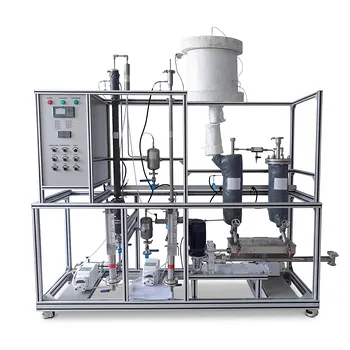
Distillation and dehydration are the twin pillars of anhydrous bioethanol production.
To transform a dilute fermentation broth into fuel-grade 99.9 wt% anhydrous ethanol, you need two distinct downstream separation stages. First, a fractional distillation column concentrates the ethanol to its azeotropic limit of roughly 96 wt%. Second, a dehydration unit—most commonly a molecular sieve adsorption column operating via pressure swing adsorption—breaks the azeotrope and removes the final 4% of water. In a distillation pilot plant, these are configured as a continuous beer‑stripping and rectification column directly coupled with zeolite molecular sieve beds, giving students and researchers a full-scale view of the thermodynamics and process dynamics involved.
The ethanol‑water azeotrope imposes a hard thermodynamic ceiling on ordinary distillation. Pilot‑scale bioethanol purification therefore mirrors industrial practice by integrating a fractionating “beer column” with a downstream molecular sieve or membrane dehydration step, creating a seamless loop that demonstrates both the limitation and the engineering solution in a single platform.
Why a Single Distillation Column Isn’t Enough
The Azeotropic Barrier
At atmospheric pressure, ethanol and water form a minimum‑boiling azeotrope at approximately 96 wt% ethanol.
No amount of additional reflux or trays in a conventional fractional column can push purity beyond this point.
The vapor phase composition at the azeotrope is identical to the liquid, making further enrichment by distillation impossible.
What the Fermentation Broth Actually Looks Like
Raw fermentation broth typically contains only 6‑10 wt% ethanol, along with water, residual sugars, yeast cells, and minor fermentation by‑products like fusel oils and organic acids.
In continuous processes, the broth is often first processed through a yeast‑recycling separator (e.g., a hydrocyclone or centrifuge) to maintain high fermenter productivity.
The resulting liquid stream—still very dilute—then enters the distillation cascade.
The Two‑Stage Separation Architecture
Stage 1: The Beer Column and Rectification Section
The first unit operation is a fractional distillation column (often called a “beer column”) that does the heavy lifting.
It strips ethanol from the aqueous feed and concentrates it to near‑azeotropic composition.
In pilot‑plant configurations, this column frequently incorporates a stripping section to remove light ends and a rectifying section to separate heavier fusel oils, ensuring the overhead product is free of organoleptic impurities.
The column is equipped with adjustable feed points and a controlled reflux loop.
Students can manipulate the reflux ratio to see its direct impact on distillate purity and energy consumption—an essential teaching tool for process optimization.
Stage 2: Dehydration – Breaking the Azeotrope
Once the ethanol has reached ~96 wt%, the dehydration unit takes over.
The predominant technology in modern educational pilot plants is zeolite molecular sieve adsorption using pressure swing adsorption (PSA).
Water molecules are selectively trapped in the pores of the zeolite while ethanol vapor passes through, yielding an anhydrous product that easily meets the 99.9 wt% specification.
How a Molecular Sieve Dryer Is Integrated
In a continuous setup, the distillate from the rectification column is vaporized and sent to one of two (or more) adsorption beds.
While one bed is in adsorption mode, the other is regenerating under vacuum or with a purge gas.
This cyclic operation lets students observe adsorption breakthrough curves and learn regeneration‑energy trade‑offs directly on the plant.
Alternative Dehydration: Pervaporation Membranes
Some pilot plants opt for pervaporation membrane units instead of molecular sieves.
A hydrophilic membrane selectively permeates water under vacuum, achieving the same azeotrope‑breaking effect.
This configuration highlights mass‑transfer principles and offers a cleaner, chemical‑free alternative to older azeotropic distillation methods that used entrainers like benzene.
Distillation Pilot‑Plant Configuration in Practice
Modular and Continuous Operation
Educational pilot plants are usually built on a modular skid with flexible piping.
The distillation column can be run in batch or continuous mode by redirecting feed streams and collection vessels.
Continuous operation, where fermenter broth is fed steadily into the beer column, best mimics industrial bioethanol facilities and provides a realistic platform for studying column hydraulics, pressure drop, and tray efficiency.
Addressing Height Constraints with Dual Columns
When the required number of theoretical trays exceeds a single‑column height limit, the pilot plant can be split into two separate columns in series.
The bottoms of the first column feed the top of the second, while vapor from the second returns to the first.
This design reduces overall pressure drop and allows safe operation at moderate reboiler temperatures, which is especially valuable when the plant is later reconfigured for vacuum distillation of other products.
Essential Control Parameters for Learning
- Reflux ratio – directly ties product purity to energy input.
- Reboiler duty – demonstrates heat‑integration trade‑offs.
- Adsorption bed timing – teaches dynamic process scheduling and regeneration efficiency.
- Column pressure and temperature profiles – visualize the separation path and detect flooding or weeping.
Understanding the Trade‑offs
Molecular Sieves vs. Pervaporation
Molecular sieve PSA systems are rugged and regenerate reliably, but they require a supply of dry regeneration gas and have a higher thermal energy demand.
Pervaporation membranes offer continuous, compact dehydration with potentially lower heat consumption, yet they are sensitive to fouling and may need periodic cleaning or replacement.
Pilot‑plant designers often choose the technology that best fits their research focus: adsorption thermodynamics or membrane‑mass‑transfer dynamics.
Energy and Cost Considerations
The distillation column accounts for the bulk of the energy consumption—typically 50‑70% of the total purification cost.
Integrating a heat recovery system (e.g., using the hot bottoms stream to preheat the feed) can dramatically cut operating costs, and pilot plants frequently include shell‑and‑tube heat exchangers to demonstrate these thermal integration principles.
Safety and Chemical Exposure
Older azeotropic distillation methods using entrainers like benzene can still be found in some pilot units, but they are being phased out due to carcinogenicity and environmental concerns.
Modern educational plants almost exclusively use molecular sieves or pervaporation to teach the same unit operation fundamentals in a safer, greener environment.
How to Apply This to Your Project
The right downstream configuration depends on what you want your pilot plant to emphasize. Use the goals below to guide your design.
- If your primary focus is teaching thermodynamic separations: Use a single continuous beer‑stripping column coupled with a molecular sieve PSA unit. This clearly demonstrates both the azeotropic limitation and the adsorption break‑through principle.
- If your primary focus is process control and automation: Integrate multiple feedstock points, adjustable reflux loops, and timed adsorption bed switching valves. This creates a rich data environment for PID tuning and cycle‑optimization experiments.
- If your primary focus is alternative dehydration technologies: Substitute the molecular sieve beds with a pervaporation membrane module. This allows side‑by‑side comparison of energy consumption and product purity with the same distillation front‑end.
- If your primary focus is a complete bioprocess workflow: Include a hydrocyclone or centrifuge for continuous yeast recycling ahead of the distillation column, creating a closed‑loop system from fermenter to anhydrous ethanol storage.
A well‑designed pilot plant lets you isolate each unit operation while never losing sight of the integrated whole—exactly the insight that transforms theoretical knowledge into practical engineering judgment.
Summary Table:
| Separation Stage | Core Technology | Feed Concentration | Product Concentration | Primary Role |
|---|---|---|---|---|
| Stage 1: Distillation | Fractional Distillation (Beer Column) | 6–10 wt% ethanol | ~96 wt% (Azeotrope) | Concentrates dilute feed & strips light/heavy impurities. |
| Stage 2: Dehydration | Pressure Swing Adsorption (PSA) / Pervaporation | ~96 wt% ethanol | 99.9 wt% (Anhydrous) | Breaks the water-ethanol azeotrope by selectively removing water. |
Bring Industrial-Scale Bioethanol Separation to Your Lab
Are you looking to bridge the gap between thermodynamic theory and practical engineering? LABPARK designs and manufactures high-performance Educational and Vocational Unit Operations Pilot Plants in chemical engineering, bioprocess & biotech, and environmental & water treatment.
We empower universities, research institutes, and enterprises with robust, modular, and safe pilot systems tailored for hands-on learning and advanced research. Let us help you configure the ideal distillation and dehydration setup for your curriculum or pilot trials.
Contact LABPARK Today to request a customized technical proposal for your lab!
Related Products
- Green Anhydrous Ethanol Refining Practical Training Pilot Plant
- Green Anhydrous Ethanol Purification Extractive Distillation Unit Operations Training Pilot Plant
- Bio-fermentation Ethanol Production Practical Training Unit Operations Pilot Plant
- Continuous Sieve-Plate Distillation Pilot Plant for Unit Operations Laboratory Education
- Multi-Functional Special Distillation Educational Pilot Plant
People Also Ask
- How do deviation & overshoot serve as quality indicators in pilot plant control loop tuning?
- How is settling time measured on chemical engineering pilot plants? Master process control dynamics.
- How Batch vs. Continuous Pilot Plants Affect Polymer Distribution: Reactor Selection Guide
- What parameters are critical when teaching reactor mechanical design and safety? Key Pilot Plant Metrics
- How to Integrate Spectroscopy in Distillation Pilot Plants for Advanced Process Control