The choice directly re‑writes the polymer’s molecular “fingerprint.”
Operating a polymerization pilot plant in batch versus continuous mode—even with identical chemistry—produces markedly different polymer product distributions. The root cause is the residence‑time distribution: batch reactors give all chains the same reaction time (narrow distribution), while continuous stirred tanks blend short‑ and long‑lived chains, broadening the molecular weight spread. This single difference cascades through mixing, heat transfer, and recycle dynamics to alter chain length, composition, and ultimately end‑use performance.
Batch vs. continuous isn’t a subtle knob—it’s a fundamental switch that determines whether you teach the chemistry of a single recipe or the physics of steady‑state, industrially relevant process control. The resulting polymer distribution becomes your primary evidence of how reactor engineering shapes material identity.
The Fundamental Reactor Difference
How Residence‑Time Distribution Shapes Polymer Chains
In a batch reactor, all growing polymer chains start at the same instant and spend exactly the same time in the vessel. The molecular weight distribution (MWD) is governed purely by kinetics: initiation, propagation, and termination probabilities.
In a continuous stirred‑tank reactor (CSTR), incoming feed mixes instantly with material that entered minutes ago. Some chains exit almost immediately, while others linger. This spread in residence time directly widens the MWD, often producing a high‑molecular‑weight tail that a batch reactor would not.
The Critical Interplay of Chain Lifetime and Reactor Type
The effect is not universal—it depends on a polymer chain’s mean lifetime versus the reactor’s mean residence time.
When chain lifetime is long (e.g., anionic or step‑growth polymerization in a CSTR), the continuous outflow acts as an additional termination event, forcibly removing still‑growing chains. This creates a dramatically broader MWD than in batch—Denbigh’s rule predicts a polydispersity index that can double.
When chain lifetime is extremely short (e.g., free‑radical polymerization), the reverse happens: moving from batch to a CSTR narrows the MWD. In batch, the monomer depletes over time, causing the instantaneous chain length to drift; the CSTR’s steady‑state composition eliminates that drift, tightening the distribution.
Why This Matters in a Training Pilot Plant
Reproducibility and Quality Control
A batch pilot plant teaches the demands of reproducing a product lot by lot. Students see how subtle variations in heating profiles or initiator addition create batch‑to‑batch variation, a critical lesson for specialty polymers where every grade must meet a narrow specification.
A continuous pilot plant demonstrates how steady‑state operation delivers invariant product quality hour after hour—provided the control loops are tuned. The polymer’s product distribution becomes a direct readout of process stability.
Demonstrating Fundamental Principles vs Industrial Practice
Batch configurations remain the go‑to for teaching reaction kinetics fundamentals, allowing students to trace concentration‑time curves and validate rate laws.
Continuous setups shift the focus to residence‑time distribution, recycle streams, and heat management across reactor zones. For vocational training, a pilot plant that can switch from batch to continuous (e.g., a stirred tank that can be run as a CSTR) lets learners touch both worlds, seeing first‑hand how the same chemistry yields dissimilar polymers simply because of how material flows.
Comparing Modeling Approaches
Transient Kinetics in Batch
In a batch pilot plant, the modeling follows transient mass balances from initial monomer and initiator concentrations. The time‑evolution of the MWD is computed directly, giving students a precise narrative of how every polymer chain is born, grows, and dies.
This approach excels at predicting gelation points and compositional drift in copolymers—vital knowledge when designing new recipes.
Steady‑State Simulation in Continuous
Continuous reactors are naturally modeled using a steady‑state mass balance that incorporates the flow terms. The MWD be computed as a static function of the mean residence time and kinetic constants.
This explicit representation makes it easier to optimize throughput and reactor size, and it teaches students how to link measurable outputs (viscosity, conversion) back to the underlying chain‑building chemistry.
Understanding the Trade‑offs
Flexibility vs. Consistency
A batch pilot plant can produce dozens of different polymer grades in the same vessel with simple clean‑outs—ideal for a teaching lab that rotates experiments weekly. However, its product distribution will always carry the fingerprints of heating ramps and manual injection timing.
A continuous plant delivers consistent product but demands significant time to reach steady state and is far less flexible for frequent recipe changes. It forces students to learn process automation and real‑time analytical control loops.
The Cost of Complexity: Control and Scale‑Up
Batch units are lower in upfront capital for small‑scale training and are easier to sterilize for bio‑hybrid polymer synthesis. Yet they have lower reactor utilization and can hide scale‑up pitfalls.
Continuous pilot plants mimic the relentless 24/7 operation of industry, featuring 90‑95% utilization and requiring sophisticated level, temperature, and flow controls. The penalty is higher initial cost and a steeper learning curve for undergraduates, but the reward is a direct bridge to process engineering roles.
Making the Right Choice for Your Training Goal
- If your primary focus is teaching fundamental polymerization kinetics and recipe flexibility: choose a batch reactor configuration. It lets students manipulate one variable at a time and measure the resulting MWD with clear cause‑and‑effect.
- If your primary focus is demonstrating steady‑state process control and industrial reproducibility: choose a continuous stirred‑tank or tubular reactor. The product distribution becomes a live report card on how well students manage residence time, recycle, and heat removal.
- If your goal is comprehensive vocational training that mirrors real production lines: invest in a hybrid pilot plant that pairs a batch reactor with continuous downstream units (e.g., continuous distillation columns or dryers) and offers a switchable polymerization vessel. This teaches how a batch recipe’s “recipe‑driven” distribution must be supported by steady‑state separation processes.
You are not simply choosing a piece of equipment—you are choosing the story that product distribution will tell about chemical engineering fundamentals.
Summary Table:
| Feature | Batch Configuration | Continuous Configuration (CSTR) |
|---|---|---|
| Residence-Time Distribution | Uniform (all chains react for the same time) | Broad (mixes short- and long-lived chains) |
| Molecular Weight Control | MWD drifts as monomers deplete over time | Steady-state eliminates drift, tightening MWD |
| Teaching Focus | Reaction kinetics and recipe manipulation | Steady-state control, recycle, and heat management |
| Operational Advantage | Highly flexible; easy clean-outs for multiple grades | Consistent quality; teaches industrial automation |
Equip Your Lab with Industry-Ready Training Systems
Choosing the right reactor configuration is key to preparing the next generation of engineers. LABPARK designs and delivers state-of-the-art Educational and Vocational Unit Operations Pilot Plants in chemical engineering, bioprocess & biotech, and environmental & water treatment.
Whether you are representing a university, research institute, or enterprise, our systems offer the ideal hands-on platform to bridge the gap between academic theory and industrial reality.
Contact LABPARK Today to Discuss Your Training Goals
Related Products
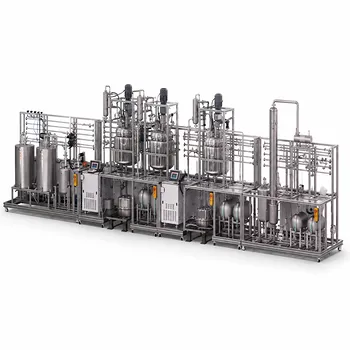
- Multi-Reactor Educational Pilot Plant for Reaction Engineering Unit Operations
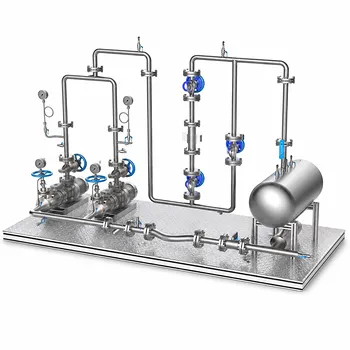
- Multi Pump Fluid Transport Process Piping Unit Operations Training Pilot Plant
- Green Anhydrous Ethanol Refining Practical Training Pilot Plant
- Natural Product Extraction Unit Operations Training Pilot Plant
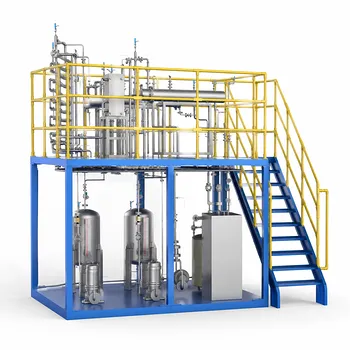
- Multi-Functional Special Distillation Educational Pilot Plant
People Also Ask
- How do educational unit operations pilot plants address safety and waste management when scaling up?
- How do educational unit operations pilot plants bridge theory and design? Bridge the Engineering Gap
- Why Compare Predicted and Experimental Excess Enthalpy? Key to Accurate Pilot Plant Scale-up
- How to study gasification in pilot plants? Compare exit gas composition & efficiency
- Why Use PTFE & Hastelloy in Chemical Pilot Plants? Prevent Corrosion & Ensure Safety