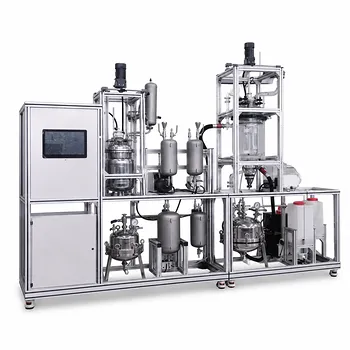
The core challenge is unpredictability. Multicomponent mixtures of hydrocarbons, alcohols, and acids defy standard predictive models in extraction and distillation pilot plants. Their non-ideal, polar-nonpolar nature can spontaneously generate multiple liquid or solid phases, shifting azeotropes, and severe emulsion problems that render purely mathematical stage calculations unreliable. Forced empirical testing in a physical pilot plant is therefore not just recommended—it is often the only way to observe actual mass transfer, identify operational bottlenecks, and gather credible data for scale-up.
The fundamental difficulty is that classical thermodynamics and shortcut design methods collapse when faced with the strong hydrogen bonding and phase splitting common to these oxygenated/hydrocarbon systems. A pilot plant becomes the definitive diagnostic tool, revealing hidden separation barriers like stubborn emulsions and unpredictable phase distributions that no simulator can reliably forecast.
The Fundamental Problem: When Equations of State Fail
Standard phase equilibrium calculations assume a predictable distribution of each component between vapour and liquid, or between two liquid phases. Oxygenated mixtures completely undermine this premise.
The Polar-Nonpolar Divide
Hydrocarbons are non-polar. Alcohols and organic acids are strongly polar and capable of hydrogen bonding. This creates extreme non-ideality in the liquid phase.
An equation of state fitted to pure-component data will often predict an adequately smooth distillation curve. In reality, the mixture can separate into two immiscible liquid phases on a tray or inside an extractor, trapping components and severely degrading separation efficiency.
The Azeotrope Explosion
Alcohols form azeotropes with water, with hydrocarbons, and even with acids. A ternary system can therefore contain multiple azeotropic boundaries that do not show up in simplistic binary interaction parameters.
This turns the nominal “boiling point order” into a deceptive sequence. A component that should distill overhead by pure-component vapour pressure may instead be held in the feed stage by a low-boiling azeotrope, forcing operators to re-plan product cuts in real time.
Chemical Association in the Vapour Phase
Carboxylic acids, such as acetic acid, famously dimerize in the vapour phase. This distorts the true molecular weight and vapour density. A pilot plant’s top-column temperature might therefore flatline or drift unexpectedly as the acid concentration changes, misleading the operator if they rely on standard saturated-vapour curves.
The Real-World Impact on Distillation Pilot Plants
The theoretical chaos translates into very tangible operational headaches the moment you put this feed into a distillation column.
Making a Mockery of Shortcut Design Tools
In a near-ideal system, you can estimate splits using a log-log plot of distillate-to-bottoms ratio (d/b) versus relative volatility (alpha). You plot your light key and heavy key points, draw a straight line, and read off the nonkey splits. With alcohols and acids present, that line is not straight. Relative volatility changes sharply with concentration, making the Fenske-Underwood-Gilliland shortcut assumptions invalid. The column performance you predicted on paper may be off by multiple theoretical stages.
The Art of Cut-Time Determination
A batch distillation pilot plant is a core research tool for these mixtures. Operators stabilize the column under total reflux, then collect product fractions sequentially. In an ideal system, a sharp temperature rise signals the end of a cut.
With these complex mixtures, the top temperature often drifts through prolonged intermediate zones where no single component dominates. The operator must collect large “transition cuts”—intermediate fractions of mixed adjacent components—and recycle them into later batches. Deciding the exact moment to start and stop a cut becomes a trial-and-error art, not a graph-reading exercise.
The Recycle Loop Burden
The transition cuts grow in volume as the mixture’s non-ideality increases. The pilot plant’s logistical bottleneck shifts from the distillation column itself to the storage and handling of these off-spec fractions. A feed that looked simple—three or four components—can balloon into a recycling flowsheet with several intermediate tanks, adding to the experiment’s time and cost.
The Additional Burden in Liquid-Liquid Extraction
When the separation moves to an extraction column, the same chemistry creates a specific set of operational nightmares.
Emulsion: The Silent Run-Stopper
Alcohols and acids act as surface-active agents. They stabilize a rag layer of emulsion at the liquid-liquid interface inside the extractor. Instead of a clean coalescence zone, you get a growing band of disengaged droplets that drags one phase into the outlet of the other. This renders the plant inoperable and can take days of adjusting pH, salt concentration, or temperature to resolve—none of which is predicted by a phase-equilibrium model.
Shifting Distribution Coefficients
The partition coefficient of the acid or alcohol between the organic and aqueous phases is strongly concentration-dependent. As the solute transfers, the extract’s solvency power changes, altering the distribution of the other components. The extraction profile you measured in a shaking funnel with dilute solutions will not match the continuous counter-current column performance, forcing a full pilot-scale mapping of the concentration profile.
Understanding the Trade-offs of Empirical Pilot Testing
The only reliable answer is to run the physical pilot plant, but this solution carries its own set of limitations that must be managed transparently.
Data That Does Not Scale Linearly
A pilot-scale column can reveal the exact minimum stirrer speed or temperature at which an emulsion breaks, but that critical energy dissipation rate does not scale predictably to a plant-scale vessel. What works perfectly in a 50 mm column can fail in a 2 m column because the local shear environment is fundamentally different. The data is essential, but it must be viewed as a calibration point for a scale-aware model, not a turnkey recipe.
The Cost of Iterative Learning
Because no model can predict the optimal operating window, the pilot program becomes iterative. You run the column, discover an unexpected azeotropic boundary, reformulate the feed or change the solvent, and run again. Each cycle burns raw materials and operator time. Overpromising a timeline based on ideal-mixture assumptions is a classic mistake.
The Trap of One-Feed Optimization
You meticulously map the separation for a feed containing 10% acetic acid, 20% ethanol, and 70% hexane. Then the upstream process drifts to 8% acetic acid and 22% ethanol. The carefully tuned cut-times and solvent ratios shift; the column may flood or the extraction may lose product yield. The pilot plant delivers a deep but narrow truth. Robustness testing across a feed composition range must be part of the scope from the start.
Making the Right Choice for Your Pilot Plant Campaign
The path forward depends entirely on your specific goal. There is no universal “best” method, only the right focus for your development stage.
- If your primary focus is confirming basic separation feasibility: Start with a batch distillation pilot plant in total reflux. Observe the temperature profile and collect small cuts. If you hit a temperature plateau that doesn’t match any pure-component boiling point, you have identified a critical azeotrope that must be broken chemically or through pressure swing before further optimization.
- If your primary focus is designing an extraction column: Invest heavily in mini-plant runs with continuous recycle of the solvent. Do not rely on shake-flask partition coefficients. The pilot plant’s main value will be mapping the emulsion boundary, including the influence of trace impurities like corrosion products or salts, and defining the minimum residence time for phase disengagement.
- If your primary focus is training operators or students: Use this challenging mixture as an advanced exercise. Have them estimate cuts with the log-log d/b plot, let them see it fail, and then force them to rely on top-temperature inflection and on-stream composition analysis. The recycling of transition cuts will teach more about industrial logistics than any idealised simulation.
- If your primary focus is model development: Treat the pilot plant strictly as a truth source for parameter regression. Take detailed composition profiles from multiple stages, not just the end products. Use this data to fit the liquid-phase activity coefficient interaction parameters, discarding predictive models that cannot reproduce the internal profiles.
Empirical observation wins against theory every time with these tough, associative mixtures. The point is not to wish for a perfect predictive model, but to design a pilot program that surfaces the real separation barriers with time and budget to tackle them.
Summary Table:
| Challenge | Operational Impact | Pilot Plant Solution |
|---|---|---|
| Polar-Nonpolar Split | Extreme non-ideality; dual liquid phases trap components. | Continuous runs to map actual mass transfer. |
| Multiple Azeotropes | Shifts boiling sequences; standard shortcut models fail. | Batch runs at total reflux to spot temperature plateaus. |
| Emulsion & Phase Drag | Alcohols/acids stabilize interface; column flooding. | Empirical testing of pH, salt, and temperature adjustments. |
Master Complex Separations with LABPARK Pilot Plants
Navigating unpredictable multicomponent mixtures requires robust, real-world testing environments. LABPARK provides state-of-the-art Educational and Vocational Unit Operations Pilot Plants in chemical engineering, bioprocess & biotech, and environmental & water treatment. Designed specifically for universities, research institutes, and enterprises, our systems empower you to accurately map phase behavior, resolve emulsion issues, and scale up your processes with confidence.
Ready to optimize your separation processes? Contact our experts today to find the perfect pilot plant solution for your facility.
Related Products
- Continuous Batch Extractive Distillation Educational Pilot Plant
- Green Anhydrous Ethanol Purification Extractive Distillation Unit Operations Training Pilot Plant
- Green Anhydrous Ethanol Refining Practical Training Pilot Plant
- Multi-Functional Special Distillation Educational Pilot Plant
- Electrolyte Distillation Purification and Formulation Educational Pilot Plant
People Also Ask
- Wilson vs. UNIQUAC: How to Choose the Right Thermodynamic Model for Your Pilot Plant
- How to Configure a Distillation Pilot Plant? Key Steps for Multi-Mode Setup
- How does the feed thermal state influence distillation pilot plant design and utility consumption?
- Why use non-ideal VLE calculations in distillation pilot plants? Ensure accurate scale-up & purity
- How to Integrate Spectroscopy in Distillation Pilot Plants for Advanced Process Control