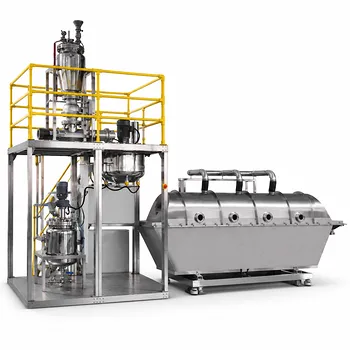
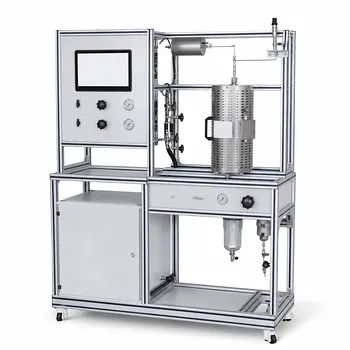
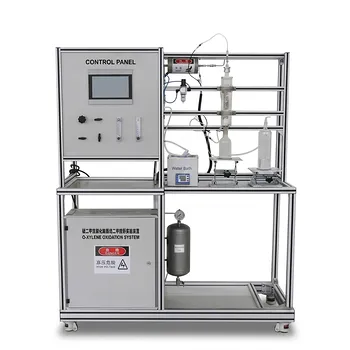
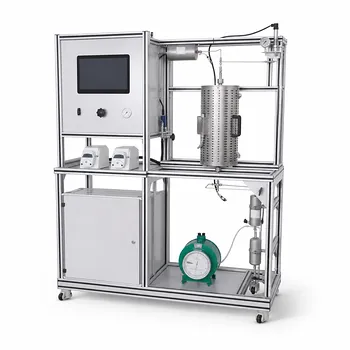
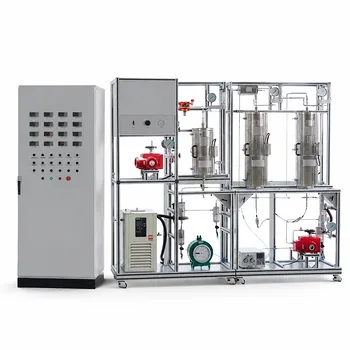
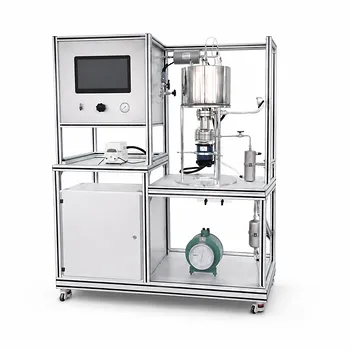
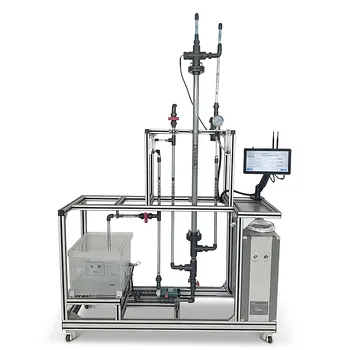
The core arsenal of any pilot-scale melt polymerization reactor rests on three specialized engineering pillars: high-torque agitation, precision thermal jackets, and deep vacuum capability.
These features are not luxuries—they are absolute necessities when simulating industrial processes where viscosity can soar to 600 Pa·s at 300°C. Without them, a pilot plant cannot reliably manage the steep heat transfer penalties and mixing dead zones that arise as molecular weight builds and byproducts like phenol must be continuously stripped away.
Melt polymerization creates a punishing environment where viscosity grows exponentially, turning the reaction medium into a near-solid that resists both flow and heat dissipation. The pilot reactor’s design therefore revolves around a single principle: keep the highly viscous fluid in uniform motion and rapidly remove heat and volatiles across clean, continuously swept surfaces.
The Unique Heat and Flow Challenge of Melt Polymerization
The Exponential Viscosity Trap
As monomer converts to polymer, the reaction medium transitions from a free‑flowing liquid to a viscoelastic melt that can exhibit pronounced non‑Newtonian behavior.
This dramatic viscosity increase slashes the convective heat transfer coefficient, making it far harder to carry away the exothermic heat of reaction.
Without aggressive intervention, localized hot spots develop, triggering auto‑acceleration (the gel effect) that can rapidly corrupt molecular weight distribution or even cause a thermal runaway.
Why Temperature Control Defines Product Quality
Uneven temperature during chain growth leads to broad polydispersity and may spur side reactions that taint the final polymer.
Pilot plants must therefore replicate the tight isothermal conditions of a commercial reactor—often ±2°C—even as the melt’s heat‑carrying capacity diminishes.
This demands heating/cooling jackets that respond instantly and a mixing system that continuously refreshes the fluid boundary layer against the heat transfer surface.
The Hidden Role of Vacuum in Melt Processes
In transesterification‑driven melt polymerizations, the equilibrium shift toward high molecular weight depends on removing volatile byproducts like phenol.
Failing to maintain sustained sub‑atmospheric pressure (often below 1 torr, ~130 Pa) leaves volatiles trapped in the viscous melt, effectively stalling the reaction.
A high‑performance vacuum system works in concert with agitation to expose fresh melt surface area, enabling efficient devolatilization even at extreme viscosities.
Essential Reactor Design Features for High‑Viscosity Service
High‑Torque Agitation That Never Stalls
A pilot reactor must be able to turn an impeller in a medium that can reach the consistency of thick honey or putty.
This rules out standard marine impellers; instead, the reactor relies on anchor, frame, or helical ribbon impellers that sweep close to the wall and generate bulk circulation.
The drive unit must deliver high torque at variable speeds—often through a hydraulic or heavy‑duty gearmotor—to avoid stalling when viscosity spikes and to allow gentle start‑up to protect the motor.
Precision Heating Jackets Built for 300°C and Beyond
The jacket must reach and hold process temperatures up to 300°C uniformly around the entire vessel.
Multi‑zone electrical or liquid‑phase heating with cascade control is typical; each zone responds independently to local temperature sensors embedded in the wall.
Rapid cooling capability is equally important. Sudden cooling can “freeze” a reaction if it runs away, so the jacket must switch from heating to cooling almost instantly, often using a tempered oil loop or cooling water injection.
Robust Vacuum System with Minimal Pressure Pulsation
A stable deep vacuum is non‑negotiable. The pilot plant typically employs a two‑stage liquid ring pump or a dry screw pump backed by a booster to maintain pressures below 1 mbar while handling condensable vapors.
Crucially, the system must avoid pressure fluctuations that cause unpredictable boiling and foam formation in the viscous melt, which would disrupt mixing and temperature control.
Overcoming Heat Transfer Limitations in Viscous Media
Why Internal Coils and Fins Are a Liability
It is tempting to add internal coils or corrugated surfaces to increase heat transfer area. In melt polymerization, this is a mistake.
Such features create dead zones where high‑viscosity material accumulates and thermally degrades, leading to fouling, reduced heat removal, and black specks in the product.
Smooth, unobstructed vessel walls are mandatory so that the sweeping action of the agitator constantly renews the fluid film and scrubs the surface clean.
Swept‑Surface Heat Transfer as the Gold Standard
The most effective thermal strategy pairs a close‑clearance impeller (such as an anchor) with a highly polished, jacketed vessel wall.
The impeller’s scraping or near‑scraping action forces the viscous layer to mix back into the bulk, eliminating the insulating boundary layer that would otherwise form.
This design delivers a high heat transfer coefficient even as bulk viscosity climbs, because the dominant resistance is kept at the thin, continuously renewed liquid film next to the wall.
Understanding the Trade‑offs and Practical Limits
Even well‑designed pilot plants face inherent compromises when handling ultra‑high‑viscosity melts.
- Power and shear sensitivity: High‑torque agitation can impart enough shear to mechanically degrade the polymer chain, lowering molecular weight. The impeller speed and clearance must be chosen to balance mixing against excessive shear heating and polymer breakage.
- Capital and operational cost: Multi‑zone high‑temperature jackets, high‑torque drives, and deep‑vacuum systems multiply the cost of a pilot unit. These are not off‑the‑shelf stirred tanks; they require custom engineering and robust structural materials (like 316L stainless or nickel‑based alloys) to resist creep and loss of strength at 300°C.
- Scale‑up fidelity: A pilot reactor’s surface‑to‑volume ratio is much larger than a production vessel’s. Heat removal is inherently easier at small scale, so operators must deliberately limit cooling rates to avoid masking the real thermal bottleneck that will appear in the full‑scale plant.
- Cleaning and turnaround: Smooth, crevice‑free internals minimize fouling but do not eliminate it. Decomposed polymer residues must be removed between runs, often by thermal cleaning or solvent flushing, which adds downtime and complexity.
Making the Right Choice for Your Pilot Plant Goal
The ideal feature mix depends on what you need to learn or prove in your pilot operation.
- If your primary focus is replicating production‑scale heat transfer limits: Prioritize a vessel with a minimal jacket area relative to volume, precise multi‑zone temperature control, and a swept‑surface agitator that closely mimics the commercial unit’s wall clearance.
- If your primary focus is studying kinetics and molecular weight development: Invest in a high‑torque, variable‑speed agitator with helical ribbon elements and a deep vacuum system that can hold steady pressures below 1 mbar to ensure complete byproduct removal.
- If your primary focus is producing high‑purity polymer for downstream testing: Choose a fully smooth‑walled reactor without internal coils, coupled with a jacketed bottom outlet and possibly a wiped‑film evaporator for final devolatilization to keep the product free of contaminants.
- If your primary focus is safety and runaway prevention: Equip the unit with redundant temperature sensors, rapid quench cooling loops, and a drive motor capable of handling sudden viscosity surges without stalling, alongside a pressure‑relief system rated for the maximum credible upset temperature.
A melt polymerization pilot plant succeeds not by adding more components, but by aligning agitation, heat transfer, and vacuum capacity into a single, coherent system that keeps a nearly solid‑like reaction mass moving and uniformly controlled—exactly the condition that determines product quality and plant safety at any scale.
Summary Table:
| Key Design Feature | Primary Function | Technical Requirements |
|---|---|---|
| High-Torque Agitation | Prevents stalling, ensures bulk circulation | Anchor/helical ribbon impellers, variable speed |
| Precision Thermal Jacket | Uniform temperature control, prevents hot spots | Multi-zone electrical/liquid heating up to 300°C+ |
| Deep Vacuum System | Removes volatile byproducts (e.g., phenol) | Two-stage liquid ring or dry screw pump (< 1 mbar) |
| Smooth Vessel Walls | Eliminates dead zones and thermal degradation | No internal coils, close-clearance swept surfaces |
Scale Up Your Chemical Engineering Processes with LABPARK
Need to design a high-performance pilot plant that overcomes extreme viscosity and heat transfer challenges? LABPARK provides state-of-the-art Educational and Vocational Unit Operations Pilot Plants in chemical engineering, bioprocess & biotech, and environmental & water treatment.
We empower universities, research institutes, and enterprises with custom-engineered, robust pilot systems that ensure process safety, precise control, and seamless scalability.
Contact our engineering experts today to discuss your specific project requirements!
Related Products
- Polymerization Granulation and Pellet Processing Educational Unit Operations Pilot Plant
- Methanol Synthesis and Catalyst Performance Evaluation Educational Unit Operations Pilot Plant
- Fixed-Bed Chemical Reaction and Gas Dust Tar Removal Unit Operations Pilot Plant
- Multi-Reactor Educational Pilot Plant for Reaction Engineering Unit Operations
- Ethyl Acetate Synthesis Unit Operations Pilot Plant for Practical Training
People Also Ask
- How do educational unit operations pilot plants bridge theory and design? Bridge the Engineering Gap
- How do educational unit operations pilot plants address safety and waste management when scaling up?
- Why Compare Predicted and Experimental Excess Enthalpy? Key to Accurate Pilot Plant Scale-up
- When to transition from PID to adaptive control in pilot plants? Key process indicators.
- Why Use PTFE & Hastelloy in Chemical Pilot Plants? Prevent Corrosion & Ensure Safety