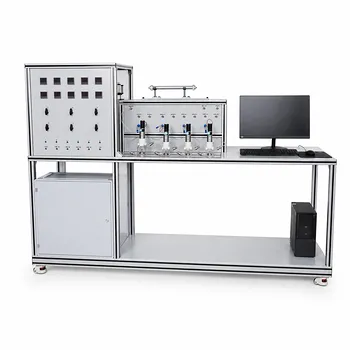
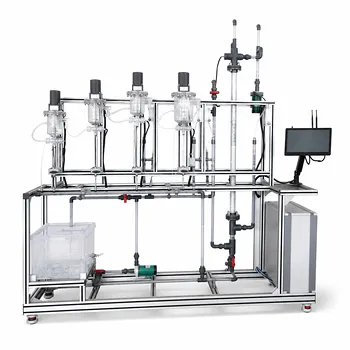
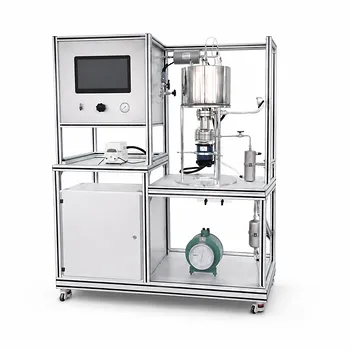
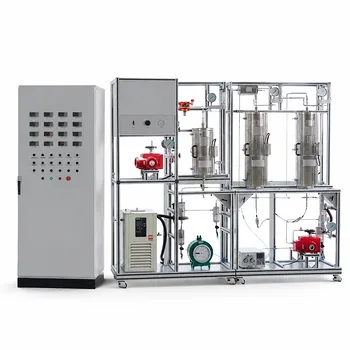
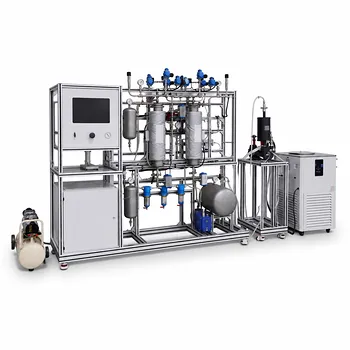
Teaching the trade-off between chemical kinetics and thermodynamic equilibrium is an exercise in controlled contrast. A water-gas shift (WGS) pilot plant built for education must allow students to physically manipulate temperature and immediately see the opposing effects on reaction rate and final conversion. At its core, this requires a reactor system that provides multi-stage catalyst beds with inter-stage cooling, precise multi-zone temperature control, online gas analysis, and adjustable space velocity.
The central conflict students must grasp is that the exothermic WGS reaction ((CO + H_2O \rightleftharpoons CO_2 + H_2)) favors high CO conversion at low temperatures, yet slow kinetics demand high temperatures for acceptable rates. A properly designed educational pilot plant makes this tension tangible by creating distinct temperature zones where learners can watch the reaction “run fast but not far” or “crawl toward a deep equilibrium,” then combine both strategies in a staged configuration that mirrors industrial practice.
Understanding the Kinetics-Equilibrium Conflict
The core learning objective is to demonstrate why a single reactor operating at one temperature cannot optimize both speed and yield.
The Exothermic Dilemma
Because the WGS reaction releases heat, thermodynamic equilibrium shifts toward products (high CO conversion) as temperature drops. This means a low-temperature exit gas will contain less CO, all else being equal.
The Kinetic Hurdle
However, reaction kinetics—the rate at which molecules transform—plummet at lower temperatures. The catalyst simply cannot work fast enough to reach that favorable equilibrium in a reasonably sized reactor. Students must see that a real, finite reactor must balance these two forces.
Essential Design Features for a Demonstrative WGS Pilot Plant
To teach this balance, the pilot plant must be engineered as a flexible, observable platform. The following features are mission-critical.
Multi-Stage Reactor Configuration with Inter-Stage Cooling
A single catalyst bed cannot illustrate the trade-off effectively. The plant must house at least two separate catalyst stages—typically a high-temperature shift (HTS) reactor followed by a low-temperature shift (LTS) reactor.
Inter-stage cooling, usually via a heat exchanger or quench system, drops the gas temperature before it enters the LTS stage. This lets students observe how the HTS stage achieves a fast but equilibrium-limited conversion (reducing CO to roughly 3–4%), after which the cooler LTS stage pushes the reaction closer to completion by exploiting the now more favorable equilibrium.
Multi-Zone Temperature Control and Precise Bed Profiling
Each reactor stage requires independently controlled heating jackets or multi-zone furnaces that can maintain distinct temperature profiles along the catalyst bed. The HTS section, for example, must be operable in the 300–530 °C range typical of iron-chromium catalysts.
Equally important are multiple thermocouples installed at various axial points in the bed. These enable students to map the temperature profile and see an exothermic temperature rise in the HTS bed, then the cooler, flatter profile in the LTS bed where kinetics are gentler but equilibrium more favorable.
Online Gas Composition Analysis
To transform temperature settings into a learning moment, real-time gas analyzers (e.g., for CO, CO₂, H₂) must be plumbed at key points: after each reactor stage and at the final outlet.
This immediate feedback closes the loop. A student raising the HTS inlet temperature will quickly see the CO drop faster in the analyzer, but then notice that the LTS stage now has less work to do and the final CO is not significantly lower. Conversely, lowering the inter-stage temperature too much will show sluggish conversion in the LTS stage. The numbers make the trade-off concrete.
Variable Flow Control and Space Velocity Adjustment
Space velocity—the ratio of gas flow rate to catalyst volume—directly influences how long reactants spend in the kinetic “sweet spot.” The plant must include mass flow controllers that allow students to vary the feed rate.
- High space velocity: Residence time is short. The gas may rush through the HTS bed before reaching equilibrium, demonstrating kinetic limitation.
- Low space velocity: Residence time increases. Students can watch the outlet CO concentration asymptotically approach the equilibrium value predicted by thermodynamics, illustrating the shift from kinetic to thermodynamic control.
Gas Distribution Systems for Uniform Flow
While not the main topic, poor gas distribution creates misleading hot spots and channeling that obscure the kinetics-equilibrium lesson. An educational plant should include a transparent or accessible gas distributor—such as a perforated plate or inert ceramic ball layer—at the top of each fixed bed.
This feature itself becomes a teaching point: non‑ideal flow mimics real industrial challenges, and uniform distribution is essential for valid comparison of temperature and space velocity effects.
Navigating the Practical Limitations
Even the best educational pilot plant has constraints that instructors must address honestly.
The Cost of Flexibility
Multi-stage systems with extensive instrumentation are expensive to build and maintain. A plant that tries to do everything—HTS, LTS, multiple analytical points—can become a maintenance burden rather than a teaching asset. Budget often forces a trade-off between the number of stages and the richness of data.
Catalyst Deactivation and Safety
Iron-chromium HTS catalysts are robust, but they are susceptible to sintering at excessive temperatures and can generate hazardous chromium(VI) species. The plant must include over-temperature protection and proper containment, especially if students will handle spent catalyst. These safety features add complexity but are non‑negotiable for a learning environment.
Simplified vs. True Industrial Representation
A pilot plant with just two adiabatic beds and inter-stage cooling approaches industrial reality, but true industrial trains often include multiple reactors with waste heat recovery and gas purification. If the educational goal is purely the kinetics-equilibrium trade-off, a simpler two‑stage isothermal or adiabatic setup may suffice—but the instructor must clarify what is being abstracted.
Making the Right Choice for Your Educational Goal
The design choices hinge on what you most need students to take away.
- If your primary focus is demonstrating the fundamental kinetic vs. equilibrium conflict: Prioritize a single adiabatic bed with multi‑zone temperature control, an axial thermocouple array, and outlet gas analysis. Let students vary temperature and space velocity to map the conversion-vs.-rate curve.
- If your primary focus is replicating industrial practice: Invest in a two‑stage (HTS + LTS) system with inter‑stage cooling, where students can see how industry balances fast bulk conversion with a deep final polishing step.
- If your primary focus is safety and operational simplicity in a teaching lab: Choose a single bed with robust over-temperature shutdowns, a heterogeneous catalyst that is non‑toxic when spent, and a clear visual indicator for gas distribution uniformity.
A well-designed WGS pilot plant does more than demonstrate a reaction—it transforms an abstract engineering principle into a hands‑on, measurable experience that students can control and question.
Summary Table:
| Design Feature | Purpose & Function | Educational Value |
|---|---|---|
| Multi-Stage Configuration | Uses HTS & LTS reactors with inter-stage cooling | Demonstrates kinetics vs. equilibrium shifts |
| Multi-Zone Temp Control | Independent heating & axial thermocouples | Maps temperature profiles & exothermic heat |
| Online Gas Analysis | Real-time CO, CO2, and H2 measurement | Provides instant feedback on conversion rates |
| Variable Flow Control | Mass flow controllers adjust space velocity | Shows transition from kinetic to equilibrium control |
Bring advanced chemical engineering concepts to life in your lab. LABPARK designs and manufactures premium Educational and Vocational Unit Operations Pilot Plants in chemical engineering, bioprocess & biotech, and environmental & water treatment for universities, research institutes, and enterprises.
Ready to upgrade your teaching or research lab? Contact our experts today to get a tailored pilot plant solution!
Related Products
- Fixed-Bed Chemical Reaction and Gas Dust Tar Removal Unit Operations Pilot Plant
- Gas Phase Mixing and Residence Time Distribution Determination Educational Unit Operations Pilot Plant
- Fluidized Bed Gas Solid Catalytic Reaction Educational Pilot Plant
- Fixed Bed Gas Solid Catalytic Reaction Educational Pilot Plant
- 100L Continuous Loop Hydrogenation Educational Unit Operations Pilot Plant
People Also Ask
- When to transition from PID to adaptive control in pilot plants? Key process indicators.
- How do deviations in estimating latent heat impact pilot plant thermal systems? Avoid hardware mis-sizing.
- Why Compare Predicted and Experimental Excess Enthalpy? Key to Accurate Pilot Plant Scale-up
- Why Use PTFE & Hastelloy in Chemical Pilot Plants? Prevent Corrosion & Ensure Safety
- How to study gasification in pilot plants? Compare exit gas composition & efficiency