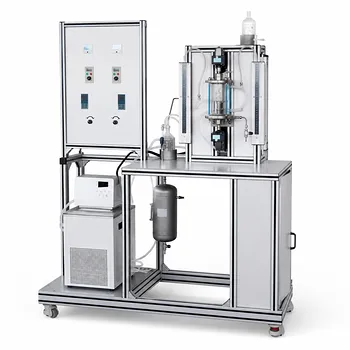
The initial separation unit is chosen by the feed’s phase behavior, solids burden, separation objective, and downstream requirements. For gas–liquid systems, a flash, absorber, condenser, or reboiled stripper is selected according to volatility, equilibrium (K)-values, gas solubility, composition, and required recovery. For gas–liquid–solid systems, solid removal and gas/vapor recovery are usually prioritized early, using filters, centrifuges, cyclones, settling, or flash operations before more difficult liquid–liquid separations.
The first unit operation should remove the phase that is easiest to separate and most disruptive to downstream equipment. In practice, this usually means recovering or conditioning the gas and removing solids before optimizing liquid-phase separations.
Start with the Feed and the Separation Objective
Identify the phases and their physical condition
The first question is whether the feed is primarily gas, liquid, vapor–liquid, or gas–liquid–solid. The answer determines whether the initial operation should be a flash vessel, separator, filter, centrifuge, absorber, condenser, or another contactor.
Important feed properties include:
- Temperature and pressure
- Gas and liquid flow rates
- Density difference between phases
- Viscosity and surface tension
- Particle concentration and particle-size distribution
- Foaming, emulsification, and solids deposition tendencies
- Corrosiveness, toxicity, flammability, and pressure hazards
Pilot plants must also accommodate changes in these properties because pilot-scale experiments commonly cover a wider operating range than a fixed production unit.
Define what must be recovered or removed first
The initial separator is not selected solely to maximize immediate purity. It is chosen to protect downstream equipment, recover valuable material, control recycle composition, and establish a stable feed for subsequent operations.
Typical first-step objectives include:
- Removing dissolved or entrained gas
- Recovering valuable vapor or product
- Removing solids before they foul equipment
- Reducing the load on a distillation or absorption column
- Preventing impurity buildup in a recycle loop
- Producing a stable liquid feed for liquid–liquid separation
A unit operation that achieves moderate purity but substantially reduces downstream flow or fouling may be preferable to a more intensive operation used at the front of the process.
Choosing the First Operation in Gas–Liquid Systems
Use a flash when phase equilibrium provides sufficient separation
A simple flash is appropriate when pressure reduction or temperature adjustment creates a useful vapor–liquid split. It is especially effective when the more volatile components preferentially enter the vapor phase and the less volatile components remain in the liquid.
The separation depends on vapor–liquid equilibrium, commonly represented by the component equilibrium ratio:
[ K_i=\frac{y_i}{x_i} ]
where (y_i) is the vapor-phase composition and (x_i) is the liquid-phase composition.
A large difference between the (K)-values of light and heavy components favors flash separation. The primary reference identifies a (K)-value ratio greater than approximately 10 as a useful criterion for simple flashing, but this should be treated as a screening guideline, not a universal design rule.
Feed composition, vapor fraction, pressure, temperature, residence time, entrainment, and required product purity must also be evaluated. Multiple flash stages with intermediate heating or cooling can improve separation when one flash is insufficient.
Use absorption when recovery is more important than simple phase splitting
Gas absorption is selected when a target component must be recovered from the gas at high efficiency or when pressure reduction alone cannot achieve adequate removal.
The absorbent may be:
- A fresh solvent
- A process liquid
- A recycled solvent
- A liquid already available elsewhere in the process
Absorption is favored when the target gas has high solubility or selectivity in the liquid absorbent. The pilot system should provide control of gas and liquid flow rates, contact time, interfacial area, pressure drop, and solvent circulation.
The key design question is whether the absorbent can capture the target component without creating an excessive liquid load or introducing a difficult solvent-regeneration problem.
Use reboiled stripping for mixtures rich in light and intermediate components
A reboiled stripping column is useful when the feed contains substantial light and intermediate fractions that must be removed from a heavier liquid product.
In this arrangement, a precooled liquid feed enters near the top of a column equipped primarily with a reboiler. Vapor generated in the reboiler strips volatile components upward, while heavier material collects at the bottom.
This operation is appropriate when:
- The heavy fraction should remain in the bottoms
- Light components must be removed from a liquid product
- A stripping gas or generated vapor can provide the driving force
- A simple flash does not provide adequate fractionation
The selection depends on volatility differences, allowable reboiler temperature, thermal sensitivity, pressure, and the required light-component removal.
Consider condensation when temperature control can recover the vapor
A condenser or partial condenser may be the best first operation when the objective is to recover condensable product from a gas stream. Cooling can remove heavy vapor components while leaving lighter gases for recycle, absorption, or further treatment.
The choice depends on:
- Condensation temperatures of the components
- Available cooling utility
- Product value
- Fouling and freezing risk
- Required gas purity
- Whether the condensed liquid forms one phase or multiple liquid phases
A partial condenser may be used when only part of the vapor should be condensed, creating a controlled gas–liquid split before downstream processing.
Choosing the First Operation in Gas–Liquid–Solid Systems
Remove solids early when they threaten reliability
Solids in a reactor effluent or solids formed by precipitation are commonly removed near the beginning of the separation sequence. Early removal protects valves, pumps, columns, heat exchangers, membranes, and analytical equipment from plugging, erosion, and fouling.
The appropriate solids-removal device depends on particle size, concentration, density, shape, compressibility, and liquid viscosity.
Use filters for relatively coarse or readily captured solids
Filtration is suitable when particles can form or pass through a stable filter cake and the liquid is not excessively viscous. Pilot filters are useful for measuring:
- Pressure-drop development
- Filtration rate
- Cake resistance
- Moisture content of the solids
- Cleaning and regeneration requirements
Filter selection must account for blinding, cake compressibility, solvent compatibility, and safe solids discharge.
Use centrifuges when density differences or fine particles limit filtration
A centrifuge can separate solids that settle too slowly under gravity or that are difficult to retain economically in a conventional filter. It is particularly useful when the solid concentration is significant and continuous or semi-continuous removal is required.
The main criteria are particle settling behavior, liquid viscosity, centrifugal force, solids throughput, wear, and the desired dryness of the recovered solids.
Use settling or cyclonic separation when gravity or inertia is sufficient
Gravity settlers and decanters can remove dense, relatively coarse solids with modest equipment complexity. They require sufficient residence time and a meaningful density difference between solids and liquid.
Cyclones or inertial separators can be considered for entrained solid particles in a gas stream. Their effectiveness depends strongly on particle size, gas velocity, density difference, and pressure drop.
Treat precipitation as a process choice, not merely a separator choice
Solids can be created intentionally through cooling, concentration, or addition of a mass-separation agent. This may improve recovery, but it also introduces additional equipment, recycle streams, waste handling, and possible nucleation or fouling problems.
Precipitation is therefore justified only when the benefit of creating a separable solid outweighs the added process complexity.
Apply Separation-Sequence Heuristics
Recover gas or vapor early when it affects recycle and safety
Gas or vapor recovery is commonly placed on one of three streams:
- Purge stream: when valuable product or unreacted feed would otherwise be lost
- Recycle stream: when impurities accumulate and impair the reactor or catalyst
- Flash vapor stream: when both product recovery and recycle purity are important
No vapor-recovery unit may be justified when product loss is small and recycle impurities do not affect operation.
The pilot plant should make these alternatives observable so that recovery, energy use, recycle quality, and operational complexity can be compared.
Separate solids before liquid–liquid subsystem design
In a gas–liquid–solid process, gas recovery and solid removal are often relatively independent of the later liquid–liquid separation problem. Designing these operations first reduces the flow and contamination burden entering the liquid-separation subsystem.
This is especially important when solids would stabilize emulsions, foul contactors, or interfere with settling and phase disengagement.
Leave difficult liquid–liquid separations until the major loads are reduced
After gas and solids have been removed, liquid–liquid separation can be designed with a more stable and better-defined feed. Mixing intensity, solvent-to-feed ratio, and settler residence time can then be optimized without excessive gas entrainment or solid interference.
Excessive mixing should be avoided because it can create stable emulsions and make gravity separation ineffective.
Match the Unit Operation to the Separation Driving Force
Use volatility and solubility differences for gas–liquid separation
Flash, condensation, and stripping exploit differences in volatility and vapor–liquid equilibrium. Absorption exploits differences in gas solubility and, when applicable, chemical affinity between the gas and absorbent.
The correct choice depends on whether the process has a stronger phase-equilibrium driving force or a stronger solvent-selectivity driving force.
Use density and particle behavior for solid separation
Settlers, decanters, and centrifuges rely primarily on density differences and particle settling. Filters rely on particle retention and cake formation.
When particles are very fine, deformable, sticky, or present at low concentration, a simple gravity device may be inadequate even if the density difference is large.
Consider alternative technologies only when conventional methods are inadequate
Membranes, adsorption, cryogenic separation, chemical absorption, extraction, and crystallization may provide better selectivity in specific cases. However, their suitability depends on pressure, temperature, material compatibility, fouling, solvent management, safety, and pilot-scale controllability.
The first operation should not be made unnecessarily sophisticated when a robust flash, filter, or separator can achieve the required initial conditioning.
Understanding the Trade-offs
A flash is simple but may not deliver high purity
Flash vessels have relatively simple operation and can reduce the load on downstream equipment. However, a single equilibrium stage may provide inadequate separation when volatility differences are small or when high recovery and purity are required simultaneously.
Adding flash stages improves performance but increases equipment, control, heating or cooling demand, and recycle complexity.
Absorption improves recovery but creates solvent duties
Absorption can achieve high gas-component recovery, but it introduces solvent circulation, possible solvent losses, pressure drop, foaming, and regeneration requirements.
The absorbent must be selected for both separation performance and its effect on the rest of the process.
Early solids removal improves reliability but can sacrifice valuable liquid
Filters and centrifuges may retain product with the solids or require washing and solids handling. They can also experience fouling, wear, or high pressure drop.
The design should therefore measure not only solids-removal efficiency but also liquid recovery, solids moisture, cleaning frequency, and operating stability.
Precipitation can create a separable phase but increases complexity
Deep cooling or addition of a separating agent may make solids easier to remove. The disadvantages include extra energy demand, recycle loops, waste streams, and possible contamination of the recovered solid or liquid.
Pilot-scale behavior may not match laboratory behavior
Gas dispersion, phase hold-up, emulsion formation, pressure drop, residence-time distribution, and heat transfer can change significantly with scale. Pilot equipment should therefore permit adjustment of temperature, pressure, phase ratios, mixing, residence time, and flow rates.
These adjustable variables are essential for distinguishing a fundamentally suitable unit operation from one that works only under narrow laboratory conditions.
How to Apply This to Your Project
The following decision sequence provides a practical starting point:
- If your primary focus is rapid gas–liquid screening: Begin with feed phase-equilibrium data and test a flash or partial condenser across the intended pressure and temperature range.
- If your primary focus is high recovery of a valuable gas component: Evaluate absorption using solvent selectivity, circulation rate, regeneration requirements, and achievable recovery.
- If your primary focus is removing light components from a heavy liquid: Consider reboiled stripping when a flash cannot provide adequate fractionation.
- If your primary focus is reliable gas–liquid–solid operation: Remove solids as early as practical using filtration, centrifugation, settling, or cyclonic separation selected from particle and slurry properties.
- If your primary focus is minimizing recycle and impurity buildup: Recover vapor on the purge, recycle, or flash-vapor stream according to where product loss or impurity accumulation is most damaging.
- If your primary focus is liquid–liquid separation after gas and solids removal: Design the liquid-contacting and settling subsystem only after reducing gas entrainment, solids loading, and unnecessary flow.
Choose the first separator by identifying the dominant separation mechanism, the phase that most threatens downstream operation, and the recovery or purity target that the pilot plant must demonstrate.
Summary Table:
| System or objective | Recommended initial operation | Key selection criteria |
|---|---|---|
| Gas-liquid phase split | Flash or partial condenser | Volatility, K-values, pressure, temperature, and vapor fraction |
| Valuable gas recovery | Absorber | Gas solubility, solvent selectivity, circulation, and regeneration |
| Light-component removal | Reboiled stripper | Volatility, reboiler temperature, pressure, and required removal |
| Vapor recovery | Condenser | Condensation temperature, cooling capacity, fouling, and gas purity |
| Coarse or filterable solids | Filter or gravity settler | Particle size, concentration, cake formation, and density difference |
| Fine or slowly settling solids | Centrifuge or cyclone | Particle size, viscosity, throughput, centrifugal force, and pressure drop |
| Downstream liquid-liquid separation | Gas and solids removal first | Minimize entrainment, fouling, emulsions, and process load |
Need to select and validate the right first separation step for your process? Contact LABPARK for Educational and Vocational Unit Operations Pilot Plants designed for chemical engineering, bioprocess and biotech, and environmental and water treatment applications. Our pilot systems help universities, research institutes, and enterprises evaluate flash separation, absorption, condensation, stripping, filtration, centrifugation, settling, and gas-liquid-solid process sequences under adjustable operating conditions. LABPARK can support practical testing of phase behavior, recovery, solids removal, fouling risk, recycle performance, and scale-up decisions—helping you choose reliable equipment and generate meaningful process data before full-scale investment.
Related Products
- Gas-Solid Heterogeneous Separation Demonstration Educational Unit Operations Pilot Plant
- Gallium and Indium Selective Extraction Educational Pilot Plant
- Bench Scale Dual Column Gas Separation and Capture Educational Pilot Plant
- Dual-Drive Stirred Gas-Liquid Mass Transfer Coefficient Determination Pilot Plant
- Packed Bed Absorption Educational Unit Operations Pilot Plant
People Also Ask
- Why is pressure drop characterization critical in separation pilot plants? Key operational insights.
- How do separation pilot plants compare distillation vs alternatives? Optimize process selection
- What separation subsystems should be analyzed when configuring separation units for chemical and bioprocess pilot plants? Key Design Factors
- Why Do Flash Calculations Fail for Light-Gas Mixtures? Prevent Pilot Plant Simulation Errors
- What are the key thermodynamic considerations for gas mixture modeling? Expert Guide