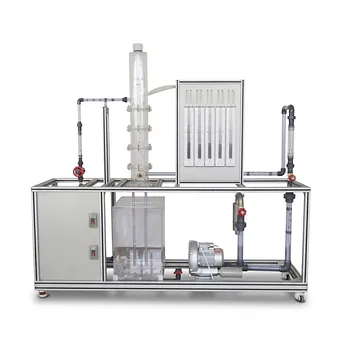
The core principles are dynamic conservation laws coupled with equilibrium relationships. Transient models of pilot-scale flash drums and binary distillation columns track how component mass, total mass, and energy change within liquid holdups and other control volumes over time. These balances are coupled to vapor-liquid equilibrium, phase flow relationships, pressure behavior, and equipment-specific effects such as reboiler duty, condenser condensation, and tray or drum holdup.
Transient separation behavior is governed by the interaction of accumulation, flow, energy transfer, and phase equilibrium. Flash drums usually emphasize changing phase fractions and vessel holdup, while distillation columns extend the same principles across multiple interconnected equilibrium stages.
What Governs Transient Separation Behavior?
Dynamic Material Balances
For each control volume, the rate of accumulation equals the difference between material entering and leaving:
[ \frac{dM_i}{dt}=\sum \dot n_{i,\text{in}}-\sum \dot n_{i,\text{out}} ]
Here, (M_i) is the amount of component (i) stored in the liquid or vapor holdup.
In a binary system, the model must track both total holdup and composition. These quantities determine how quickly outlet compositions respond to startup, feed changes, pressure disturbances, or changes in heat input.
Energy Balances
The energy balance determines how heating, condensation, vaporization, and sensible-heat changes affect the transient state:
[ \frac{dU}{dt}=\sum \dot n_{\text{in}}h_{\text{in}} -\sum \dot n_{\text{out}}h_{\text{out}} +\dot Q-\dot W ]
For pilot units, the reboiler heat duty and condenser behavior are particularly important because they influence vapor generation, condensation, temperature, and ultimately composition.
Vapor-Liquid Equilibrium
Material balances alone do not determine how components divide between phases. The vapor and liquid compositions are linked through VLE.
For a binary mixture with constant relative volatility, the equilibrium relation can be written as:
[ y=\frac{\alpha x}{1+(\alpha-1)x} ]
where (x) is the liquid mole fraction of the more volatile component, (y) is its equilibrium vapor mole fraction, and (\alpha) is the relative volatility.
The vapor is enriched in the more volatile component when (\alpha>1). This equilibrium enrichment is the physical basis for both flash separation and staged distillation.
How Flash Drum Transients Are Modeled
The Drum Is a Holdup Volume
A flash drum is modeled as a control volume containing liquid and, where relevant, vapor holdup. Its transient behavior depends on how quickly material and energy enter the vessel compared with how quickly vapor and liquid leave it.
A simplified total-material balance is:
[ \frac{dM}{dt}=\dot F-\dot V-\dot L ]
where (F) is the feed rate, (V) is the vapor outlet rate, and (L) is the liquid outlet rate.
Component balances determine how the composition of each outlet evolves. The vapor and liquid compositions are not generally equal because the more volatile component preferentially enters the vapor phase.
Pressure Drop Drives Flashing
A high-pressure liquid entering a lower-pressure vessel may become thermodynamically unstable as a single liquid phase. Part of the feed then vaporizes until the vessel reaches a condition compatible with its pressure, temperature, composition, and phase amounts.
This is the defining transient event in a flash drum: pressure reduction and available thermal energy alter the vapor fraction, while VLE determines the compositions of the resulting phases.
Holdup Controls the Response Time
Liquid holdup acts as storage. A larger holdup generally produces slower composition and level changes for a given imbalance between inlet and outlet flows.
Vapor holdup can also matter in a real pilot vessel, especially during rapid pressure changes. However, many introductory and design models neglect vapor holdup when it is small relative to liquid holdup, reducing the number of dynamic states.
How Binary Distillation Transients Are Modeled
Each Tray Is a Coupled Control Volume
A dynamic distillation column treats each tray, reboiler, and condenser as a material and energy balance region. For tray (j), a simplified component balance has the form:
[ \frac{d(M_jx_j)}{dt}
L_{j-1}x_{j-1} +V_{j+1}y_{j+1} -L_jx_j -V_jy_j ]
The liquid composition (x_j), vapor composition (y_j), liquid flow (L_j), and vapor flow (V_j) are coupled across adjacent stages.
This arrangement creates propagation and interaction: a disturbance introduced at the feed or reboiler can affect internal tray compositions before it appears in the overhead product.
Stage Equilibrium Links Liquid and Vapor States
Under the ideal-stage assumption, the vapor leaving a tray is in equilibrium with the liquid leaving that tray:
[ y_j=\frac{\alpha x_j}{1+(\alpha-1)x_j} ]
This relationship converts liquid composition into vapor composition and provides the separation effect of each stage.
Real trays may not reach complete equilibrium. Stage efficiency is therefore an important refinement when measured pilot behavior differs from the ideal model.
Reboiler and Condenser Set Boundary Conditions
The reboiler supplies vapor to the column through its heat duty. A change in (\dot Q_R) changes vapor generation, bottom composition, internal flows, and the eventual overhead response.
The condenser removes heat from the overhead vapor and may operate with total or partial condensation. Its condensation rate, reflux behavior, and accumulated liquid holdup strongly influence the overhead composition trajectory and column pressure.
Pressure Affects Both Flow and Equilibrium
Pressure is not merely an operating label. It affects boiling temperatures, phase equilibrium, vapor density, flow behavior, and the amount of vapor generated by a given heat input.
A constant-pressure model can be appropriate when pressure-control dynamics are much faster than composition dynamics. A pressure-dynamic model is needed when condenser capacity, vapor holdup, pressure-drop effects, or rapid load changes are significant.
Why Holdup Matters
Holdup Creates Dynamic Lag
A unit with no holdup would respond instantaneously to changes in its inputs. Real trays, drums, reboilers, and condensers store material and energy, creating delays and smoothing transients.
The relevant time scale is related to stored material divided by the characteristic flow rate. This is why pilot units can display visibly slower responses than steady-state equilibrium calculations suggest.
Holdup Couples Level and Composition
Liquid level and composition are linked through the same stored liquid inventory. An outlet-flow change can alter level first, composition first, or both, depending on the relative size of the holdup and the flow disturbance.
A model that tracks composition but omits physically meaningful holdup cannot reliably predict startup trajectories, level behavior, or the timing of composition changes.
Energy Holdup Can Be Important
The liquid and equipment can store sensible energy. During startup or large heat-duty changes, this thermal storage affects temperature and vaporization rates.
Neglecting energy accumulation may be acceptable for slow, near-isothermal operation, but it can distort transient predictions when the reboiler, feed, or condenser undergoes substantial thermal changes.
Understanding the Trade-offs
Neglecting Vapor Holdup
Assuming negligible vapor holdup simplifies the equations and often captures the dominant liquid-composition dynamics. It can become inaccurate during fast pressure transients or in equipment with substantial vapor volume.
The assumption should be checked against the vessel geometry, operating pressure, vapor volume, and time scale of the disturbance.
Assuming Equal Molar Heats of Vaporization
Equal molar heats of vaporization support the constant-molar-overflow approximation. Under this assumption, condensation of one mole of vapor supplies approximately the energy required to vaporize one mole of liquid.
This is useful for transparent binary-column models, but real mixtures can have different latent heats and temperature-dependent enthalpies. The approximation should therefore be treated as a modeling choice rather than a universal property.
Neglecting Heat Loss
An adiabatic column model sets environmental heat losses to zero. This focuses attention on internal reboiler, condenser, and phase-change effects.
Pilot equipment may lose meaningful heat through walls, fittings, and uninsulated sections. Such losses can shift temperatures and vapor rates, especially during startup or low-throughput operation.
Holding Relative Volatility Constant
Constant (\alpha) produces a simple algebraic VLE relation and is often adequate for an instructional binary model over a limited operating range.
Relative volatility can vary with temperature, pressure, and composition. A model intended for quantitative pilot prediction may need a more detailed thermodynamic property method.
Assuming 100% Stage Efficiency
The ideal-stage assumption states that vapor and liquid leaving each tray reach thermodynamic equilibrium. It isolates the effects of balances, holdup, and VLE.
Actual trays have finite mass-transfer rates, mixing patterns, entrainment, weeping, and other inefficiencies. Applying ideal stages without calibration can overpredict separation and produce overly optimistic transient composition profiles.
How to Apply This to Your Project
A useful transient model should begin with the simplest balance structure that represents the equipment and then add complexity only where measurements show it is necessary.
- If your primary focus is flash-drum pressure or level response: Include total and component material balances, liquid holdup, outlet-flow relations, pressure behavior, and an energy balance if flashing is strongly thermal.
- If your primary focus is flash-drum phase composition: Couple the balances to VLE and calculate how pressure, temperature, and total holdup determine vapor fraction and phase compositions.
- If your primary focus is distillation startup or load changes: Model liquid holdup on each tray, the reboiler, the condenser, feed conditions, internal liquid and vapor flows, and stage-equilibrium relationships.
- If your primary focus is overhead composition trajectory: Represent condenser condensation and reflux dynamics explicitly, because overhead composition is shaped by both column propagation and condenser behavior.
- If your primary focus is quantitative pilot prediction: Test the simplifying assumptions against data, especially stage efficiency, heat loss, vapor holdup, pressure variation, and the composition dependence of relative volatility.
A reliable transient model is a physically consistent balance-and-equilibrium model whose assumptions match the time scale and operating range of the pilot unit.
Summary Table:
| Modeling principle | Role in transient behavior | Key considerations |
|---|---|---|
| Material balances | Track total and component accumulation in drums, trays, reboilers, and condensers | Feed, vapor, liquid, and product flows |
| Energy balances | Describe heating, cooling, vaporization, condensation, and thermal storage | Reboiler duty, condenser capacity, heat loss |
| Vapor-liquid equilibrium | Relate liquid and vapor compositions and drive phase separation | Relative volatility, pressure, temperature |
| Holdup | Creates dynamic lag and links level changes with composition response | Liquid and vapor volume, flow rates |
| Pressure behavior | Influences boiling points, vapor generation, density, and equilibrium | Constant versus dynamic pressure assumptions |
| Stage modeling | Represents composition propagation through a binary distillation column | Tray efficiency, reboiler, condenser, reflux |
| Model assumptions | Balance accuracy and computational simplicity | Vapor holdup, heat loss, constant volatility, ideal stages |
Planning a pilot-scale separation system or upgrading your process training capabilities? Contact LABPARK to discuss Educational and Vocational Unit Operations Pilot Plants tailored to your needs. LABPARK supports universities, research institutes, and enterprises with pilot systems for chemical engineering, bioprocess and biotechnology, and environmental and water treatment. Our equipment helps teams study flash separation, binary distillation, dynamic material and energy balances, vapor-liquid equilibrium, holdup effects, startup behavior, and process control using realistic, hands-on platforms. Share your teaching, research, or production objectives with our specialists so we can help define the appropriate configuration, instrumentation, and operating scope.
Related Products
- Continuous Sieve-Plate Distillation Pilot Plant for Unit Operations Laboratory Education
- Multi-Modal Distillation Unit Operations Training Pilot Plant
- Continuous Batch Extractive Distillation Educational Pilot Plant
- Dual-Mode Rectification Pilot Plant for Practical Training Unit Operations
- Multi-Functional Special Distillation Educational Pilot Plant
People Also Ask
- How do distillation pilot plants validate VLE data? Achieve reliable solvent separation scale-up.
- How to select the right activity coefficient model (Wilson, NRTL, UNIQUAC) for distillation pilot plants?
- How does catalyst water concentration affect distillation pilot plant design? Key separation train choices.
- Why is the column performance diagram critical? Optimize distillation pilot plant safety & efficiency.
- Why is vacuum operation capability an essential feature for a distillation unit operations pilot plant? Unlock Efficiency