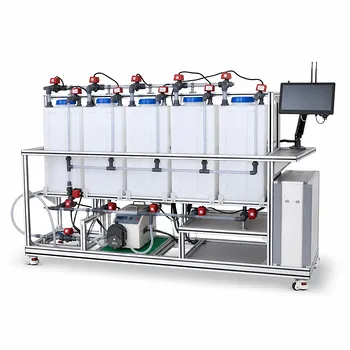
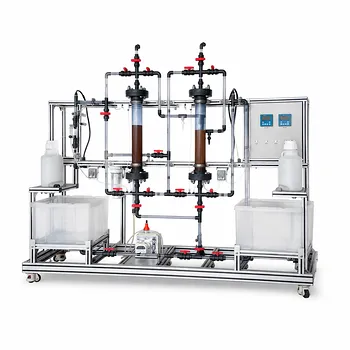
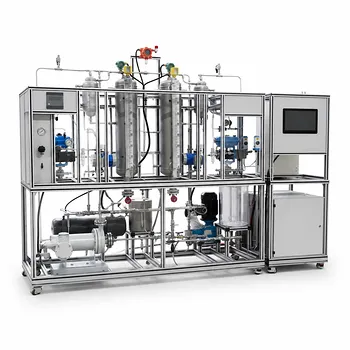
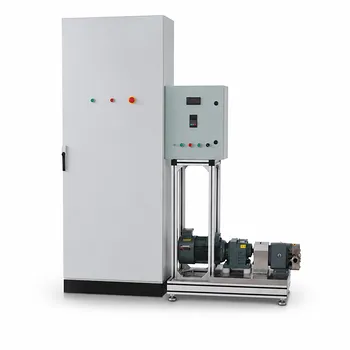
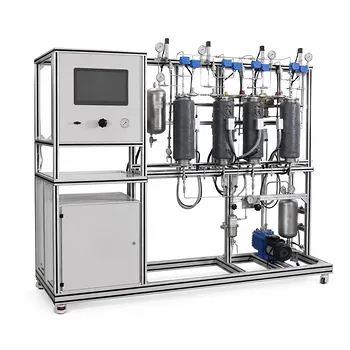
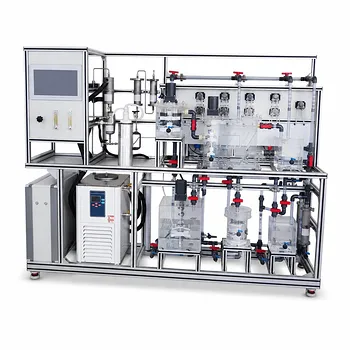
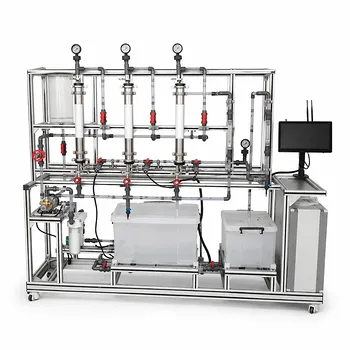
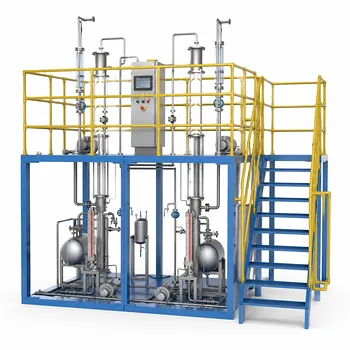
Temporary hardness removal treatment pilot plants are fundamentally a live demonstration of chemical precipitation. The core reaction uses a base, typically slaked lime [Ca(OH)₂], to convert the dissolved calcium and magnesium bicarbonates that define temporary hardness into insoluble mineral precipitates. By operating these pilot-scale units, you directly observe the stoichiometric dosing, rapid mixing, flocculation, sedimentation, and final filtration needed to turn soluble hardness ions into a removable solid sludge.
Temporary hardness is not “boiled out” in modern plants—it is chemically neutralized and settled. A pilot plant makes the abstract textbook equations tangible, revealing that precise stoichiometry, mixing energy, and solid-liquid separation are what truly govern successful softening—not just the chemistry itself.
The Chemistry: From Soluble Bicarbonates to Solid Precipitates
What Makes Hardness “Temporary”
Temporary hardness is caused by calcium bicarbonate [Ca(HCO₃)₂] and magnesium bicarbonate [Mg(HCO₃)₂] dissolved in water.
These salts enter water through the natural weathering of limestone (CaCO₃) and dolomite (Ca,Mg)CO₃ under the influence of carbon dioxide‑rich rainwater.
If you simply boiled the water, they would decompose thermally into scale-forming carbonates and release CO₂—an expensive and impractical industrial option.
The Lime‑Softening Reaction Mechanism
A pilot plant with a chemical dosing system lets you add a base—typically hydrated lime, Ca(OH)₂—to the hard water.
The lime supplies hydroxide ions that force the bicarbonate ions to convert to carbonate ions, which immediately bind with calcium to form insoluble calcium carbonate (CaCO₃).
For magnesium, the lime‑induced high pH precipitates it as magnesium hydroxide [Mg(OH)₂] rather than a carbonate—a crucial nuance many simplified texts miss.
The key reactions you are demonstrating are:
For calcium temporary hardness:
Ca(HCO₃)₂ + Ca(OH)₂ → 2CaCO₃↓ + 2H₂O
For magnesium temporary hardness:
Mg(HCO₃)₂ + 2Ca(OH)₂ → Mg(OH)₂↓ + 2CaCO₃↓ + 2H₂O
These equations are the backbone of the pilot plant exercise, driving home the direct relationship between lime dose, hardness ion concentration, and sludge volume.
The Driving Force: Solubility Product and Precipitate Formation
The demonstration hinges on the very low solubility of calcium carbonate and magnesium hydroxide.
The lime addition pushes the ionic product past the solubility product constant (Ksp), so the solution becomes supersaturated and the solids nucleate.
By adjusting the lime dose and monitoring the pH, you physically see the cloud of fine precipitate particles form—making the concept of chemical equilibrium truly visible.
Unit Operations of the Pilot Plant: Bridging Chemistry and a Real Process
Chemical Dosing and Stoichiometric Control
The first unit operation is the accurate metering of the lime slurry into the hard water stream.
This forces you to calculate the theoretical lime requirement based on the feed water’s calcium and magnesium bicarbonate concentrations—exposing the practical impact of excess vs. deficient reagent.
A slight over‑dose leaves residual hydroxide alkalinity; an under‑dose leaves hardness uncaptured. The pilot plant’s online pH and turbidity sensors make these mis‑steps immediately obvious.
Rapid Mixing and Flocculation
The precipitation reactions occur almost instantly, but the tiny CaCO₃ and Mg(OH)₂ particles need to grow large enough to settle.
The rapid mix chamber disperses the lime evenly, maximizing particle collisions, while the subsequent flocculation zone with gentle agitation promotes agglomeration into larger, settleable flocs.
This directly demonstrates how reaction kinetics and mixing intensity control the size and morphology of the solids that will later be separated.
Sedimentation and Sludge Management
The heart of the visual demonstration is the clarifier or settling basin.
The flocculated precipitate settles by gravity, forming a sludge blanket at the bottom while the softened water rises near the top.
Measuring the sludge volume and calculating the solids retention time reveals the practical limitations: an overloaded clarifier will carry over floc into the softened water, ruining the effluent quality. This connects chemical principles to equipment sizing.
Post‑Precipitation Filtration
Finally, the pilot plant typically includes a sand filter or a multimedia filter to polish the clarified water.
Even after good settling, fines can escape; this step demonstrates the need for a physical barrier to meet the low‑turbidity specs required for boiler feed or cooling systems.
The pressure drop across the filter, backwash frequency, and effluent turbidity become real performance numbers that operators must manage.
Understanding the Trade‑offs and Limitations of Lime Softening
Sludge Handling and Disposal
Lime softening generates a large volume of alkaline sludge rich in CaCO₃ and Mg(OH)₂.
This wet solid must be dewatered and disposed of—a significant operational expense that is easily overlooked in a textbook but inescapable when you clean the pilot plant’s clarifier.
The pilot plant exercise therefore also teaches the true cost of hardness removal, not just its chemistry.
Incomplete Hardness Removal and pH Dependence
Cold‑process lime softening typically cannot reduce hardness to zero; it leaves a residual of about 30–50 mg/L as CaCO₃ due to the solubility of the precipitate itself.
For magnesium, the required pH above ~10.5 to precipitate Mg(OH)₂ can be difficult to maintain uniformly, and excess lime can lead to post‑precipitation in downstream pipes.
The pilot plant vividly shows that “theoretically complete” often falls short in practice.
Comparing with Ion Exchange: A Complementary Principle
While the primary reference focuses on precipitation, many pilot plant curricula also include an ion exchange column—a fundamentally different chemical principle.
A sodium zeolite bed exchanges calcium and magnesium ions (both temporary and permanent hardness) for sodium ions, removing hardness without producing sludge.
This process is reversible: passing a concentrated NaCl brine regenerates the resin via the law of mass action. It’s a critical trade‑off to understand: precipitation creates solid waste but handles high hardness loads cheaply; ion exchange produces a liquid brine waste but can deliver near‑zero hardness.
Making the Right Choice for Your Demonstration Goal
After working through the pilot plant’s chemical and operational principles, the right focus depends on what you need the experiment to teach.
- If your primary focus is fundamental precipitation chemistry and solid‑liquid separation: Base your pilot plant around the lime softening train. It teaches stoichiometry, Ksp, flocculation, and the realities of sludge handling in one integrated flow sheet.
- If your primary focus is hardness removal selectivity and regeneration cycles: Incorporate the ion exchange zeolite bed alongside the precipitation unit. This lets you contrast the removal of temporary vs. permanent hardness, explore breakthrough curves, and demonstrate the law of mass action through brine regeneration.
- If your primary focus is operator training for plant reliability: Keep the pilot plant running with intentional upsets—varying the lime dose, increasing flow rate, or skipping flocculation—to see how quickly effluent quality degrades. That builds the intuition no manual can provide.
A well‑designed pilot plant transforms temporary hardness from an abstract titration number into a living process you can control, measure, and optimize.
Summary Table:
| Unit Operation | Chemical/Physical Principle | Key Process Control |
|---|---|---|
| Chemical Dosing | Stoichiometric precipitation of calcium & magnesium | pH & Reagent Flow Rate |
| Rapid Mixing & Flocculation | Particle nucleation and agglomeration | Agitation Speed & Floc Size |
| Sedimentation | Gravity settling of CaCO₃ and Mg(OH)₂ solids | Sludge Volume & Clarity |
| Filtration | Physical separation of residual suspended solids | Turbidity & Pressure Drop |
Bring Hands-On Water Treatment Chemistry to Your Lab
LABPARK provides premium Educational and Vocational Unit Operations Pilot Plants in chemical engineering, bioprocess & biotech, and environmental & water treatment. Designed specifically for universities, research institutes, and enterprises, our pilot systems turn abstract chemical principles into tangible, practical training experiences.
Ready to upgrade your educational or research capabilities? Contact us today to find the perfect pilot plant for your facility!
Related Products
- Electrochemical Water Treatment Educational Unit Operations Pilot Plant
- Ion Exchange Water Purification Educational Pilot Plant for Engineering Unit Operations
- Multi-Functional Membrane Separation Educational Pilot Plant for Unit Operations Lab
- Dual-Mode Rectification Pilot Plant for Practical Training Unit Operations
- Solid Waste Pyrolysis and Refining Educational Pilot Plant for Unit Operations
People Also Ask
- What design features do educational electrochemical pilot plants utilize to manage gas liberation and water loss?
- How can unit operations pilot plants show lead-acid concentration vs state of charge? Real-time monitoring guide.
- How do educational electrochemical pilot plants scale up electrolysis? Master industrial engineering.
- How to Estimate Sulfate in Water Treatment Pilot Plant Deposits: Gravimetric Guide
- How can foaming be managed during steam generation experiments in water treatment unit operations pilot plants? Tips