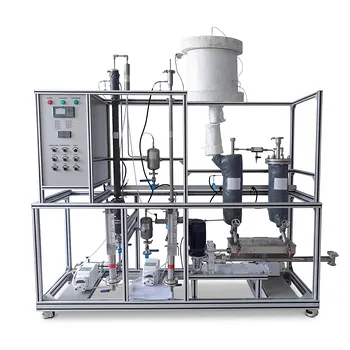
Superheating is a deceptive hazard. It turns a routine boil-up into a sudden, violent eruption that can shatter glassware, spray flammable solvents, and trigger fires. The root cause is a lack of nucleation sites, and the fix is remarkably straightforward: you must deliberately introduce them. In a pilot plant reactor, the safest and most reliable defenses are mechanical agitation or the careful addition of porous boiling chips.
The core problem isn't about the temperature—it’s about the absence of microscopic “seeds” that allow bubbles to form. Without these seeds, a liquid stores thermal energy like a loaded spring. When it finally releases, the result is bumping: an instantaneous, explosive boil that can destroy equipment and endanger operators. The solution is to provide a steady stream of nucleation sites through stirring or inert, porous materials.
The Physics of Superheating and Bumping
Understanding the science behind the hazard is the first step toward designing it out of your pilot plant.
The Missing Nucleation Sites
A pure liquid in a smooth, clean vessel can easily be heated past its atmospheric boiling point. It remains stubbornly liquid because there are no pre-existing gas pockets to trigger bubble formation.
These gas pockets, called gasification nuclei, are normally trapped in surface scratches, dust particles, or the pores of container walls. When they’re absent, the liquid’s vapor pressure must overcome not only atmosphere pressure but also the significant surface tension pressure required to create an entirely new bubble from nothing. This is easier if tiny gas pockets already exist.
This metastable condition stores superheat—excess thermal energy relative to the equilibrium boiling point. The liquid becomes a ticking clock.
Why It’s So Dangerous in Pilot Plants
When a nucleation site finally appears—say, a speck of dust lands on the surface—the entire stored energy releases in a chain reaction. The result is bumping: a sudden, vigorous surge of vapor that propels hot liquid upward.
In a pilot plant setting, this isn't just a wet benchtop. It’s a reactor potentially containing liters of boiling ethanol, acetone, benzene, or other flammable solvents. A bumping event can:
- Shatter a glass sight glass or vessel.
- Spray a combustible mist into the workspace.
- Cause immediate thermal shock to sensors and seals.
- Lead to a flash fire or explosion if the vapor cloud finds an ignition source.
Because pilot plants often operate in a semi-automated mode with less constant operator presence, an undetected superheating event can escalate into a catastrophic release.
Prevention Strategies for Pilot Plant Reactors
You have two primary, field-proven defenses. Both work by reliably introducing nucleation sites.
Mechanical Agitation – The Engineered Solution
A properly designed stirred reactor is the gold standard for preventing superheating. A spinning impeller creates shear, turbulence, and continuously regenerates tiny vapor cavities.
How it works: The low-pressure trailing edges of impeller blades naturally create cavitation bubbles. These serve as a constant, distributed supply of nucleation sites. Even at a gentle stir, the liquid’s homogeneity suppresses the formation of localized superheated zones.
Key advantages for pilot plants:
- No contamination from added solids.
- Continuous, automated protection that scales with reactor size.
- Simultaneous mixing improves heat and mass transfer, enhancing the boiling process itself.
The primary limitation is that agitation becomes less effective for highly viscous liquids or when the reactor operates in a dead-end boiling configuration with minimal liquid turnover.
Boiling Chips – The Chemical Solution
For situations where mechanical agitation isn’t possible—or as an additional backstop—porous boiling chips are the classic answer. These are small, inert particles (often silicates or calcium carbonate) riddled with microscopic cavities.
How they work: When added to the heated liquid, the chips release trapped air from their pores as they warm up. This creates a constant, gentle stream of seed bubbles that establish a smooth, rolling boil. The chips prevent the liquid from ever accumulating significant superheat.
Selection criteria for pilot plant use:
- Chemical inertness: Must not react with the solvent or product. Porous porcelain or carborundum are common choices.
- Particle size: Large enough not to clog bottom valves or transfer lines, but small enough to provide numerous nucleation sites.
- Single-use caution: Boiling chips typically lose their trapped air after one heating cycle. They cannot be reused if the liquid cools and is reheated. Fresh chips must be added each time.
Understanding the Trade-offs
No single method is perfect. Your choice involves managing competing priorities.
Agitation introduces heat and complexity. A stirring motor adds mechanical energy, which itself becomes a small heat input. In an exothermic reaction, you must account for this. The shaft seal also becomes a potential failure point, especially under vacuum or pressure.
Boiling chips introduce a solid contaminant. In a pilot plant producing a high-purity intermediate, filtering out chip fines later can be a headache. A shattered chip can also scratch a glass-lined reactor surface or embed in a bottom valve seat.
The “safe” illusion of chips can backfire. If an operator forgets that chips are spent after a cool-down and re-heats the batch, superheating will occur just as violently as if they’d never been added. This demands a strict procedural control or a preference for agitation as the primary defense.
Not all nucleation is smooth. In a vacuum distillation, the reduced pressure can cause a frothing boil that still entrains liquid. Boiling chips help, but they aren’t a substitute for proper vapor space and demister design.
Making the Right Choice for Your Pilot Plant
Your prevention strategy should match your operating reality. Use these goal-based guidelines to build a robust protocol.
If your primary focus is absolute product purity: Rely on mechanical agitation as your primary defense. Avoid any solid additives that could require downstream filtration. Validate your impeller speed to ensure cavitation even at lower power inputs.
If you are operating a simple, un-agitated vessel (like a round-bottom flask or glass reactor): Use fresh boiling chips for every single heating cycle. Implement a hard rule: if the liquid cools below its boiling point, add new chips before re-heating. Never rely on used chips.
If you are handling high-viscosity fluids or slurries: Mechanical agitation may be insufficient to eliminate dead zones. Use a combination of slow agitation and multiple, larger boiling chips. Ensure the chips are truly suspended and not just sitting in a stagnant heel.
If you prioritize a fully hands-off, automated operation: Invest in a reliable stirred reactor with cavitation-optimized blades and a temperature ramp controller that senses bubble formation. This eliminates the human error of forgetting to add chips and provides a permanent, built-in safety layer.
Your fundamental goal is to never allow a pure liquid in a pilot plant to reach a quiescent, superheated state. By engineering a steady source of nucleation, you turn a potentially explosive hazard into a predictable, boring, and safe process.
Summary Table:
| Prevention Method | How It Works | Key Advantages | Primary Limitations |
|---|---|---|---|
| Mechanical Agitation | Creates shear & cavitation bubbles as nucleation sites | No contamination, continuous & automated protection | Less effective for high-viscosity fluids; adds heat/complexity |
| Boiling Chips | Releases trapped air from pores to seed bubbles | Simple, effective for un-agitated vessels | Single-use only; risk of solid contamination/scratching |
Ensure Safe and Efficient Pilot Plant Operations with LABPARK
Preventing hazardous events like liquid bumping is critical for operator safety and process success. LABPARK provides premium Educational and Vocational Unit Operations Pilot Plants in chemical engineering, bioprocess & biotech, and environmental & water treatment for universities, research institutes, and enterprises.
Our systems are engineered with advanced safety controls and robust mixing mechanisms to ensure reliable scale-up and risk-free hands-on learning. Contact LABPARK today to find the perfect pilot plant solution for your facility!
Related Products
- Fixed-Bed Chemical Reaction and Gas Dust Tar Removal Unit Operations Pilot Plant
- Fluidized Bed Gas Solid Catalytic Reaction Educational Pilot Plant
- Fixed Bed Gas Solid Catalytic Reaction Educational Pilot Plant
- 100L Continuous Loop Hydrogenation Educational Unit Operations Pilot Plant
- Multi-Reactor Educational Pilot Plant for Reaction Engineering Unit Operations
People Also Ask
- When to transition from PID to adaptive control in pilot plants? Key process indicators.
- How do deviations in estimating latent heat impact pilot plant thermal systems? Avoid hardware mis-sizing.
- Why Compare Predicted and Experimental Excess Enthalpy? Key to Accurate Pilot Plant Scale-up
- How to study gasification in pilot plants? Compare exit gas composition & efficiency
- Why Use PTFE & Hastelloy in Chemical Pilot Plants? Prevent Corrosion & Ensure Safety