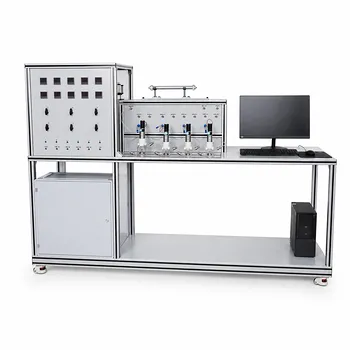
The root cause of most catalyst failures in steam reforming training units is the silent accumulation of solid carbon deposits, known as coke, which physically blocks the active sites. During methane steam reforming (MSR), high temperatures accelerate the decomposition of methane into surface carbon. In ethanol steam reforming (ESR), the reaction network is even more complex, where the intermediate formation of ethylene and subsequent cracking leads to rapid coking. This is compounded by sintering, where high temperatures cause the metal nanoparticles to agglomerate, permanently reducing the catalytically active surface area. Effective mitigation relies on a dual strategy: leveraging advanced catalyst support materials with high oxygen storage capacity to continuously gasify carbon, and implementing precise operational controls on temperature and the steam-to-carbon (S/C) ratio.
The persistent challenge in pilot-scale steam reforming isn't just the chemical reaction, but an engineering battle against material degradation. Optimal performance hinges on a deep understanding of the metal-support interface, where the choice of a carrier like ceria (CeO2) can actively clean the catalyst surface, and disciplined process control prevents the formation of the coke precursors in the first place.
Diagnosing the Dual Mechanism of Deactivation
To solve the problem, you must separate the intertwined causes. Both MSR and ESR suffer from a one-two punch of physical blockage and structural damage.
The Coking Cascade in Methane and Ethanol Systems
The primary reference correctly identifies coking as the dominant deactivation pathway. However, the chemistry of carbon formation differs critically between the two feedstocks.
- In Methane Steam Reforming (MSR): The high temperatures required (often above 500°C) favor methane’s deep dehydrogenation. Without enough steam, methane cracks on the nickel surface, leaving behind hard, graphitic carbon filaments.
- In Ethanol Steam Reforming (ESR): The pathway is more precarious. Ethanol first dehydrates to ethylene, especially on acidic support sites. Ethylene then polymerizes and cracks, forming a soft, encapsulating coke that blankets the active metal instantly.
Sintering: The Permanent Loss of Active Sites
Fouling by coke is often reversible; sintering is not. Under the high operating temperatures of a pilot plant, the metal crystallites (typically Ni or Co) become mobile. They migrate across the support surface and coalesce into larger particles. This reduces the surface-area-to-volume ratio, permanently destroying the active sites where C-H, O-H, and C-C bonds are broken. The supplementary references highlight that this agglomeration is often accelerated by steam, making it a central design problem for a robust training unit.
Engineering Material Solutions for Stability
The right catalyst formulation doesn’t just resist carbon; it actively destroys it. The choice of active metal and support determines the lifespan of the reactor bed.
Leveraging Active Support Materials
The support is not an inert carrier; it is a chemical participant. The primary reference's mitigation advice relies heavily on this.
- Ceria (CeO2) for Oxygen Delivery: CeO2 acts as an oxygen reservoir. It can switch between Ce4+ and Ce3+ oxidation states, releasing oxygen at the metal-support interface. This surface oxygen reacts with adsorbed carbon atoms, gasifying them into CO and freeing the active metal site.
- Zirconia (ZrO2) for Thermal Resistance: Doping a support with ZrO2 stabilizes the crystal structure against sintering. It inhibits the phase transformation that typically causes the support to collapse and trap the active metal particles.
- Avoiding Problematic Carriers: Charged with hydroxyl groups, basic supports like MgAl2O4 promote steam adsorption and mitigate the acidity that catalyzes the ethanol-to-ethylene dehydration route, directly preventing the precursor for ESR coking.
Choosing the Right Active Phase
A complete analysis moves beyond cost.
- Nickel (Ni) vs. Noble Metals: While the primary reference implies high-activity, low-temperature catalysts are a solution, the supplementary references add nuance. Ni is cost-effective and highly active but inherently susceptible to carbon nucleation. Noble metals (Pt, Rh) are resistant but cost-prohibitive for a full pilot bed.
- The Case for Cobalt (Co) in ESR: For ethanol reforming, Co offers a strategic advantage. It possesses higher innate resistance to carbon filament growth than Ni in the 400–800°C range, making it a superior choice if the primary goal is long-term stability over maximum per-gram activity.
Operational and Plant Design Strategies
Intelligent reactor design can compensate for the thermodynamic limits of the catalyst itself.
The Guard Bed Principle
The concept of a sacrificial guard bed, detailed in the supplementary materials, is critical for training units that may use inconsistent or unpurified feedstocks, particularly bio-ethanol. A small, replaceable bed of a high-capacity adsorbent or a sacrificial catalyst upstream of the main reactor captures irreversible poisons (like sulfur) or decomposes heavy tars before they reach the sensitive reforming catalyst. This mirrors industrial best practice and teaches operational safety.
Dynamic Temperature Control
The primary reference notes mitigation via catalysts active below 700°C. The deeper insight from the supplementary references is the strategy of temperature programming. A well-designed training unit can implement a control logic that gradually ramps the bed temperature over a 50-hour run. This compensates for slow, inevitable sintering by providing the remaining active sites with more thermal energy to maintain constant conversion, extending the useful data-collection window of the experiment.
Understanding the Trade-offs
No single solution eliminates the problem without introducing a new liability. Objectivity requires acknowledging these conflicts.
- Steam-to-Carbon Ratio: Cleaning vs. Efficiency: The primary reference stresses precise S/C control to promote gasification. An overly high S/C ratio (e.g., 4:1) effectively removes coke but incurs a massive energy penalty, cools the catalyst bed, and can accelerate the sintering of metals like Ni through hydrothermal effects.
- Activity vs. Stability: A highly dispersed Ni catalyst on a pure silica support may start with very high activity. However, without a structural promoter and an oxygen-storing support, it will deactivate within hours. You must accept a slightly lower peak conversion for a dramatically longer lifetime.
- Regeneration Complexity: Integrating an oxygen injection system for controlled coke combustion (regeneration) is powerful. However, the exothermic burn can easily damage the catalyst if not meticulously controlled, turning a reversible poison into a permanently fused mass. This is a high-risk, high-reward feature for any pilot unit.
Making the Right Choice for Your Training Goal
Your specific research or educational objective dictates the optimal mitigation strategy.
- If your primary focus is demonstrating steady-state kinetics over a long run: Select a 0.5% Pt/CeO2-ZrO2 catalyst. Operate below 650°C with a high S/C ratio to prioritize near-permanent stability over maximizing conversion yield per pass.
- If your primary focus is maximizing hydrogen yield from a compact reactor volume: Use a high-loading Ni/MgAl2O4 catalyst. Accept a shorter lifespan and integrate a strict feedstock purification protocol with a sacrificial guard bed to delay the inevitable carbon accumulation.
- If your primary focus is teaching students the chemistry of deactivation and regeneration: Design the system with a Co-based catalyst for ESR. Run it under aggressive, low-S/C conditions to induce rapid coking for a clear experimental signal, then demonstrate the recovery of activity through a carefully metered air-oxidation cycle as detailed in the regeneration protocols.
A deep understanding of these mechanistic pathways transforms catalyst deactivation from a frustrating operational failure into a predictable, manageable, and teachable variable.
Summary Table:
| Deactivation Cause | Mechanism | Mitigation Strategy |
|---|---|---|
| Coking (MSR) | Carbon cracking on metal surfaces at high temperatures | Optimize Steam-to-Carbon (S/C) ratio; use CeO2 supports |
| Coking (ESR) | Ethylene polymerization on acidic support sites | Use basic supports (MgAl2O4) or Co-based catalysts |
| Sintering | Metal nanoparticle agglomeration due to high heat/steam | Dope supports with ZrO2; implement dynamic temperature control |
Optimize Your Chemical Engineering Lab with LABPARK
Building robust pilot-scale systems requires balancing complex chemical reactions with real-world engineering constraints. LABPARK provides premium Educational and Vocational Unit Operations Pilot Plants in chemical engineering, bioprocess & biotech, and environmental & water treatment. Designed for universities, research institutes, and enterprises, our training units help students and researchers master catalyst dynamics, process control, and reactor maintenance.
Ready to elevate your research and training capabilities? Contact LABPARK today to find the perfect pilot plant solution for your lab!
Related Products
- Fixed-Bed Chemical Reaction and Gas Dust Tar Removal Unit Operations Pilot Plant
- Multi-Reactor Educational Pilot Plant for Reaction Engineering Unit Operations
- Fixed Bed Gas Solid Catalytic Reaction Educational Pilot Plant
- Ethylbenzene Dehydrogenation Educational Unit Operations Pilot Plant
- Chemical Pipeline Assembly and Fluid Transport Practical Training Unit Operations Pilot Plant
People Also Ask
- When to transition from PID to adaptive control in pilot plants? Key process indicators.
- How do deviations in estimating latent heat impact pilot plant thermal systems? Avoid hardware mis-sizing.
- Why Compare Predicted and Experimental Excess Enthalpy? Key to Accurate Pilot Plant Scale-up
- How to study gasification in pilot plants? Compare exit gas composition & efficiency
- Why Use PTFE & Hastelloy in Chemical Pilot Plants? Prevent Corrosion & Ensure Safety