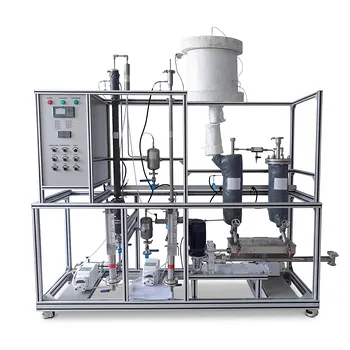
The choice between glass-lined and fluoropolymer-lined vessels for a pilot reactor is a classic battle between chemical toughness and mechanical resilience. Glass-lined steel delivers exceptional, high-temperature resistance to most acids and organic chemicals, but its brittleness makes it a liability under thermal or physical stress. Fluoropolymer linings forgive those shocks and offer superior protection against alkalis and hydrofluoric acid, yet they impose strict temperature ceilings and demand flawless bonding to prevent stealthy permeation failures.
For pilot-scale work, where temperature swings, frequent changeovers, and aggressive cleaning cycles are the norm, a glass lining’s catastrophic fragility often outweighs its chemical inertness. A fluoropolymer lining’s forgiving flexibility and alkali resistance make it the safer default—unless your process demands sustained temperatures above 200°C.
Glass-Lined Steel: Uncompromising Acid Resistance at a Price
How the Enamel Lining Protects
Glass linings are fused to the steel shell at over 800°C, creating a chemically inert, oxide-rich surface that resists attack from virtually all organics, salts, and acids except hydrofluoric acid. This barrier works from cryogenic temperatures up to the glass’s softening point (typically near 350°C), making it a workhorse for hot sulfuric, hydrochloric, or nitric acid reactions.
Where the Weakness Hides
The lining is a brittle glass, not a flexible coating. Even a rapid 50°C temperature swing can crack it, exposing the steel substrate to corrosive attack. Mechanical impact—a dropped tool, a stirrer banging against the wall—can chip the enamel instantly. And because glass dissolves in hot, concentrated alkalis and hydrofluoric acid, any caustic cleaning step or unexpected pH excursion becomes a high-stakes event.
The Repair Reality Check
Once chipped, glass cannot be economically re-enameled on site. Specialized tantalum plugs can patch small defects, but this is a temporary fix that leaves a metallic spot vulnerable to different corrosion modes. Frequent plugging erodes confidence in the integrity of your pilot data.
Fluoropolymer Linings: Flexibility and Alkali Protection
A Soft Barrier That Flexes
PTFE and PVDF linings are polymer sheets bonded—or mechanically locked—to the steel interior. They remain ductile under thermal cycling and resist cracking from mechanical knocks. This inherent toughness makes them far more forgiving during installation, commissioning, and routine pilot-plant modifications.
Chemical Fortitude Where Glass Fails
Fluoropolymers excel exactly where glass falls short: strong alkalis and hydrofluoric acid pose no threat. Their near-universal chemical resistance is limited only by a few exotic reagents like molten alkali metals or elemental fluorine. For a pilot plant that may run alkaline hydrolysis one day and a fluorous synthesis the next, this broad-spectrum defense is invaluable.
The Hidden Risks: Temperature and Permeation
The Achilles’ heel is heat. PTFE linings top out around 250°C, while PVDF cannot reliably exceed 140°C. Beyond these limits, the polymer softens, loses mechanical integrity, and may flow or blister. Equally dangerous is low-temperature permeation: small molecules like HCl or water vapor slowly diffuse through the lining and condense at the polymer-steel interface. If the bond isn’t perfect, this accumulation can cause vacuum collapse—the liner buckles inward under normal process vacuum, tearing away from the wall and shutting down the reactor.
Understanding the Critical Trade-offs
Thermal Shock vs. Temperature Ceiling
A glass-lined vessel can handle a 350°C steady-state process but will crack with a sudden 80°C temperature change. A PTFE-lined vessel can shrug off water quenching after a 200°C run but degrades rapidly if the jacket steam exceeds 260°C. Choose based on the steepest thermal gradient your pilot protocols will ever see, not just the maximum operating temperature.
Chemical Universality vs. Brittle Exclusions
Fluoropolymers offer the widest chemical compatibility envelope in the industry—they laugh at alkalis and HF—while glass demands that you treat caustic and fluoride ions as show-stoppers. However, glass provides absolute, non-permeating protection against hot, concentrated mineral acids where PTFE might suffer vapor blistering.
Maintenance and Longevity in a Pilot Context
Pilot plants live in a world of constant reconfiguration. Fluoropolymer linings can often be field-repaired or re-bonded. Glass requires a Tantalum plug repair kit and a prayer. Over the 2-5 year life of a typical pilot campaign, the probability of a glass vessel surviving without a mechanical incident is lower than that of a properly bonded fluoropolymer lining—especially if operators are still learning the process.
The Bonding Quality Gap
A fluoropolymer liner’s reliability is only as good as its adhesion to the steel wall. Poor bonding invites immediate permeation blisters and eventual collapse. Glass linings have no such bonding dependency; the enamel becomes one with the metal. When ordering a fluoropolymer-lined reactor for a pilot plant, insist on spark testing and hot-dry cycles to validate the bond before accepting delivery. This extra step is a non-negotiable quality gate.
Making the Right Choice for Your Pilot Reactor
Your decision should anchor to the harshest condition you expect during the entire campaign—not just the primary reaction. Consider heat-up ramps, cleaning cycles, and possible excursions.
- If your process involves sustained temperatures above 200°C with hot, concentrated mineral acids and zero alkaline exposure: A glass-lined vessel brings the highest chemical inertness and no permeation risk. Ensure your operators are trained to avoid thermal shock and mechanical impact.
- If you need to handle strong alkalis, hydrofluoric acid, or frequent thermal cycles from aggressive heating/cooling steps: A fluoropolymer lining (PTFE for up to 250°C, PVDF for more economical sub-140°C service) will give you the flexibility and chemical coverage you need. Budget for rigorous bond-integrity testing before the first run.
- If your pilot plant must cover a broad, unpredictable chemistry scope with rapid changeovers: Prioritize fluoropolymers. The forgiving nature and alkali/fluoride resistance reduce the chance of a single mistake destroying your reactor shell. Accept the lower temperature ceiling and invest in proper permeation prevention.
The smartest pilot-plant investment isn’t the most inert material on paper—it’s the one that can survive the reality of your operating culture, your cleaning procedures, and your inevitable process upsets.
Summary Table:
| Feature | Glass-Lined Steel | Fluoropolymer-Lined (PTFE/PVDF) |
|---|---|---|
| Acid Resistance | Exceptional (except HF) | Near-universal |
| Alkali & HF Resistance | Poor (causes degradation) | Excellent |
| Max Operating Temp | Up to 350°C | PTFE: ~250°C / PVDF: ~140°C |
| Thermal Shock | High risk of cracking | Excellent resistance |
| Mechanical Durability | Brittle; prone to chipping | Forgiving and ductile |
| Repair & Maintenance | Requires complex tantalum plugs | Field-repairable / re-bondable |
Scale Up Your Pilot-Scale Operations with LABPARK
Selecting the right reactor vessel lining is critical to ensure process safety, reliability, and accurate data collection. LABPARK provides premium Educational and Vocational Unit Operations Pilot Plants in chemical engineering, bioprocess & biotech, and environmental & water treatment tailored for universities, research institutes, and enterprises.
Avoid costly equipment failures and optimize your chemical processes. Contact LABPARK today to design the perfect pilot plant solution for your facility!
Related Products
- Micro-Scale Gas-Solid Catalytic Reaction Educational Pilot Plant
- Fixed-Bed Chemical Reaction and Gas Dust Tar Removal Unit Operations Pilot Plant
- Fixed Bed Gas Solid Catalytic Reaction Educational Pilot Plant
- Residence Time Distribution and Reactor Flow Characteristics Determination Educational Pilot Plant
- Multi-Reactor Educational Pilot Plant for Reaction Engineering Unit Operations
People Also Ask
- Why is a multibed configuration necessary for exothermic reactions? Optimize your pilot plant trajectory.
- Fluidized vs. Fixed Bed Reactors: Comparing Heat & Complexity in Pilot Plants
- Why is thermal management a major challenge in methane oxidative coupling? Reactor Solutions for Pilot Plants
- How does the Mears criterion evaluate transport resistance? Key Guide to Intrinsic Kinetics
- How do reactor pilot plants safely study gas-solid reactions? Master kinetics with thermal & flow control.