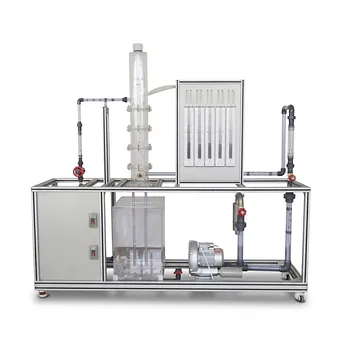
Packing support devices in an educational pilot plant must satisfy three non-negotiable structural requirements: mechanical strength, high open area, and phase distribution integrity. In practice, this translates to a support plate strong enough to bear the combined weight of wet packing and pressure drop, yet open enough to prevent liquid backup (flooding). Common types include grid plates for random packing, perforated pipe distributors for smaller liquid loads, and gas-injection (hump) supports for high gas-rate experiments.
The core purpose of a packing support isn't just to hold weight; it's a hydraulic balancing act. In a packed column, the support's free area must exceed the packing's void space. If the support is even slightly restrictive, it becomes the bottleneck where liquid backs up, causing premature flooding that ruins the experiment's mass transfer data and teaches incorrect hydraulic principles.
Why the Support Plate is the Column's Hydraulic Bottleneck
The most critical lesson a pilot plant can teach is the concept of a flooding point. The support plate is the most common unintended failure point for this demonstration.
The Priority of Free Area Ratio
The primary reference specifies that the open area of the support must be greater than the void fraction of the packing. This is a strict design rule, not a suggestion. If you are using structured packing with 98% void space, a 70% open-area grid plate is a liability. The liquid will pool exactly at the support interface, decoupling the measured pressure drop from the packing's actual performance.
Mechanical Stiffness Prevents Bed Movement
Beyond corrosion resistance, the support's rigidity prevents sagging that would compress the packing at the bottom. In educational settings, where columns are frequently repacked with different media, a permanently deformed support plate destroys the uniform gas inlet velocity profile.
The Three Fundamental Structural Requirements
These requirements form a performance triangle. Sacrifice one, and the plant stops being an accurate teaching tool.
1. The Ability to Bear the "Wet" Dead Load
Students often underestimate the weight by ignoring liquid holdup. The support must hold the packing, but critically, the dynamic weight of the retained operating liquid. The design must factor in the pressure drop pushing down on the liquid layer. If the grid is too thin, it flexes, cracking ceramic saddles and altering the bed's porosity.
2. Preventing the "Liquid Backup" Mechanism
This is the primary hydraulic requirement. Gas rises up, liquid cascades down. If the holes in the support plate are too small or spaced wrongly, the gas velocity through those remaining holes increases sharply. This high interstitial velocity physically suspends the descending liquid, creating a seal. The column floods first at the support, not in the bed itself. This gives students a false, mechanical flood point unrelated to the packing's theoretical capacity.
3. Uniform Phase Distribution
The support acts as a primary gas distributor for the entire packed bed. If the support has a solid outer ring, gas channels through the center. A properly designed support utilizes the entire cross-section immediately. Moreover, it must feature integrated liquid collectors or drainage tongues to guide the liquid away from the gas inlet zone.
Types of Packing Supports in Educational Systems
Your choice depends on whether you are running a gas-side or liquid-side limited experiment. The primary reference defines three primary geometries.
Grid Plate Supports (栅板型)
This is the industry workhorse and the most common choice for ceramic or metal random packing. It consists of a heavy, segmented plate with slotted perforations.
- Application: Holds dense ceramic Berl saddles or Raschig rings securely.
- Educational Trade-off: While robust, the gas injection point is flat. This can create undesirable turbulence directly below the bed, teaching students about poor initial distribution unless a separate gas distributor is used.
Gas-Injection or Hump Supports (驼峰型)
This is the preferred high-performance support for modern education. It resembles a series of parallel, raised trapezoids or humps with lateral slots.
- Key Advantage: Gas enters through the side faces of the humps, away from the liquid outlet. The liquid flows down the valleys between the humps. This physically separates the two phases at the column's most critical junction.
- Educational Value: It offers the widest turndown ratio. It allows students to successfully operate at extremely low liquid loads without weeping through the gas inlet, a failure common with flat grids.
Perforated Pipe Distributors (孔管型)
Used less as a weight-bearing support and more as a support-distributor hybrid in narrow-diameter pilot columns, particularly for structured packing or for liquid distribution above a bed.
- Configuration: A ladder of perforated tubes supports the bed while maintaining high open area for gas. However, it struggles with heavy random packing that falls through large gaps, requiring a secondary mesh—which students must be warned can easily blind or clog.
Common Pitfalls to Avoid
Many student-led investigations fail not because of poor theory but because of installation ignorance.
Ignoring the "Zero-Gap" Rule
A gap between the column wall and the support plate is catastrophic. The wall acts as a channel for gas bypassing. Even a 3-mm gap allows a significant fraction of the gas to shortcut the packing, rendering HETP (Height Equivalent to a Theoretical Plate) calculations invalid. Educational supports must have tight zero-tolerance dimensions or effective flange seals.
Ignoring Corrosion and Wear in Ceramics
When demonstrating acid stripping, metal supports corrode. When using metal packing, ceramic supports can fracture from repeated loading and unloading. For an educational plant that changes configurations weekly, the support must be over-engineered for mechanical abuse, not just steady-state weight.
Making the Right Choice for Your Educational Goals
When selecting the support for a pilot plant, align the material and type with the specific learning outcome.
- If your primary focus is visual hydraulics and binary distillation: Choose a clear acrylic column section directly above a gas-injection (hump) support. This allows students to observe the clear separation of gas and liquid before entry into the bed.
- If your primary focus is testing heavy, high-density random packing: Select a multi-segment grid plate with heavy-duty bolting. Ensure the segments sit perfectly flush to prevent differential settling that exposes the column wall to bypassing.
- If your primary focus is HETP measurement for structured packing in a small-diameter column: Use a low-profile perforated pipe or narrow flat grid that provides maximum open area, verifying the gas F-factor is calculated at the support plane to catch support losses immediately.
- If your primary focus is demonstrating the "wet loading" technique with ceramics: The support must handle the dynamic sloshing of water during installation without shifting, reinforcing the principle that packing support integrity begins before the experiment starts.
A pilot plant's value is measured by how clearly it demonstrates first-principle physics; the packing support, if properly specified, silently ensures the experimental data reflects the packing's performance rather than the equipment's flaws.
Summary Table:
| Support Type | Key Advantage | Best Application |
|---|---|---|
| Grid Plate (栅板型) | High load capacity and mechanical stiffness | Heavy random packing (ceramic/metal) |
| Gas-Injection / Hump (驼峰型) | Separates gas/liquid phases; wide turndown ratio | Visual hydraulics and high-performance gas/liquid separation |
| Perforated Pipe (孔管型) | High open area and low profile | Structured packing in small-diameter columns |
Elevate Your Chemical Engineering Lab with LABPARK
Are you looking to provide students and researchers with hands-on, industry-accurate experimental data?
LABPARK provides state-of-the-art Educational and Vocational Unit Operations Pilot Plants in chemical engineering, bioprocess & biotech, and environmental & water treatment. Specifically designed for universities, research institutes, and enterprises, our systems feature robust, professionally designed packing columns that prevent hydraulic flooding and ensure reliable HETP measurements.
Contact LABPARK today to discuss your laboratory requirements and request a customized equipment solution!
Related Products
- Packed Bed Absorption Educational Unit Operations Pilot Plant
- Absorption and Desorption Educational Unit Operations Pilot Plant
- Bench Scale Dual Column Gas Separation and Capture Educational Pilot Plant
- Plate Column Hydrodynamics Tray Demonstration Educational Pilot Plant
- Educational Rotary Disc Liquid-Liquid Extraction Pilot Plant
People Also Ask
- How Do Flow Regimes Transition in Packed Bed Pilot Plants? Key Scale-up Insights
- How does reactant concentration determine absorption column control? Gas-film vs. dual-film.
- How is the packing height of an absorption column calculated? Master HTU & NTU Concepts
- How does the wall effect impact packed-bed conversion? Essential pilot plant scale-up tips.
- How does static vs. operating holdup affect pilot plant calibration? Avoid Critical Scale-Up Errors