The fundamental principle behind treating high-concentration organic wastewater with advanced oxidation is simple: you must create an environment where the most stubborn chemical bonds shatter, leaving only harmless molecules. Supercritical Water Oxidation (SCWO) achieves this by heating and pressurizing water past its critical point, creating a single, super-dense fluid where organic waste and oxygen mix perfectly for a near-instantaneous reaction. Catalytic wet oxidation, by contrast, accelerates this breakdown in the liquid phase using a catalyst, offering a powered-up but distinct alternative for highly toxic streams. Environmental treatment pilot plants are the non-negotiable bridge to reality, allowing you to assess not just if a reaction works, but if it can work safely, continuously, and economically at scale.
Before committing to a high-pressure oxidation system, you must understand that the core challenge is not just chemistry, but physics. The true hurdle is engineering reliable mass transfer, managing corrosive environments, and handling the extreme thermal profiles. Pilot plants are your only laboratory for solving these interconnected physical problems.
Decoding the Principle of Supercritical Water Oxidation (SCWO)
SCWO transforms water from a familiar liquid into a chemically alien solvent. The goal is to leverage this new phase to completely bypass the typical barriers that slow down oxidation.
The Magic of Crossing the Critical Point
Water's critical point is at 374.2°C and 22.0 MPa. Above this threshold, something profound happens.
The dielectric constant plummets. Water suddenly behaves like a non-polar solvent, becoming completely miscible with organic compounds and oxygen.
This creates a single, homogeneous phase reaction environment. The physical barrier between gas (oxygen) and liquid (waste) simply vanishes. Oxidation is no longer limited by how fast you can bubble air into water.
Why the Reaction is So Fast and Complete
Operating at extreme conditions (often 552°C and 25 MPa) drives the chemistry to completion in seconds. Total organic carbon (TOC) removal rates exceed 97%.
The single-phase environment guarantees that every organic molecule is surrounded by oxygen molecules at a molecular level. The oxidation reaction proceeds rapidly and uniformly, converting complex pollutants directly into CO2, H2O, and N2.
Inorganic salts, which are no longer soluble, precipitate out as solids. This allows for their removal and prevents them from interfering with the reaction.
How Catalytic Wet Oxidation Works
Catalytic wet oxidation operates on a different strategic premise. It keeps water in the liquid phase but introduces a solid catalyst to create a highly reactive surface, making it suitable for concentrated or highly toxic streams that might not require the extreme conditions of SCWO.
The Role of High-Pressure Liquid Phase Chemistry
Instead of turning water into a non-polar solvent, this process increases the solubility of oxygen in hot, high-pressure liquid water. The heart of the technology is a specialized catalyst.
The catalyst’s surface provides active sites where organic pollutants and dissolved oxygen adsorb. This proximity lowers the activation energy, allowing oxidation to proceed at significantly lower temperatures and pressures than SCWO.
The process is particularly tuned for high-concentration or highly toxic wastewater. The catalyst can be designed for selectivity, targeting specific noxious compounds for destruction while managing a concentrated organic load.
Comparing the Two Destructive Philosophies
SCWO uses brute-force thermodynamics by altering the solvent's fundamental nature to achieve a universal, high-speed wipeout. Catalytic wet oxidation uses a more surgical kinetic approach.
The former excels at achieving the highest possible destruction efficiency for nearly any organic. The latter trades that ultimate performance for potentially lower operating costs and gentler process conditions, but must constantly manage catalyst deactivation and poisoning from the wastewater's inorganic contaminants.
The Critical Role of Environmental Treatment Pilot Plants
A pilot plant is not a glorified benchtop experiment. It is a risk-reduction tool designed to reveal the engineering truths that textbook chemistry hides.
Safely Testing Extreme and Hazardous Conditions
These pilot systems allow laboratories to safely handle high pressures, temperatures, and deadly wastes in a controlled, small-scale environment. They are designed specifically for testing processes on real, hazardous mixtures like phenols and pesticides.
Researchers use them to assess TOC removal rates under realistic dynamic flow conditions, not just in a static pressure vessel. A key output is determining the optimal catalyst formulation and its long-term stability, particularly against poisoning.
Bridging the Gap from Chemistry to Engineering
The most valuable data from a pilot plant is often not about the reaction itself, but the vessel’s survival. Evaluating corrosion resistance is paramount. Supercritical water, especially with halogens or salts, can be incredibly aggressive to even high-grade alloys.
Thermal integration is the second critical parameter. A pilot plant lets you test heat exchangers and energy recovery systems. An SCWO process that vents all its heat is economically dead on arrival; the pilot proves if you can use the exothermic reaction’s heat to pre-heat the incoming cold waste.
Finally, these systems provide the essential scale-up data for industrial design. They reveal flow distribution problems, salt-plugging mechanisms, and byproduct quenching needs that are invisible in a lab beaker.
Understanding the Trade-offs
Choosing between these technologies is a battle against hidden costs and physical limits. The "best" chemical process is the one whose engineering challenges you can solve most economically.
The Corrosion and Engineering Nightmare of SCWO
SCWO’s Achilles' heel is the reactor itself. The mixture of supercritical water, oxygen, and often halogenated organics or inorganic salts creates a spectacularly corrosive environment.
High pressures (above 22 MPa) demand thick-walled, expensive reactors. Salt precipitation, while a nice separation mechanism, can quickly plug reactors and heat exchangers. A pilot plant’s primary job is to test whether a chosen alloy can survive these conditions for months, not just hours.
The Deactivation Risk in Catalytic Wet Oxidation
The catalyst in wet oxidation is a consumable filter, not a magic bullet. Heteroatoms like sulfur or heavy metals in the waste stream can poison the catalyst, permanently deactivating its surface.
While the process operates at a lower temperature, maintaining that temperature against a variable organic load requires careful thermal control. The pilot plant is essential to track catalytic activity over time and calculate the real cost-per-gallon of replacing or regenerating the catalyst bed.
Making the Right Choice for Your Goal
Your choice of technology and how you use a pilot plant must follow your primary operational objective. The experiment program must confirm the main design assumptions.
- If your primary focus is unparalleled destruction efficiency for the most recalcitrant waste: Direct your pilot plant studies toward SCWO, focusing heavily on corrosion coupon mass loss and heat exchanger fouling rates.
- If your primary focus is treating a concentrated, known toxic stream with lower capital cost: Optimize a catalytic wet oxidation pilot system, and dedicate your testing to measuring catalyst activity decay curves and poisoning thresholds.
- If your primary focus is gaining fundamental reaction engineering data: Use the pilot plant to study reaction kinetics, byproduct formation pathways, and validate computational fluid dynamics models of the reactor.
A successful oxidation process isn't just a chemical formula; it's an engineered system whose physical survival must be proven before it can ever clean a drop of water.
Summary Table:
| Feature | Supercritical Water Oxidation (SCWO) | Catalytic Wet Oxidation (CWO) |
|---|---|---|
| Reaction Phase | Single-phase (supercritical fluid) | Liquid phase (with solid catalyst) |
| Typical Conditions | Extreme (>374°C, >22 MPa) | Moderate high temp/pressure |
| TOC Removal Rate | >97% (universal) | High (catalyst-dependent) |
| Main Challenge | Reactor corrosion and salt plugging | Catalyst deactivation and poisoning |
| Pilot Plant Focus | Alloy testing and heat integration | Catalyst lifetime and decay curves |
Bring Advanced Oxidation to Life with LABPARK Pilot Plants
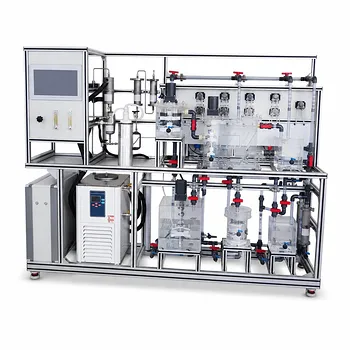
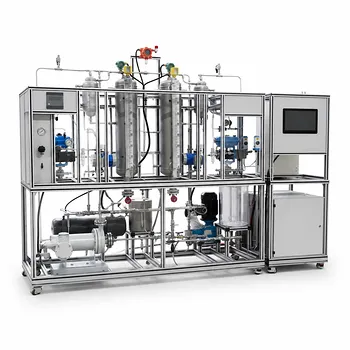
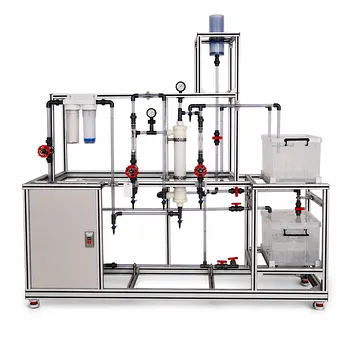
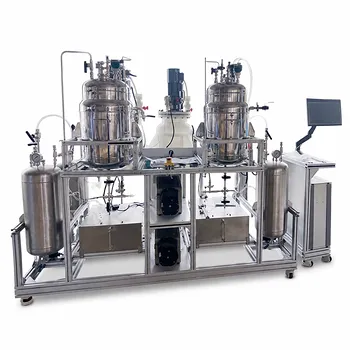
Transitioning SCWO or catalytic wet oxidation from theory to practice requires robust, reliable data. LABPARK provides premium Educational and Vocational Unit Operations Pilot Plants in chemical engineering, bioprocess & biotech, and environmental & water treatment for universities, research institutes, and enterprises.
Why partner with LABPARK?
- Engineered for Safety: Safely manage extreme temperatures, pressures, and corrosive environments.
- Accurate Scale-Up Data: Gather critical insights on TOC removal, thermal efficiency, and alloy durability.
- Tailored Systems: Customized configurations to align perfectly with your research and training objectives.
Let us help you build the bridge between chemistry and industrial application. Contact LABPARK today to discuss your project!
Related Products
- Supercritical High-Gravity Flash Evaporation Educational Unit Operations Pilot Plant
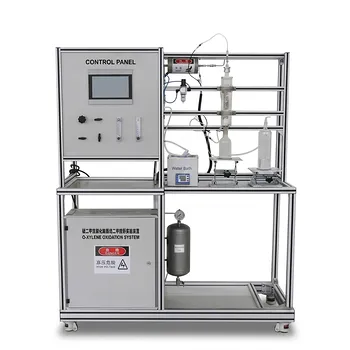
- O-Xylene Oxidation to Phthalic Anhydride Educational Unit Operations Pilot Plant
- Photocatalytic Membrane Separation and Degradation Unit Operations Pilot Plant
- Electrochemical Water Treatment Educational Unit Operations Pilot Plant
- Multi-Functional Special Distillation Educational Pilot Plant
People Also Ask
- How is the heat transfer area calculated for an evaporation unit operations pilot plant during experimental design? Guide
- How to select educational evaporator pilot plants for thermal & scaling solutions? Complete Guide
- What is the practical significance of Kb in pilot plant evaporation? Master process design.
- How to Select Natural vs. Forced Circulation Evaporators by Feed Type
- How do flash calculations relate to flash evaporation pilot plants? Bridge Theory and Practice