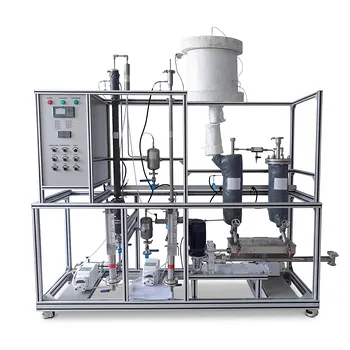
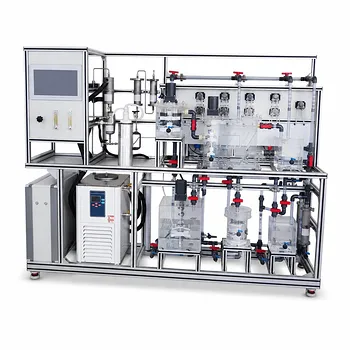
The choice between thermochemical and biochemical conversion defines everything in a pilot plant, from the reactor walls to the control systems.
Thermochemical conversion uses intense heat to tear biomass apart into a chaotic mix of gases and oils, requiring rugged, high-temperature hardware. Biochemical conversion, by contrast, relies on enzymes and microbes in a gentle, water-based soup, demanding pinpoint control of temperature, pH, and oxygen. These fundamental process differences drive two completely separate pilot plant blueprints—one built like a miniature refinery, the other like a highly instrumented brewery.
Thermochemical pilot plants are designed around heat and mass transfer at extreme conditions, while biochemical pilot plants are designed around the delicate physiology of living catalysts. The core design challenge for any training facility is that these pathways share almost no common unit operations, forcing a deliberate choice based on educational goals.
The Fundamental Process Differences
The underlying chemistry and physics of these two pathways are worlds apart. That divergence dictates every downstream engineering decision.
Thermochemical Conversion: Breaking Bonds with Heat
Thermochemical processes like gasification and pyrolysis operate at high temperatures (often 500–1000 °C). The organic structure of the biomass is shattered into a broad spectrum of simpler molecules like syngas (CO + H₂) or a complex bio-oil.
This is a brute-force approach. It cares little about the specific molecular structure of the feedstock—it just applies enough thermal energy to break most chemical bonds. The product is a non-selective mixture that often requires extensive upgrading.
Key operating conditions vary by sub-type: gasification uses a carefully controlled, sub-stoichiometric oxygen environment, while pyrolysis operates in the complete absence of oxygen. These atmospheric requirements fundamentally shape the safety and material demands of the reactor.
Biochemical Conversion: Directed by Biological Precision
Biochemical pathways, such as hydrolysis and fermentation, operate in a liquid-phase, mild-temperature environment (usually 30–60 °C). They use enzymes to break down specific polymers like cellulose into sugars, and microorganisms to ferment those sugars into a target molecule like ethanol.
This is a surgical approach. The enzymes and microbes are highly selective, but they are also fragile. They demand a narrow window of temperature, pH, and nutrient balance. Contamination by foreign microbes can kill the entire batch, making aseptic technique and sterility critical concerns.
The product is a highly specific compound dissolved in an aqueous broth, which sets up a very different separation challenge than for thermochemical products.
How These Differences Shape Pilot Plant Design
For a training pilot plant, these process differences translate directly into a list of required unit operations. There is almost no overlap.
The Thermochemical Training Plant: A High-Temperature Refinery
A thermochemical pilot unit must safely contain extreme heat and handle mixed-phase products. The design prioritizes material integrity and gas handling. Key components include:
- High-temperature reactors built from refractory-lined steel or special alloys, often incorporating fluidized beds for superior heat transfer.
- Gas-solid separation cyclones to remove char and ash particles from the hot syngas stream, preventing downstream fouling.
- Gas clean-up and conditioning systems, such as scrubbers and catalytic reformers, to remove tars and adjust the H₂/CO ratio.
- Robust safety systems for managing flammable and toxic gases like carbon monoxide, including extensive leak detection and emergency shutdown logic.
The Biochemical Training Plant: A Sophisticated Farm
A biochemical pilot plant resembles a food or pharmaceutical facility more than a refinery. The design revolves around keeping the biocatalysts alive and productive. Essential equipment includes:
- Jacketed bioreactors and fermenters with precise, automated control loops for temperature, pH, and dissolved oxygen (DO). A jacket allows for heating to sterilize and cooling to remove metabolic heat.
- Sterilization-in-place (SIP) and clean-in-place (CIP) systems to prevent cross-contamination between student experiments.
- Liquid-solid separation, beginning with filtration to remove unreacted solids like lignin, followed by distillation columns to concentrate the biofuel product from the dilute fermentation broth.
- Upstream pretreatment vessels for breaking down the tough lignocellulosic structure of biomass, making it accessible to enzymes.
Understanding the Trade-offs
This architectural split presents a direct trade-off for any educational program. A single, versatile pilot plant covering both pathways equally well is economically impractical.
The capital cost structure diverges completely. Thermochemical systems are built from expensive, high-grade materials to resist heat and corrosion. Biochemical systems invest instead in precision sensors, automated controllers, and sterile valves. A facility trying to do both risks owning two half-built, compromised plants.
The operational skills developed are also distinct. Training on a thermochemical plant builds competencies in high-temperature process safety, gas chromatography, and catalyst management. Biochemical training develops expertise in microbiology, aseptic technique, and the dynamics of living systems. Mixing them in a single curriculum without dedicated equipment can lead to shallow, non-transferable skills.
Finally, feedstock flexibility can't be conflated with process flexibility. A gasifier can handle a wide range of low-quality, mixed feedstocks. A fermentation process demands a more consistent, pre-processed sugar stream. The training plant's design locks in which real-world challenge the students will be prepared to tackle.
Making the Right Choice for Your Training Goal
The best pilot plant design is the one that matches your educational mission. There is no single "correct" answer.
- If your primary focus is training for thermochemical roles: Specify a skid-mounted, electrically heated fluidized-bed gasifier with integrated gas clean-up. This builds core skills for bio-power, waste-to-energy, and chemical synthesis from syngas.
- If your primary focus is training for biochemical roles: Invest in a pair of fully instrumented, 50-liter CSTR bioreactors with automated SIP/CIP and a downstream micro-distillation column. This creates deep competence in the fermentation industry, from pharma to advanced biofuels.
- If your primary focus is comparative systems-level analysis: Accept the compromise. Configure two smaller-scale, modular pilot units side-by-side, and direct the budget toward shared analytical instruments and a high-fidelity process control simulator that can model the dynamics of both pathways.
By clearly understanding these design imperatives, you can commission a pilot plant that doesn't just demonstrate processes, but genuinely prepares a new generation of engineers for the distinct realities of the bioeconomy.
Summary Table:
| Feature | Thermochemical Pilot Plants | Biochemical Pilot Plants |
|---|---|---|
| Operating Temp. | High (500–1000 °C) | Mild (30–60 °C) |
| Core Equipment | Fluidized-bed reactors, cyclones, scrubbers | Bioreactors, fermenters, SIP/CIP, distillation |
| Control Focus | Gas pressure, high-temp safety, gas composition | Temperature, pH, dissolved oxygen, sterility |
| Feedstock Selectivity | Low (handles diverse, mixed feedstocks) | High (requires specific, sugar-rich streams) |
| Key Skill Outcomes | High-temp safety, gas chromatography | Aseptic technique, bioreactor dynamics |
Build the Future of Bioenergy Education with LABPARK
Whether your curriculum focuses on high-temperature thermochemical refining or precise biochemical fermentation, LABPARK provides state-of-the-art Educational and Vocational Unit Operations Pilot Plants designed specifically for universities, research institutes, and enterprises.
Empower your students and researchers with hands-on experience in chemical engineering, bioprocess & biotech, and environmental & water treatment.
Contact LABPARK today to customize the perfect pilot plant solution for your facility!
Related Products
- Dual-Mode Rectification Pilot Plant for Practical Training Unit Operations
- Bio-fermentation Ethanol Production Practical Training Unit Operations Pilot Plant
- High-Gravity Emulsification and Mass Transfer Educational Pilot Plant
- Natural Product Extraction Unit Operations Training Pilot Plant
- Continuous Batch Extractive Distillation Educational Pilot Plant
People Also Ask
- How does polyphosphate hydrolysis affect scale and corrosion in pilot plants? Essential Monitoring Guide
- How do predictive thermodynamic models integrate into pilot plants? Bridging Theory and Practice
- Which cross-validation strategy should be selected for pilot plant time-series & batch data? Avoid Data Leakage
- How can process control schemes be configured to teach basic and advanced control?
- Why Use Center Points in Process Analyzer Calibration? Key Benefits Explained