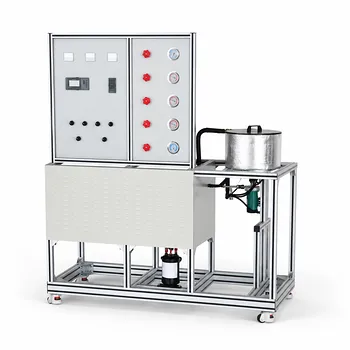
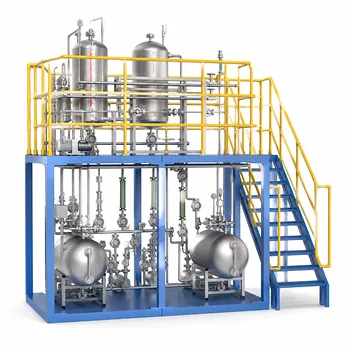
Heat recovery between transient fluid streams in a batch process is anything but steady-state.
The primary operational challenges are flow instability during vessel emptying and the complex scheduling required to synchronize hot and cold streams. As a vessel drains, the falling liquid level reduces pump suction head and disrupts flow, causing heat transfer efficiency to plummet. In unit operations training systems, this forces instructors to teach not just heat exchanger theory, but the real-world art of managing a dying stream and orchestrating batch cycles so that thermal energy is not lost.
Core Takeaway The real challenge in training systems isn’t the heat exchanger design—it’s teaching operators to recognize and respond to the inherent mismatch between transient fluid supply and stable heat transfer demands. Mastering this means controlling flow instability at low vessel levels and building schedules that keep hot and cold streams simultaneously available, even when the plant’s natural rhythm works against it.
Why Stable Heat Recovery is So Elusive in a Batch World
The fundamental problem is that batch operations are dominated by start-and-stop fluid movements, while heat exchangers crave continuous, steady flows. This disconnect creates two intertwined challenges that define the training experience.
The Direct Impact of Flow Instability on Heat Transfer
During a vessel-to-vessel transfer, the process initially looks continuous. The pump delivers a steady rate, and the heat exchanger performs predictably.
The crisis begins as the source vessel nears empty. The liquid level drops, the net positive suction head (NPSH) falls, and the flow rate becomes erratic.
Since the heat transfer coefficient is a strong function of velocity, even a modest drop in flow rate causes a disproportionate collapse in thermal performance. In a training system, students see the outlet temperature drift completely off target, not because of fouling or utility failure, but because the stream itself is fading away. Learning to anticipate this endpoint behavior is a critical operational skill.
The Scheduling Puzzle: Synchronizing Hot and Cold Streams
Heat recovery requires a hot stream that needs cooling and a cold stream that needs heating—at the same time. In a batch plant, these two requirements rarely coincide by accident.
A hot reaction mass may finish and need quenching long before the next cold feed is ready to be preheated. If you wait, you lose the heat. If you store the hot material, you add hold-up steps that extend cycle time.
Training systems must force students to confront this scheduling conflict directly: how do you re-order batches, insert buffer tanks, or adjust cycle times so that heat supply and heat demand overlap? When the scheduling logic becomes too convoluted, the lesson shifts from energy recovery to operational feasibility.
Operational Strategies Built into Training Systems
To teach these challenges honestly, training systems incorporate specific design elements that mirror real plant practices. These are not theoretical—they are hard-wired into the control logic and piping.
Bypass Lines and Exchanger Isolation
The most common defense against low-flow heat transfer collapse is a bypass line around the heat exchanger. As the source vessel level drops below a critical threshold, operators are trained to divert the process fluid away from the exchanger, protecting the equipment from thermal shock and preventing cold-end temperature excursions.
Simultaneously, the heat exchanger is isolated and either drained or kept warm with a low-flow utility stream. Training scenarios emphasize the decision point: exactly when to switch to bypass. Switch too early and you waste recoverable heat; switch too late and you risk process upsets or mechanical damage.
Balancing Process Rhythm and Energy Targets
Effective heat recovery demands a master schedule that considers both production and energy. In training, this is often taught through dynamic simulation exercises where students manipulate batch start times, transfer durations, and intermediate storage.
The goal is to find a rhythm that maximizes simultaneous hot/cold availability without creating bottlenecks. For example, delaying a raw material preheat step by 15 minutes might align it perfectly with a hot product stream that was previously being cooled by a utility. These are tactical decisions, not just thermodynamic ones, and training systems must expose that interplay.
Understanding the Trade-offs
No solution is perfect. The very methods used to manage transient heat recovery introduce their own hidden costs, and honest training must lay these trade-offs bare.
The Efficiency Penalty of Workarounds
When direct heat recovery fails because scheduling cannot be resolved, plants often resort to indirect recovery via thermal storage or utility loops. A hot stream heats an intermediate fluid or a storage tank, and that stored energy is used later to heat a cold stream.
The price is clear: every indirect step introduces a temperature loss (ΔT degradation) and additional capital cost. Overall thermal efficiency drops because you cannot recover heat at the full temperature potential. Training systems must quantify this penalty—often 10-30% lower energy recovery compared to an ideal direct exchange—so that operators understand the true cost of the scheduling gap they are compensating for.
Complexity vs. Realism in Training
Adding bypasses, buffer tanks, and complex sequence controls makes a training system more realistic, but also more difficult to operate. There is a genuine risk of overwhelming students with interlocks and conditional logic before they grasp the core heat transfer physics.
The key trade-off is between pedagogical clarity and operational fidelity. A training system might simplify the schedule to let students focus on the flow instability first, but that creates a danger: they will underestimate the real-world scheduling effort. The best training programs stage this complexity, introducing the full scheduling challenge only after flow management becomes intuitive.
Making the Right Choice for Your Training Goal
The design and operation of a unit operations training system should be driven by the specific skills you want to build. Focus your emphasis based on your primary learning objective.
- If your primary focus is fundamental heat transfer understanding: Prioritize the flow instability challenge. Let students see the direct, real-time impact of decaying flow on exchanger performance. Use simple schedules first, then gradually introduce bypass control logic so the physics remains the central lesson.
- If your primary focus is operational decision-making and plant-wide energy management: Build in the full scheduling conflict. Force students to re-sequence batches, evaluate the cost of buffer tanks, and make the call on when to abandon direct recovery for thermal storage. The lesson is that energy efficiency is an operational, not just a design, property.
- If your primary focus is safety and equipment protection: Highlight the low-flow isolation procedures. Train students to recognize the precursor signals (pump cavitation noise, flickering flow transmitters, temperature spike) and automate the bypass action. The exchanger’s mechanical integrity takes precedence over recovering the last bit of heat.
In every case, the ultimate goal is the same: to replace the naive assumption of steady-state behavior with a confident, hands-on respect for the transient nature of batch processes.
Summary Table:
| Challenge | Primary Cause | Operational Impact | Training Strategy |
|---|---|---|---|
| Flow Instability | Falling vessel level & low NPSH | Reduced velocity & collapsed heat transfer | Implement bypass lines & isolation logic |
| Scheduling Mismatch | Non-coincident hot/cold batch steps | Lost thermal energy or extended cycle times | Teach dynamic scheduling & buffer tank use |
| Efficiency Trade-offs | Use of indirect recovery/thermal storage | 10-30% lower energy recovery & higher cost | Quantify energy loss vs. system complexity |
Bring Real-World Batch Process Challenges to Your Lab
Teaching transient heat recovery requires robust, industry-grade equipment. LABPARK designs and manufactures premium Educational and Vocational Unit Operations Pilot Plants in chemical engineering, bioprocess & biotech, and environmental & water treatment. Our systems help universities, research institutes, and enterprises train operators to master complex flow dynamics, scheduling, and system safety.
Ready to elevate your engineering curriculum or industrial training program? Contact LABPARK today to customize your pilot plant!
Related Products
- Dual Mode Heat Transfer Pilot Plant for Unit Operations Training
- Three-Tube Heat Transfer Educational Pilot Plant for Unit Operations Training
- Comprehensive Multi-Modal Heat Transfer Unit Operations Pilot Plant for Engineering Training
- Multi-Reactor Educational Pilot Plant for Reaction Engineering Unit Operations
- Multi-Modal Distillation Unit Operations Training Pilot Plant
People Also Ask
- When is ε-NTU preferred over LMTD in pilot plants? Predict heat exchanger performance without iteration.
- Why is the prevention of scale formation on heat exchanger surfaces a critical learning objective? Key Lessons
- How do unit conversions affect pilot plant calibration? Avoid errors in heat transfer data analysis
- How is the thermal resistance of a thick-walled hollow cylinder calculated? Key Equations
- How to analyze heat exchanger CAPEX vs. OPEX in pilot plants? Optimizing Process Design Education