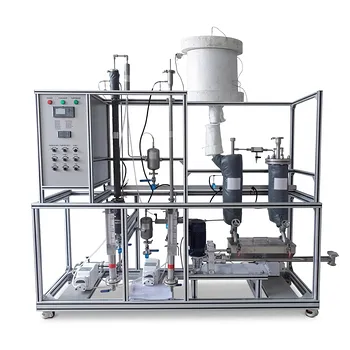
Steam reforming, water-gas shift, and methanation are the textbook triad, but actually operating a reforming or gasification pilot plant demands a broader view—especially when solid feedstocks are involved. You must master the specific hydrocarbon- or carbon-steam reactions that make the synthesis gas, the exothermic oxidation reactions that supply the necessary heat, and the catalytic shift reaction that lets you tune the final H₂/CO ratio.
While steam reforming of hydrocarbons, the water-gas shift, and methanation dominate natural gas‑based syngas production, gasification pilot plants pivot on the endothermic water‑gas reaction (C + H₂O ⇌ CO + H₂) and Boudouard reaction (CO₂ + C ⇌ 2CO), balanced by exothermic carbon oxidation. For any pilot plant, the water‑gas shift reaction emerges as the universal lever to adjust hydrogen yield and composition, and every student must link these reactions to observed temperatures, gas compositions, and energy balances.
The Core Reaction Set for Steam Reforming of Hydrocarbons
When your pilot plant runs on natural gas, naphtha, or light hydrocarbons, three reactions define the entire conversion map.
Steam Reforming – The Syngas Birthplace
The feedstock (CxHy) reacts with high‑temperature steam over a nickel catalyst to produce hydrogen and carbon monoxide.
- Equation: CxHy + xH₂O → xCO + (x + y/2)H₂
- This strongly endothermic reaction absorbs heat and requires a steady, high-temperature energy input—typically around 800°C at the reformer outlet.
- Students track the approach to equilibrium by measuring the outlet CH₄ slip; a high methane concentration signals under‑fired or under‑steamed conditions.
Water‑Gas Shift – Tuning the Hydrogen Output
The shift reaction converts the CO made in the reformer into additional H₂, using excess steam.
- Equation: CO + H₂O ⇌ CO₂ + H₂
- It is mildly exothermic. Lower temperatures favor H₂ production, so industrial and pilot units often split the shift into high‑temperature and low‑temperature stages.
- In a pilot plant, monitoring the CO/CO₂ ratio tells you exactly how far the shift has progressed.
Methanation – The Reverse Path
Methanation drives the reversible steam reforming reaction backward, consuming CO and H₂ to make methane.
- Equation: CO + 3H₂ ⇌ CH₄ + H₂O
- This highly exothermic reaction is typically unwanted in syngas production but becomes the central step when the goal is synthetic natural gas.
- On a pilot scale, even trace methanation in a shift reactor can distort mass balances; students learn to spot it by an unexpected drop in H₂ and CO coupled with a rise in CH₄.
The Fundamental Reaction Network for Gasification of Solid Fuels
When coal, biomass, or coke enters a gasification pilot plant, the chemistry shifts from hydrocarbon steam cracking to heterogeneous gas‑solid reactions. The three reactions that matter most are the water‑gas reaction, the Boudouard reaction, and carbon combustion.
The Water‑Gas Reaction – Primary Producer of Syngas
Steam blown over hot carbon converts the solid into CO and H₂.
- Equation: C + H₂O ⇌ CO + H₂ (ΔH = +118.8 kJ·mol⁻¹)
- This highly endothermic step consumes a massive amount of heat. In fluidized‑bed or entrained‑flow pilots, you must supply that energy through simultaneous oxidation.
- Students measure the H₂/CO ratio downstream to infer whether the bed temperature and steam‑to‑carbon ratio are balanced.
The Boudouard Reaction – CO from CO₂
Carbon dioxide gasifies residual carbon, producing additional carbon monoxide.
- Equation: C + CO₂ ⇌ 2CO (ΔH = +162.4 kJ·mol⁻¹)
- Even more endothermic than the water‑gas reaction, it becomes dominant in high‑temperature, oxygen‑starved zones.
- Operators use CO₂ concentration in the product gas as an indirect indicator of this reaction’s extent; a high CO/CO₂ ratio signals active Boudouard conversion.
Carbon Oxidation – The Thermal Engine
Oxidation is not a syngas‑making reaction per se, but it is the engine that powers all the endothermic gasification steps.
- Partial oxidation: C + ½O₂ → CO (ΔH = -110.5 kJ·mol⁻¹)
- Full combustion: C + O₂ → CO₂ (ΔH = -393.8 kJ·mol⁻¹)
- In a pilot plant, the oxygen‑to‑carbon ratio is the primary knob. Turn it too high, and you burn your product; too low, and the bed temperature collapses, stalling the water‑gas and Boudouard reactions.
The Universal Connector – Water‑Gas Shift Across Both Platforms
Whether you are reforming methane or gasifying coal, the water‑gas shift reaction (CO + H₂O ⇌ CO₂ + H₂) is the final composition‑adjustment tool. It appears:
- Immediately after a reformer to boost hydrogen for ammonia or refinery hydrogen.
- Downstream of a gasifier, often in a dedicated catalytic reactor, to raise the H₂/CO ratio for Fischer‑Tropsch synthesis or pure hydrogen production.
- In a pilot plant, shift reactor temperature profiles and the CO conversion directly demonstrate equilibrium limitations and catalyst activity.
Understanding the Trade‑offs – Endothermic vs. Exothermic Control
The At‑Scale Challenge
In both reforming and gasification, endothermic syngas‑forming reactions must be thermally balanced by exothermic reactions (oxidation, methanation, or shift). This coupling creates a sensitive heat loop.
- Give the reformer too little fuel or the gasifier too little oxygen, and the endothermic reactions quench the temperature, dropping conversion.
- Let the exothermic reactions run too hot, and you risk catalyst sintering, ash melting, or unwanted methane formation.
Common Student Pitfalls
- Neglecting the Boudouard reaction in coal pilots: students sometimes assume CO comes only from steam‑carbon reactions, skewing carbon conversion calculations.
- Misreading the shift reactor exotherm: a rising temperature suggests rapid shift, but if it coincides with a methane increase, methanation is parasitically consuming H₂.
- Ignoring tar and secondary cracking: real gasifiers produce tars that can crack on hot surfaces, altering gas composition in ways pure stoichiometric equations won’t predict.
Making the Calculations Stick – How to Apply This in the Pilot Plant
Use a goal‑driven approach to focus your measurements and control actions.
- If your primary focus is hydrogen production: Concentrate on steam‑to‑carbon ratio in the reformer/gasifier and the inlet temperature of the water‑gas shift reactor. A high steam excess pushes all three hydrogen‑producing steps (steam reforming, water‑gas, and shift) toward completion.
- If your primary focus is syngas for Fischer‑Tropsch or methanol: Aim for a specific H₂/CO ratio (≈2 for many FT catalysts). Manipulate the shift bypass or the oxygen/steam ratio in the gasifier to hit that target without producing excess CO₂.
- If your primary focus is carbon conversion efficiency: Track the gasifier’s cold‑gas efficiency by measuring the energy content of the product gas versus the solid fuel input. Use the Boudouard and water‑gas reaction extents to explain why char remains unconverted when bed temperature drops.
- If your primary focus is energy integration and safety: Map the endothermic and exothermic heat flows across the unit. The oxidation step must always supply just enough energy to maintain the required peak temperature without creating thermal runaway.
Master these reaction networks, and you’ll move beyond simply logging pressures and temperatures—you’ll be able to predict, explain, and optimize the synthesis gas composition in any reforming or gasification pilot plant.
Summary Table:
| Reaction | Chemical Equation | Thermal Nature | Pilot Plant Significance |
|---|---|---|---|
| Steam Reforming | $C_xH_y + xH_2O \rightarrow xCO + (x + y/2)H_2$ | Strongly Endothermic | Primary syngas generator; requires high temperatures (~800°C) |
| Water-Gas Shift | $CO + H_2O \rightleftharpoons CO_2 + H_2$ | Mildly Exothermic | Universal lever to adjust $H_2/CO$ ratio and boost hydrogen yield |
| Methanation | $CO + 3H_2 \rightleftharpoons CH_4 + H_2O$ | Highly Exothermic | Reverse path; target reaction for SNG but unwanted in pure syngas |
| Water-Gas Reaction | $C + H_2O \rightleftharpoons CO + H_2$ | Highly Endothermic | Core gasification reaction for solid feedstocks like coal or biomass |
| Boudouard Reaction | $C + CO_2 \rightleftharpoons 2CO$ | Highly Endothermic | Active in high-temperature, oxygen-starved zones of gasifiers |
| Carbon Oxidation | $C + \frac{1}{2}O_2 \rightarrow CO$ / $C + O_2 \rightarrow CO_2$ | Exothermic | The thermal engine providing heat to run the endothermic reactions |
Bring Industrial Syngas Chemistry to Life with LABPARK
Hands-on experience is critical for mastering complex chemical reactions like reforming and gasification. LABPARK provides state-of-the-art Educational and Vocational Unit Operations Pilot Plants in chemical engineering, bioprocess & biotech, and environmental & water treatment for universities, research institutes, and enterprises. Our systems help educators and researchers bridge the gap between theory and practice, ensuring students gain practical control over reaction equilibria, heat balances, and gas composition.
Ready to upgrade your laboratory? Contact LABPARK today to discover our custom pilot plant solutions!
Related Products
- Steam Methane Reforming Hydrogen Production and Purification Educational Pilot Plant
- Fixed-Bed Chemical Reaction and Gas Dust Tar Removal Unit Operations Pilot Plant
- Ethyl Acetate Synthesis Unit Operations Pilot Plant for Practical Training
- Dual-Mode Gas Absorption and Desorption Unit Operations Training Pilot Plant
- Thermal Desorption Exhaust Gas and Tail Water Treatment Educational Pilot Plant
People Also Ask
- How does integrating unit operations impact pilot plant thermal efficiency & CO management? Key design insights.
- How Do Temp, Pressure & S:C Ratio Affect Methane Reforming? Optimize Your Pilot Reactor
- In educational chemical engineering pilot plants, why use absorption and adsorption before reforming?
- SMR, POX, or ATR? Trade-offs in Hydrogen Production Educational Pilot Plants
- What are steam reforming pilot plant challenges? Master Feedstock Selection & Design