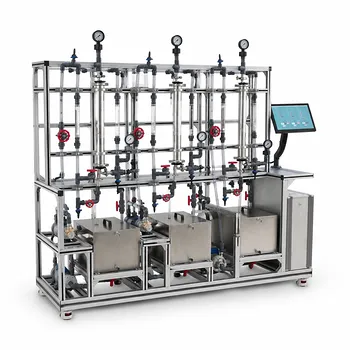
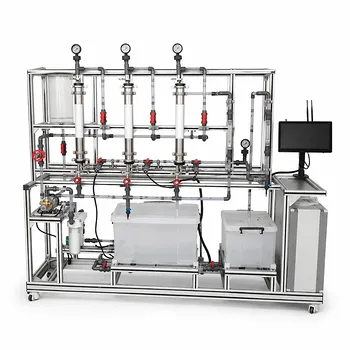
SMB integration instantly elevates a multicolumn pilot plant from a batch processing demonstrator into a continuous, countercurrent separation powerhouse. By mimicking true moving-bed dynamics through periodic valve switching, the system enables hands-on training in industrial binary separations—such as enantiomer resolution—while slashing solvent consumption and maximizing stationary-phase utilization. Researchers and students gain direct experience with the process control strategies that underpin modern bio separations, all without the mechanical attrition that would quickly destroy packed columns.
The core advantage is twofold: operationally, SMB architecture delivers continuous, high-purity product streams with dramatically reduced solvent and sorbent requirements; for training, it forces users to master the zonal flow control, valve-switching logic, and dynamic mass transfer principles that define advanced downstream processing.
Operational Advantages: From Batch Inefficiency to Continuous Precision
The jump from fixed-bed batch columns to a simulated moving bed configuration is not a minor tweak—it’s a fundamental shift in how the separation is performed. In a pilot plant setting, this translates into measurable gains in efficiency, resource usage, and product quality.
How SMB Simulates True Countercurrent Flow Without Destroying the Column
True moving-bed chromatography would require physically circulating the solid adsorbent, but high circulation rates cause severe particle attrition that ruins packing structure and separation performance.
SMB sidesteps this entirely by holding the solid phase stationary in a series of fixed beds and periodically advancing the inlet and outlet ports in the direction of fluid flow. This sequence creates the same countercurrent contact pattern between the liquid and solid phases, without any mechanical wear on the valuable adsorbent particles.
Radial vs. Axial Flow Geometry in SMB
Substantially Lower Solvent and Adsorbent Consumption
One of the most striking operational benefits is resource efficiency. In conventional batch chromatography, a large fraction of the stationary phase sits idle, and fresh solvent must be continuously introduced to elute products.
SMB’s internal solvent recycling and continuous countercurrent contact mean that adsorbent consumption can drop to roughly 1/25 of a fixed-bed equivalent, while desorbent use falls by half. For pilot plants running expensive chiral phases or high-purity solvents, this cost reduction alone justifies the configuration.
Continuous Product Withdrawal and High-Purity Output
Batch columns produce time-separated fractions that must be collected, analyzed, and pooled—a stop-start process prone to yield losses. SMB units, in contrast, continuously withdraw two product streams: the extract (strongly retained) and the raffinate (weakly retained).
Because the system can be tuned to operate within a narrow window of the adsorption isotherm, it routinely achieves purities above 99.5%. This level of performance is not just an academic curiosity; it mirrors what is expected in the industrial separation of high-value optical isomers and biopharmaceuticals.
Maximized Stationary Phase Capacity Utilization
Batch chromatography typically uses only a fraction of the column’s total capacity before reaching breakthrough—the rest of the bed is underutilized. SMB overcomes this by dividing the overall process into four distinct zones (adsorption, rectification, desorption/regeneration, and raffinate removal).
Each zone operates at a specific liquid-to-solid flow rate ratio, forcing the solid phase to work near its maximum capacity throughout the entire cycle. The result is an order-of-magnitude higher productivity per kilogram of adsorbent, a critical factor when scaling expensive affinity or chiral packings.
Training and Educational Advantages: Building Competence in Continuous Bioprocesses
Beyond operational metrics, an SMB pilot plant is an unparalleled teaching tool. It forces users to grapple with the process dynamics and control logic that batch systems simply don’t expose.
Hands-On Mastery of Complex Process Control Logic
Operating an SMB is fundamentally an exercise in timing and flow regulation. Trainees must set and maintain precise zone flow rates—often adjusting for four separate zones simultaneously—while the valve-switching frequency (the “switch time”) determines how quickly the effective solid-phase counter-movement is simulated.
This hands-on experience with automated multiport rotary valves or solenoid valve manifolds builds a deep intuition for continuous processing that a standard batch HPLC can never provide. Students leave not just understanding theory, but having tuned a real, multi-variable process.
Teaching True Continuous Mass Transfer Dynamics
Batch chromatography teaches about retention times, peak shapes, and resolution on a single column. SMB, however, demonstrates continuous, countercurrent mass transfer, where the concentration profile inside the system reaches a steady state rather than a transient peak.
Users directly observe how changing the flow ratio in the rectification zone shifts the purity profile, or how a mis-tuned desorption zone can contaminate the raffinate. This dynamic feedback bridge from abstract adsorption isotherms to real process outcomes is invaluable for chemical engineering education.
Contrasting Batch and Continuous Separation on the Same Platform
A well-designed pilot plant can operate in both batch and SMB modes, allowing students to run the same binary separation (e.g., a glucose-fructose mix or a racemic drug precursor) under both regimes and compare the results.
They see firsthand why batch columns suffer from high pressure drops and peak broadening as throughput increases, and why continuous SMB operation dissolves those bottlenecks with constant feed injection and unwavering product quality. This direct head-to-head comparison cements the fundamental principles of downstream processing.
Understanding the Trade-offs: Where SMB Pilot Plants Demand Caution
No technology is without limitations, and SMB’s operational elegance comes with a set of challenges that any pilot plant curriculum must address head-on.
Intrinsic Complexity in Scale-Up and Operational Design
SMB systems are not plug-and-play. Developing a separation method requires the precise determination of the “triangle theory” operating region—the safe zone of flow-rate ratios in the four sections that guarantees both purity and yield.
If zone flow rates drift outside this narrow window, product streams become contaminated or the stationary phase is not fully regenerated, leading to a rapid loss of performance. Training must therefore emphasize the criticality of robust process modeling and online monitoring, skills that go far beyond simple column loading.
The Difficulty of Implementing Solvent Gradients
While batch chromatography easily accommodates mobile phase gradients to optimize selectivity and peak shape, SMB is inherently an isocratic process. Simulating solid movement while simultaneously changing solvent composition across zones is exceptionally difficult to implement in a stable, reproducible way.
This means that separations which critically depend on a gradient—such as many protein purifications—are generally poor candidates for SMB. Pilot plants must clearly delineate where the technology excels (binary, isocratic splittings) and where it should be avoided.
Higher Initial Capital and Configuration Discipline
A functional SMB pilot unit requires a multi-port valve, a series of precisely packed identical columns, and sophisticated control software. This upfront cost and complexity is justified only when the target application involves continuous production at scale or the use of prohibitively expensive adsorbents.
For short-term, ad-hoc research separations of small sample amounts, a standard batch column remains more practical. Training programs should teach cost-benefit analysis, not simply champion SMB as universally superior.
Making the Right Choice for Your Pilot Plant Goals
The decision to integrate SMB capability into a multicolumn pilot plant should be driven by what you need the system to teach or prove. Different objectives demand different configurations.
After a brief evaluation of your primary aim, consider the following guidance:
- If your primary focus is training operators for industrial continuous bioprocessing: An SMB module is indispensable. It builds the valve-switching, zone-control, and steady-state management skills that translate directly to commercial-scale Sorbex-type units used in glucose/fructose syrups and chiral drug manufacturing.
- If your primary focus is accelerating process development for a high-value, isocratic binary separation: Integrating SMB will dramatically reduce solvent and adsorbent costs while delivering immediate, high-purity product streams that accelerate scale-up studies and economic feasibility analysis.
- If your primary focus is fundamental research across a wide range of mixture types, especially those requiring gradients: A flexible batch system should remain the backbone of the pilot plant. You can add a simple SMB demonstration loop for teaching, but the core workflow will rely on the gradient-capable fixed-bed setup.
The power of an SMB-equipped multicolumn pilot plant lies not in replacing batch chromatography, but in making continuous countercurrent separation a tangible, optimizable tool in the researcher’s hands.
Summary Table:
| Feature | Batch Chromatography | SMB Chromatography |
|---|---|---|
| Flow Dynamics | Discontinuous / Batch | Continuous Countercurrent |
| Solvent Usage | High (continuous fresh feed) | Low (up to 50% reduction) |
| Adsorbent Efficiency | Underutilized (breakthrough limit) | Maximized (active in all zones) |
| Process Control | Basic fraction collection | Complex valve-switching logic |
Bring Industrial-Scale Chromatography to Your Lab with LABPARK
Ready to bridge the gap between classroom theory and industrial reality? LABPARK provides premium Educational and Vocational Unit Operations Pilot Plants in chemical engineering, bioprocess & biotech, and environmental & water treatment for universities, research institutes, and enterprises.
Equip your researchers and students with the tools to master continuous SMB control logic and optimize separation efficiency. Contact our experts today to customize your pilot plant solution!
Related Products
- Multi Functional Membrane Crystallization Educational Unit Operations Pilot Plant
- Multimodal Absorption and Desorption Pilot Plant for Unit Operations Training
- High-Gravity Emulsification and Mass Transfer Educational Pilot Plant
- Packed Bed Absorption Educational Unit Operations Pilot Plant
- Multi-Functional Drying Educational Unit Operations Pilot Plant
People Also Ask
- Control Crystallization Pilot Plant Secondary Nucleation: 4 Key Adjustments
- Why is precise temperature control critical in crystallization pilot plants? Key to Scale-Up Success
- What key factors should be considered when configuring a crystallization unit operations pilot plant?
- What are the benefits of integrating online PAT tools like ATR-FTIR into crystallization unit operations pilot plants?
- How to use crystallization pilot plant agitation speed to identify diffusion vs reaction growth?