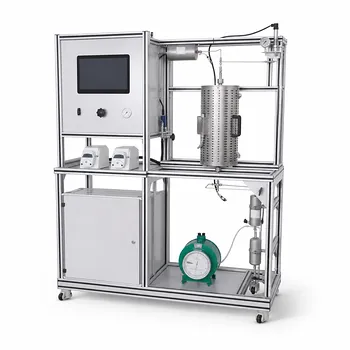
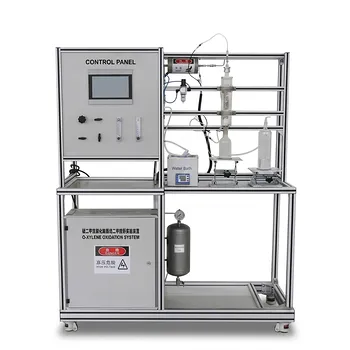
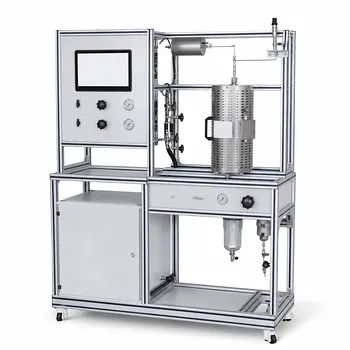
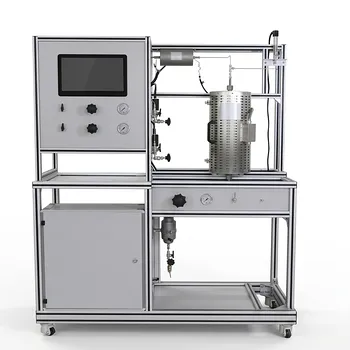
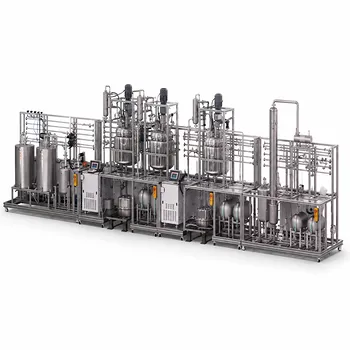
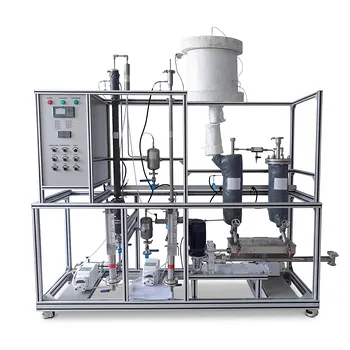
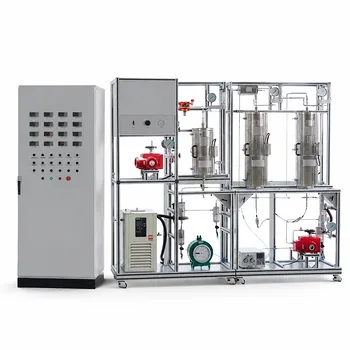
The synthesis of PET via direct esterification is a thermal and vacuum-driven tightrope walk across three distinct reaction stages. In a pilot plant, you must precisely control the esterification of purified terephthalic acid (PTA) with ethylene glycol (EG) at 257–269°C under overpressure, then transition to a pre-polycondensation stage at roughly 273°C under moderate vacuum (27.5–5.07 kPa), and finally achieve final polycondensation at up to 285°C and an ultra-low vacuum of around 100 Pa. The plant’s ability to integrate a robust vacuum system, multi-zone temperature control, and a high-viscosity agitation setup determines whether you produce a useful polymer or a thermally degraded, low-molecular-weight melt.
A pilot-scale PET plant is a thermodynamic staircase, not a simple batch kettle. Each stage demands a unique combination of temperature, pressure, and mixing intensity to shift the chemical equilibrium, remove byproducts, and build the long polymer chains without destroying them. Missing a step or letting a parameter drift will stall chain growth or degrade the product.
The Three Pillars of Direct Esterification for PET
Esterification: Dissolving and Reacting the Monomers
The first stage mixes PTA powder into a slurry with liquid EG. The reactor must handle a slurry-to-paste transition as the PTA dissolves and begins to esterify, forming bis(2-hydroxyethyl) terephthalate (BHET) monomer and water.
Maintaining a temperature between 257°C and 269°C and a pressure above 0.1 MPa (slight overpressure) is critical. The elevated pressure keeps EG in the liquid phase and enhances the solubility of PTA, while the high temperature drives the esterification forward. Inadequate mixing here will leave undissolved PTA, resulting in solid inclusions in the final polymer and poor conversion.
Pre-Polycondensation: Kicking Off Chain Growth Under Vacuum
Once most of the acid end groups have been esterified, the oligomer enters the pre-polycondensation stage. Here, the reaction shifts from acid-alcohol condensation to alcohol-alcohol transesterification, releasing EG as the main byproduct.
The reactor must transition to a moderate vacuum of 27.5–5.07 kPa at around 273°C. This vacuum begins stripping out EG and residual water, driving the equilibrium toward chain extension. If the vacuum is applied too abruptly, the EG will flash-violently disturb the melt and cause temperature instabilities. Multi-zone heating jackets and internal coils are essential to keep the heat transfer uniform as the melt viscosity starts to climb.
Final Polycondensation: Building Molecular Weight in the Melt
This is where the polymer chain length—and hence its intrinsic viscosity—truly grows. The agitation system now faces a high-viscosity melt that can exceed several hundred Pascal-seconds.
The reactor must maintain an ultra-low vacuum of approximately 100 Pa while precisely controlling temperatures up to 285°C. At these conditions, the diffusion of EG bubbles out of the viscous matrix becomes the rate-limiting step. High-torque, low-shear agitators with large surface-renewal discs (such as cage or helical ribbon impellers) are necessary to continuously expose fresh melt surface to the vacuum and prevent stagnant hot spots that lead to thermal degradation.
Critical Process Parameters: Beyond the Recipe
Temperature: The Knife-Edge Between Rate and Degradation
PET synthesis is highly temperature-sensitive. While higher temperatures accelerate end-group reactions, they also exponentially speed up thermal degradation, causing chain scission, yellowing, and the formation of acetaldehyde—a volatile that ruins food-grade PET.
Pilot plants must implement multi-zone temperature control with fast-response heaters and precise thermocouples buried in the melt. Even a localized temperature excursion of a few degrees in the final polycondensation stage can ruin an entire batch’s molecular weight distribution.
Pressure and Vacuum: The Engine of Equilibrium
The direct esterification and polycondensation reactions are reversible. According to Le Chatelier’s principle, the continuous removal of water and EG is what drives the reaction to completion.
The pilot plant’s vacuum system must be able to pull from atmospheric pressure smoothly through to 100 Pa without surging. Moreover, the vacuum line must be heated to prevent the removed glycol from condensing and refluxing back into the reactor, which would cap the chain ends and stop growth. This principle of removing byproducts to shift equilibrium is the same thermodynamic lever used in ethyl acetate synthesis pilot plants, but the vacuum depth required for PET is an order of magnitude more demanding.
Agitation and Mixing: From Slurry to Highly Viscous Melt
The agitator’s duty changes radically across the stages. In esterification, it must keep solid PTA particles suspended. In pre-polycondensation, it must ensure good heat transfer and bubble dispersion. In final polycondensation, it must generate a large melt surface area under vacuum without applying destructive shear forces.
Selecting an agitator that can operate across this range—often with a variable-speed drive and torque monitoring—is essential. Excessive shear can break polymer chains, somewhat defeating the purpose of the polycondensation stage. Torque sensing also provides a real-time proxy for viscosity build-up, giving you critical data on molecular weight evolution.
Understanding the Trade-offs
The pursuit of speed and high molecular weight in a pilot plant exposes you to several hard trade-offs.
- High Temperature vs. Product Quality: Pushing polycondensation to 290°C or higher can briefly speed up the reaction, but you will inevitably increase acetaldehyde content and introduce yellowish discoloration. The pilot plant must be tuned to find the lowest possible temperature that still gives an acceptable reaction rate.
- Vacuum Depth vs. Volatility: Too deep a vacuum too early can strip not only EG but also short-chain oligomers, causing them to condense in the vacuum line and form a solid plug. A staged vacuum ramp is safer but lengthens the batch time.
- Mechanical Shear vs. Chain Length: High-RPM mixing can mechanically scission the long polymer chains, reducing molecular weight. Low-shear designs preserve polymer integrity but may not provide sufficient surface renewal for EG removal. The pilot plant’s geometry and impeller design must compromise between mass transfer and shear sensitivity.
- Small-Scale Thermal Dynamics: A pilot-scale reactor has a much higher surface-area-to-volume ratio than an industrial reactor. Heat loss to the environment can create cold zones near the wall, causing uneven viscosity and stalled reactions. This requires more aggressive jacketing and insulation than you might initially assume.
How to Design Your PET Pilot Plant for Specific Goals
The exact configuration of your pilot plant should flow from what you intend to learn or produce with it.
- If your primary focus is education and training: Select a glass reactor system with visible stages, integrated temperature and vacuum readouts, and sampling ports between each stage. This makes the three-stage thermodynamic staircase tangible for students and allows them to monitor product DG conversion and intrinsic viscosity at each step.
- If your primary focus is process research and development: Invest in a flexible vacuum control system that can execute precise pressure ramps and in multi-point, in-melt temperature probes. Add a torque sensor to the agitator to correlate power draw with melt viscosity in real time, giving you a data-rich view of the polycondensation kinetics.
- If your primary focus is small-scale toll or specialty production: Prioritize a vacuum pump that can handle a continuous load of condensable EG vapor without pressure fluctuations and choose wetted materials (stainless steel or Hastelloy) that resist corrosion from hot acidic monomers. Build in heated vacuum lines and a knock-out pot that can be drained without breaking the reactor vacuum.
The line between a successful PET pilot experiment and a frustrating, degraded batch is drawn by your willingness to treat the reactor as a sensitive thermodynamic instrument, not just a smaller version of an industrial vessel. Measure, control, and stage your parameters accordingly.
Summary Table:
| Stage | Temperature | Pressure/Vacuum | Key Process Objective |
|---|---|---|---|
| Esterification | 257–269°C | > 0.1 MPa (Overpressure) | Dissolve PTA into EG; suspend slurry |
| Pre-Polycondensation | ~273°C | 27.5–5.07 kPa (Moderate vacuum) | Transesterification; strip EG & water |
| Final Polycondensation | Up to 285°C | ~100 Pa (Ultra-low vacuum) | Build molecular weight in high-viscosity melt |
Scale Your Chemical Engineering Processes with LABPARK
Are you looking to optimize polymer synthesis or upgrade your training laboratory? LABPARK provides state-of-the-art Educational and Vocational Unit Operations Pilot Plants in chemical engineering, bioprocess & biotech, and environmental & water treatment.
Tailored for universities, research institutes, and enterprises, our systems offer the advanced multi-zone temperature control, robust vacuum systems, and high-torque agitation required for complex reactions like PET synthesis.
Contact LABPARK today to discuss your custom pilot plant needs and accelerate your research!
Related Products
- Ethyl Acetate Synthesis Unit Operations Pilot Plant for Practical Training
- Methanol Synthesis and Catalyst Performance Evaluation Educational Unit Operations Pilot Plant
- Bio-fermentation Ethanol Production Practical Training Unit Operations Pilot Plant
- Green Anhydrous Ethanol Refining Practical Training Pilot Plant
- Green Anhydrous Ethanol Purification Extractive Distillation Unit Operations Training Pilot Plant
People Also Ask
- How do pilot plants demonstrate esterification? Visualizing Chemical Engineering Equilibrium
- When to transition from PID to adaptive control in pilot plants? Key process indicators.
- Why is the chemical plant startup schedule crucial? De-risk scale-up with pilot plants.
- Why Use PTFE & Hastelloy in Chemical Pilot Plants? Prevent Corrosion & Ensure Safety
- How do deviations in estimating latent heat impact pilot plant thermal systems? Avoid hardware mis-sizing.