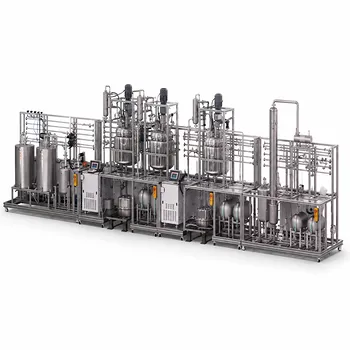
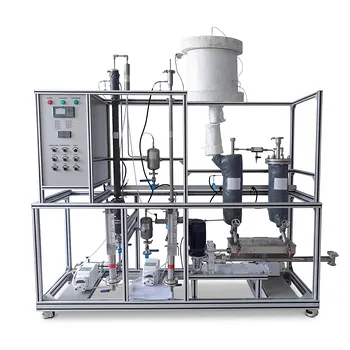
The leap from a glass beaker to a pilot plant is not just a change in scale—it’s a complete transformation from a static, manual world to a dynamic, automated one. In the lab, you manually dip a calibrated probe into a still solution, swirl a flask, and add reagent drop by drop. In a pilot plant, you deploy an industrial in-line sensor that must withstand continuous flow, connect it to a PLC-based PID controller, and manage complex dynamics like mixing dead time and sensor fouling. The core operational differences center on sensor robustness, closed-loop automation, and the need to tame fluid dynamics that simply don’t exist in a beaker.
Shifting from beaker-scale pH control to a pilot plant forces you to swap careful manual dexterity for deep process knowledge. Success hinges on selecting hardened in-line sensors, tuning a PID loop to overcome dead time, and continuously managing sensor health—challenges that turn a simple chemistry task into a real industrial control problem.
The Measurement Leap: From Glass to In-Line Sensors
In the laboratory, your pH meter is a precision instrument handled with care. It is calibrated before every session, dipped into a stationary solution, and stored in a protective buffer. The pilot plant breaks every one of those comforts. Measurement becomes a permanent, in-process responsibility.
Why Lab Probes Fail in Flowing Systems
A standard lab electrode is designed for intermittent, gentle immersion. It features delicate glass bulbs and reference junctions that foul or fracture rapidly under continuous flow, fluctuating temperatures, or abrasive particles. In a pilot plant, the probe must become part of the pipeline, not a temporary guest.
The Industrial In-Line Probe
Pilot plants force the use of robust, industrial-grade in-line probes. These sensors have thicker glass, protected reference junctions, and often include automatic temperature compensation as standard. They are built to live in the process 24/7, resisting fouling, pressure spikes, and the vibrations of pumps and mixers.
Calibration Becomes a Scheduled Event, Not a Ritual
You don’t pluck an in-line probe out of the line every few hours for a two-point calibration. Instead, calibration shifts to a maintenance routine. You learn to perform grab-sample verification—taking a manual sample, measuring it with a trusted portable meter, and using that value to adjust the in-line transmitter’s zero and span. This is about correcting drift in situ, not achieving perfect lab accuracy.
The Control Leap: Human Judgment to PLC-Based PID
Adding acid or base in the lab is a matter of perception: you see the color change or the pH drift, and your hand adjusts the burette’s stopcock. A pilot plant replaces that entire biological control loop with a deterministic electronic one, demanding that you define your reaction in numbers.
From the Burette to the Metering Pump
Manual dosing is intuitive but irreproducible. Pilot plants use positive-displacement dosing pumps that can be tied to an analog signal. This lets the control system command exact flow rates of reagent, transforming a human guess into a precise, recorded action.
The PID Controller as the New Decision-Maker
The heart of automation is the PLC-based PID control loop. The controller reads the in-line pH value, compares it to a setpoint, and calculates a pump output. But the algorithm knows nothing of chemistry—it only responds to error. Tuning the proportional, integral, and derivative terms becomes the operator’s new, non-intuitive task to prevent wild swings or sluggish response.
Dead Time: The Invisible Enemy
The most jarring difference is process dead time. In a beaker, the sensor instantly sees the result of your dosing. In a pilot plant, reagent injected at the mixing point may take 30 seconds or more to travel down the pipe to the pH probe. A PID loop that doesn’t account for this lag will oscillate wildly, constantly over- and under-shooting the setpoint because it corrects for old information.
Managing Process Dynamics You Never See in a Beaker
Beyond the control loop, the fluid itself misbehaves in ways a flask never does. You must now understand not just chemistry, but also the chemical engineering principles of mixing and transport.
The Criticality of Mixing
In a lab, you achieve homogeneity with a magnetic stir bar. In pilot plants, inadequate mixing creates spatial pH gradients. If the reagent stream doesn’t fully blend with the main process flow before reaching the sensor, the probe reports a false value—and the controller will dose incorrectly based on that lie. You must design and verify the mixing point as an integral part of the control system.
Sensor Location Determines Controllability
Where you place the pH probe in the pipe becomes a primary engineering decision. Place it too close to the dosing point, and it reads unreacted reagent. Place it too far downstream, and you introduce excessive dead time. This balancing act is a unique operational concern of continuous systems, teaching the direct link between physical layout and control quality.
Understanding the Trade-offs and Pitfalls
Automation is not a silver bullet. The move to a pilot plant introduces a new set of failure modes that a lab technician never faces, and acknowledging them is key to safe operation.
- Fouling and drift are constant battles. In-line probes degrade. Coatings form on the glass, reference junctions clog, and the signal drifts without warning. A robust lab protocol becomes a continuous maintenance campaign in the plant.
- Tuning a PID loop requires a different skillset. A poorly tuned controller is worse than manual control, injecting instability into the system. The operator must transition from a chemist’s mindset to a process engineer’s, understanding how gain, integral, and derivative terms interact.
- Safety and over-dosing risks escalate. A stuck dosing pump or a failed pH sensor can rapidly drive a system to dangerously extreme pH levels. Pilot plants demand high-high and low-low alarms, automated shutdowns, and fail-safe design that are afterthoughts on a bench top.
- You trade precision for robustness. An industrial in-line system may never achieve the ±0.01 pH accuracy of a freshly calibrated lab meter. The goal shifts from absolute measurement perfection to reliable, reproducible control within a wider acceptable band.
Making the Right Choice for Your Goal
The question isn’t which system is “better,” but which set of operational compromises matches your objective. A beaker and a pilot plant solve fundamentally different problems.
- If your primary focus is precise, one-off chemical analysis: The manual lab method remains superior. You have total control over calibration, cleanliness, and measurement conditions, and you can achieve accuracy that an in-line system cannot practically sustain.
- If your primary focus is learning industrial process control: You must embrace the pilot plant with its in-line sensors, PID loops, and dead time challenges. The educational value lies precisely in managing the imperfections—fouling, drift, and dynamic lag—that define real-world manufacturing.
- If your primary focus is scale-up and continuous production feasibility: The pilot plant is the only truthful answer. It will expose mixing and controllability problems no beaker test can predict, giving you the operational data needed to design a full-scale system.
The transition from beaker to pilot plant is your first step out of pure chemistry and into the integrated, unsteady, and sensor-laden reality of process engineering. Master the operational differences, and you stop measuring pH—and start controlling a process.
Summary Table:
| Operational Aspect | Manual Lab Beaker Tests | Automated Pilot Plants |
|---|---|---|
| Sensor Type | Delicate glass electrode | Robust, industrial in-line probe |
| Dosing Method | Manual pipette / burette | Automated dosing pump (PLC-controlled) |
| Control Loop | Human judgment & adjustment | Electronic PID control loop |
| Fluid Dynamics | Instant mixing, negligible lag | Mixing gradients & process dead time |
| Primary Goal | High analytical precision | Robust, continuous process stability |
Bring Real-World Process Control to Your Facility with LABPARK
Bridging the gap between benchtop chemistry and industrial automation requires hands-on experience with real-world scale-up challenges like PID tuning and dynamic mixing.
LABPARK provides premium Educational and Vocational Unit Operations Pilot Plants in chemical engineering, bioprocess & biotech, and environmental & water treatment. Designed specifically for universities, research institutes, and enterprises, our systems empower students and researchers to master industrial pH control and process dynamics.
Ready to elevate your training or research capabilities? Contact LABPARK today to find the ideal pilot plant solution for your facility!
Related Products
- Fixed Bed Gas Solid Catalytic Reaction Educational Pilot Plant
- Ethyl Acetate Synthesis Unit Operations Pilot Plant for Practical Training
- Carbon Dioxide Hydrogen Methanol Synthesis Educational Unit Operations Pilot Plant
- Natural Product Extraction Unit Operations Training Pilot Plant
- Multi-Reactor Educational Pilot Plant for Reaction Engineering Unit Operations
People Also Ask
- How do reactor pilot plants safely study gas-solid reactions? Master kinetics with thermal & flow control.
- How does the Mears criterion evaluate transport resistance? Key Guide to Intrinsic Kinetics
- Fluidized vs. Fixed Bed Reactors: Comparing Heat & Complexity in Pilot Plants
- Why is a multibed configuration necessary for exothermic reactions? Optimize your pilot plant trajectory.
- How is the friction factor determined for fixed-bed pilot plants? Select the best pressure drop correlation.