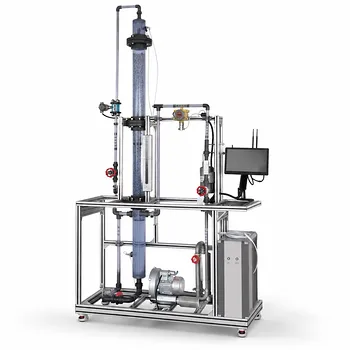
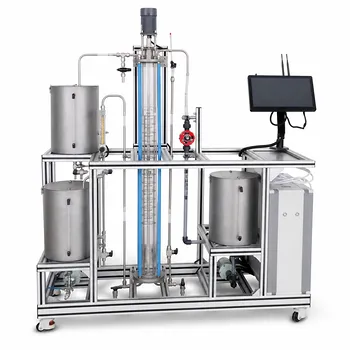
For chemical engineering pilot plants, the operational leap from a traditional gravity-fed packed column to a Rotating Packed Bed (RPB) reactor is transformative. An RPB delivers 1 to 2 orders of magnitude higher volumetric mass transfer efficiency, drastically reduces liquid holdup and residence time, reaches steady state within minutes, and shrinks the equipment footprint to a fraction of a traditional column—all while preserving the core demonstrations of gas-liquid contact and reaction kinetics.
RPB reactors replace gravity with intense centrifugal force, creating a high-gravity environment that slashes equipment size, accelerates startup, and protects heat-sensitive materials. This makes them a powerful process-intensification tool for educational and research pilot plants where space, time, and material sensitivity are paramount.
How an RPB Works: The High-Gravity (HIGEE) Principle
In a conventional packed column, gravitational acceleration (g = 9.81 m/s²) governs liquid flow and droplet formation. An RPB fundamentally alters this by spinning the packing at high speed.
Replacing Gravity with Centrifugal Acceleration
The rotor generates a centrifugal acceleration ($g' = r\omega^2$) that is tens to hundreds of times greater than standard gravity. This high-gravity field pushes the liquid phase outward through the packing, while gas flows counter-currently inward.
Creating Extreme Interfacial Area
Under this intense shear, the liquid is torn into extremely thin films, micro-droplets, and filaments. The result is a massive increase in the effective gas-liquid contact area and a higher mass transfer coefficient. This physical transformation explains why an RPB can pack the separation power of a multi-meter-tall column into a device that sits on a benchtop.
Operational Advantages for Pilot Plants
Shifting from a static packed column to a rotating bed changes the daily reality of running unit operations experiments.
Orders-of-Magnitude Improvement in Production Capacity
The unit volume production capacity of an RPB is 1 to 2 orders of magnitude higher than that of conventional packed or tray towers. For a pilot plant, this means you can demonstrate full-scale reaction kinetics and separation performance in a dramatically smaller device, without sacrificing the quality of the engineering data.
Near-Zero Warm-Up Time and Rapid Turnover
A traditional packed column can take an hour or more to reach steady-state temperature and composition profiles. An RPB reaches steady-state operation within minutes. This rapid startup and shutdown capability maximizes laboratory throughput—allowing multiple experiments per session rather than babysitting a single warm-up.
Protection for Heat-Sensitive and High-Viscosity Materials
RPBs exhibit extremely low liquid holdup and correspondingly short residence times. Materials that would degrade during prolonged exposure in a tall column (e.g., certain monomers, natural extracts, or viscous polymers) pass through the RPB quickly and gently. High-viscosity fluids, which struggle to wet and drain in a gravity-driven bed, are effectively dispersed by the centrifugal field.
Compact Footprint and Lower Installation Costs
The dramatic reduction in required packing height translates into a much smaller equipment envelope. An RPB pilot unit occupies a fraction of the floor space and headroom of a traditional column. This lowers both the direct lab-space requirement and the civil engineering costs associated with tall structures. For universities and research institutes operating in tight renovation budgets, this size advantage can be the deciding factor.
Understanding the Trade-offs
No reactor is universally superior. The decision to integrate an RPB comes with important practical considerations.
Mechanical Complexity and Maintenance
A high-speed rotating assembly introduces seals, bearings, and drive motors that demand regular maintenance and carry a failure risk that a static, gravity-fed column simply does not. In a teaching lab where simplicity and robustness are prized, this added complexity must be weighed against the performance gains.
Limited Residence Time for Slow Reactions
The very attribute that protects heat-sensitive materials—low liquid holdup—becomes a limitation for kinetically slow reactions that require extended contact. If a reaction demands minutes or hours of liquid residence to achieve meaningful conversion, a traditional packed bubble column or a trickle-bed with higher liquid holdup may be more appropriate than an RPB.
Initial Capital Cost
While an RPB saves on installation space and civil works, its purchase price per unit is often higher than that of a simple glass packed column of equivalent diameter. For a pilot facility with very limited startup funds, a carefully designed conventional column with structured packing may still offer the best initial cost-to-performance ratio.
Making the Right Choice for Your Pilot Plant Goal
Your selection should be driven by which operational pain point you most need to eliminate.
- If your primary focus is maximizing experimental throughput: Choose an RPB. Its rapid steady-state attainment lets you complete more runs per lab period and iterate faster on process conditions.
- If your primary focus is handling viscous or thermally fragile materials: Choose an RPB. The short, high-shear exposure protects sensitive feeds that would fail in a tall, high-holdup column.
- If your primary focus is demonstrating classic column hydraulics and flooding behavior: Choose a traditional packed column. The visual, gravity-driven flow patterns in a transparent column are simpler for teaching core fundamentals like loading and flooding.
- If your primary focus is minimizing upfront equipment cost and mechanical maintenance: Choose a traditional packed column. A static bed with no moving parts remains the simplest, most robust pilot-scale option for basic absorption or distillation demonstrations.
Integrating an RPB is a step-function change in operational capability—trade floor space and warm-up time for process intensification and material gentleness. Match the technology to your true research or teaching bottleneck, and the pilot plant becomes a far more efficient engine for discovery.
Summary Table:
| Feature | Rotating Packed Bed (RPB) Reactor | Traditional Packed Column |
|---|---|---|
| Mass Transfer Efficiency | 10 to 100 times higher (High-Gravity) | Standard gravity-driven limits |
| Startup Time (to Steady State) | Minutes | Hours |
| Footprint & Height | Compact (often benchtop) | Tall (requires high headroom) |
| Liquid Holdup & Residence Time | Extremely low / short (protects heat-sensitive feeds) | High / long (risk of degradation) |
| Mechanical Complexity | High (rotating rotor, seals, motor) | Low (no moving parts) |
| Initial Capital Cost | Higher equipment cost | Lower equipment cost |
Upgrade Your Unit Operations Lab with LABPARK
Choosing between process intensification and traditional unit operations requires the right equipment partner. LABPARK provides advanced Educational and Vocational Unit Operations Pilot Plants in chemical engineering, bioprocess & biotech, and environmental & water treatment designed for universities, research institutes, and enterprises.
Whether you need to demonstrate cutting-edge RPB technology or classic column hydraulics, we deliver reliable, high-performance systems tailored to your curriculum and research goals.
Contact LABPARK today to discuss your pilot plant requirements!
Related Products
- High-Gravity Emulsification and Mass Transfer Educational Pilot Plant
- Micro-Scale Gas-Solid Catalytic Reaction Educational Pilot Plant
- Packed Bed Absorption Educational Unit Operations Pilot Plant
- Multi Functional Catalytic Reaction and Reactor Evaluation Educational Unit Operations Pilot Plant
- Multi-Reactor Educational Pilot Plant for Reaction Engineering Unit Operations
People Also Ask
- How to update chemometric calibration models in pilot plants? Best practices for process engineers.
- Why is Peng-Robinson preferred over SRK? Enhance thermodynamic modeling in educational pilot plants.
- Why is continuous measurement preferred over manual sampling in pilot plants? Get real-time kinetic insights.
- How do pilot plants study gas solubility in polymer melts at high pressures? Key Mass Transfer Insights
- How does temperature affect mass transfer rates in chemical engineering educational pilot plants?