Knowledge Chemical Engineering Education What are the key principles of air-bubble acoustic mixing? Optimize microfluidic design.
Author avatar

Tech Team · LABPARK

Updated 1 month ago

What are the key principles of air-bubble acoustic mixing? Optimize microfluidic design.


At the heart of microfluidic mixing lies a counterintuitive truth: a trapped air bubble, driven by sound, becomes a powerful micromixer. Air-bubble induced acoustic mixing operates by exciting a bubble with an acoustic field, causing its surface to vibrate. This vibration generates a shearing action at the air–liquid interface, creating localized bulk flow called acoustic microstreaming and global “tornado-type” convection that rapidly homogenize fluids. To implement this effectively, you need chambers with a depth under 2 mm, air pockets spaced less than 4 mm apart, and bubbles of roughly 0.5 mm radius to stir a surrounding volume of about 2 mm radius.

The core operating principle is leveraging bubble resonance: matching the acoustic frequency to the bubble’s natural frequency amplifies surface oscillations, producing intense microstreaming. Success depends on a tight marriage between structural geometry—shallow chambers, precise bubble size, controlled air pocket pitch—and the ability to drive the bubble at its resonant frequency.

How Air-Bubble Acoustic Mixing Works: Operating Principles

The Bubble as an Acoustic Actuator

A trapped air bubble in liquid behaves like a mechanical oscillator. When an external acoustic field is applied, the pressure oscillations drive the bubble’s surface to expand and contract. At resonance, these oscillations become dramatically larger, turning the bubble into an efficient actuator. Think of it as a flexible membrane that pumps fluid by vibrating at the right pitch.

Cavitation Microstreaming and Tornado Convection

The vibrating bubble imposes a velocity gradient at the interface. Shear forces create a steady, circulatory flow close to the bubble, known as acoustic microstreaming (or cavitation microstreaming). This small-scale streaming then seeds larger, tornado-like global convective rolls that sweep across the entire chamber. The result is a dramatic reduction in mixing time—orders of magnitude faster than relying on passive diffusion alone.

The Critical Role of Resonance Frequency

Microstreaming intensity is not a linear function of driving amplitude; it depends on frequency matching. The bubble’s natural resonance frequency is inversely related to its radius. An off-resonance drive leads to weak oscillations and negligible mixing. Therefore, precise frequency tuning is just as important as the physical design—failure to match resonance leaves you with a motionless bubble.

Structural Design Requirements for Successful Implementation

Chamber Depth: Stay Below 2 mm

To confine the flow and maintain the tornado convection pattern, the micro chamber’s depth must be less than 2 mm. A deeper chamber dilutes the vortical structures, causing energy dissipation and weak bulk motion. The shallow aspect ratio ensures that the streaming-induced circulation reaches the entire volume, avoiding stagnant corners.

Bubble Radius and Effective Mixing Zone

The bubble size defines the effective stirring radius. A bubble with a radius of 0.5 mm can aggressively mix fluid within a 2 mm radius around it. This relationship dictates how you space multiple bubbles. If you need to mix a larger region, you will need an array of bubbles rather than a single large bubble, because larger bubbles have lower resonance frequencies and may not be practical to drive with standard transducers.

Air Pocket Pitch: Less Than 4 mm

When using multiple bubbles, the air pocket pitch—center-to-center distance—must be less than 4 mm. This ensures that the 2 mm effective zones overlap, leaving no unmixed dead zones. A pitch wider than 4 mm risks creating isolated mixing cells that do not communicate, ruining overall homogeneity.

The Resonance-Geometry Feedback Loop

Designing only the geometry is insufficient. You must integrate the acoustic driving system to match the bubble’s resonance frequency. The bubble radius sets the target frequency; the chamber’s acoustic impedance and the transducer’s bandwidth must accommodate it. In practice, this often means iterative tuning or fabricating chambers where bubble size is precisely controlled.

Understanding the Trade‑offs and Pitfalls

Even a well-designed system faces inherent limitations. Acknowledging these is critical for lab‑scale or pilot implementation.

  • Bubble Stability: Bubbles can dissolve, coalesce, or be displaced by flow. Long‑term operation requires surface treatments or gas‑supply features to maintain the exact air pocket geometry.
  • Frequency Sensitivity: Resonance is extremely narrow‑band. Slight temperature changes, liquid composition shifts, or bubble size drift can detune the system, causing mixing performance to collapse.
  • Throughput vs. Mixing Intensity: The tornado convection is effective for small volumes. Scaling up by simply enlarging the chamber kills the shallow‑depth advantage; you trade off between high‑intensity micromixing and larger batch sizes.
  • Biocompatibility Concerns: In biological applications, the shear forces from microstreaming might damage cells or denature sensitive molecules, requiring careful selection of driving power and bubble size.

Making the Right Choice for Your Mixing Goal

Your design should be driven by the specific outcome you need. Use the following guideposts to steer your implementation:

  • If your primary focus is rapid homogenization of small volumes: Use a single 0.5‑mm bubble in a sub‑2‑mm‑deep chamber and match its resonant frequency precisely. This yields the fastest mixing time per unit volume.
  • If your primary focus is mixing larger‑area chambers without dead zones: Deploy a bubble array with a pitch below 4 mm. Ensure each bubble can be individually excited or that the array collectively resonates in‑phase to maintain overlapping convection cells.
  • If your primary focus is ease of operation and robustness: Prioritize bubble stabilization—integrate micropillars or hydrophobic patches to pin bubbles—and consider a slightly off‑resonance but broader‑band excitation to tolerate minor frequency drift, even if it sacrifices peak mixing intensity.

A methodical combination of shallow geometry, resonance‑matched bubble size, and tightly spaced air pockets transforms a simple air bubble into a miniature tornado that conquers diffusion. Master these design rules, and you turn sound into a precise mixing tool.

Summary Table:

Parameter / Aspect Design Requirement Impact on Mixing
Chamber Depth < 2 mm Prevents energy dissipation and weak bulk motion
Bubble Radius ~0.5 mm Achieves a 2 mm effective stirring radius
Air Pocket Pitch < 4 mm Ensures overlapping mixing zones without dead zones
Acoustic Frequency Resonance-matched Triggers cavitation microstreaming & global convection

Scale Up Your Unit Operations with LABPARK

Translating fluidic principles into robust, scalable systems requires the right experimental foundation. LABPARK provides state-of-the-art Educational and Vocational Unit Operations Pilot Plants in chemical engineering, bioprocess & biotech, and environmental & water treatment. Designed specifically for universities, research institutes, and enterprises, our pilot systems empower you to demonstrate advanced fluid dynamics and unit operations with precision.

Ready to enhance your laboratory and training capabilities? Contact our experts today to find the perfect pilot plant solution for your institution.

Related Products

People Also Ask

Related Products

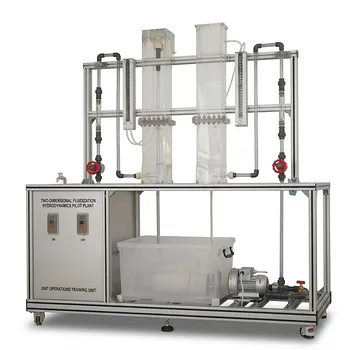
Two-Dimensional Fluidization Hydrodynamics Educational Pilot Plant for Unit Operations Training

Two-Dimensional Fluidization Hydrodynamics Educational Pilot Plant for Unit Operations Training

Explore gas-solid and liquid-solid fluidization hydrodynamics with our transparent 2D educational pilot plant. Ideal for chemical engineering unit operations labs, it demonstrates fixed to fluidized bed regimes, measures pressure drop, and integrates QR-code digital learning for enhanced student training.

Multi Pump Fluid Transport Process Piping Unit Operations Training Pilot Plant

Multi Pump Fluid Transport Process Piping Unit Operations Training Pilot Plant

Industrial-scale multi-pump pilot plant for unit operations training in fluid transport and process piping, featuring real-material and semi-physical simulation modes, comprehensive pump and flowmeter calibration, and safety-enhanced two-tier platform, bridging academic theory and industrial practice for chemical engineering education.

Multi-Reactor Educational Pilot Plant for Reaction Engineering Unit Operations

Multi-Reactor Educational Pilot Plant for Reaction Engineering Unit Operations

Integrated bench-scale educational pilot plant for chemical engineering teaching featuring fixed bed fluidized bed and stirred tank reactors with web-based digital twin controls and safety interlocks for hands-on unit operations and reaction engineering comparative studies in one compact system.

Multi-Functional Drying Educational Unit Operations Pilot Plant

Multi-Functional Drying Educational Unit Operations Pilot Plant

Versatile multi-functional drying educational unit operations pilot plant integrating tunnel, fluidized bed, and spray drying. Enables hands-on study of drying curves, psychrometry, and gas-solid separation for chemical engineering curriculum in higher education labs.

Quantitative Dosing and Liquid Flow Control Educational Unit Operations Pilot Plant

Quantitative Dosing and Liquid Flow Control Educational Unit Operations Pilot Plant

Explore industrial fluid transport and automated process control with this quantitative dosing and liquid flow control educational pilot plant, featuring local and remote control cabinets, variable speed metering pump, high-precision flow sensors, and PLC-based SCADA integration for engineering students.

Comprehensive Fluid Mechanics Educational Unit Operations Pilot Plant

Comprehensive Fluid Mechanics Educational Unit Operations Pilot Plant

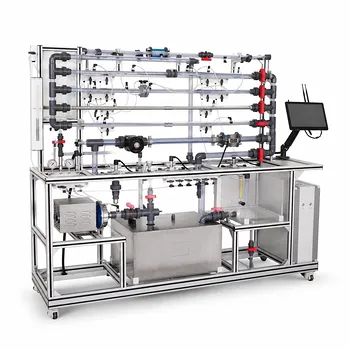
Hands-on fluid mechanics pilot plant for engineering education covering over 13 principles including pipe flow, minor losses, flowmeter calibration, and pump performance with industrial-grade components, smooth and rough piping, venturi and orifice flowmeters, and centrifugal pump testing and analysis.

Fluid Friction Resistance Determination Educational Unit Operations Pilot Plant

Fluid Friction Resistance Determination Educational Unit Operations Pilot Plant

Engineered bench-scale system for university engineering labs. Provides hands-on fluid mechanics experience: quantitative energy loss analysis, flow regime observation, friction coefficient determination. Features four-point pressure measurement, transparent sections, industrial touchscreen PLC, 3D virtual simulation. Ideal for chemical, mechanical, civil engineering.

Multi-Functional Membrane Separation Educational Pilot Plant for Unit Operations Lab

Multi-Functional Membrane Separation Educational Pilot Plant for Unit Operations Lab

The Multi-functional Membrane Separation Educational Unit Operations Pilot Plant is an integrated bench-scale laboratory system designed for teaching undergraduate engineering education. It features Ultrafiltration, Nanofiltration, and Reverse Osmosis modules in a compact, mobile unit for practical hands-on learning.

Multi-Modal Distillation Unit Operations Training Pilot Plant

Multi-Modal Distillation Unit Operations Training Pilot Plant

Multi-modal distillation pilot plant for practical unit operations training in chemical engineering education. Features real, analog, and semi-physical simulation modes, industrial construction, customizable for university labs. Hands-on fractionation columns, SCADA control, safety systems. Includes sight glasses, sampling ports, closed-loop recycling.

Multi Functional Catalytic Reaction and Reactor Evaluation Educational Unit Operations Pilot Plant

Multi Functional Catalytic Reaction and Reactor Evaluation Educational Unit Operations Pilot Plant

Bench-scale educational pilot plant for catalytic reaction and reactor evaluation, integrating fixed bed, fluidized bed, and stirred tank reactors. Students compare reactor designs, evaluate catalysts, and study reaction kinetics and hydrodynamics. Perfect for unit operations labs in chemical engineering curricula.

Fluid Transport and Piping Dynamics Practical Training Unit Operations Pilot Plant

Fluid Transport and Piping Dynamics Practical Training Unit Operations Pilot Plant

This industrial-scale fluid transport and piping dynamics training pilot plant provides essential hands-on experience with pump operations, cavitation, piping resistance, flow metering, and process control. Customizable to fit specific academic engineering curricula.

Cavitation Phenomenon Demonstration and Analysis Educational Unit Operations Pilot Plant

Cavitation Phenomenon Demonstration and Analysis Educational Unit Operations Pilot Plant

Advanced educational pilot plant for demonstrating and analyzing cavitation phenomena in fluid systems. Features a transparent acrylic Venturi test section, high-precision pressure and flow sensors, digital data acquisition, and integrated safety relief valves for engineering curricula.

Gas-Solid Heterogeneous Separation Demonstration Educational Unit Operations Pilot Plant

Gas-Solid Heterogeneous Separation Demonstration Educational Unit Operations Pilot Plant

Comprehensive visual transparent gas-solid separation pilot plant for chemical engineering labs. Demonstrates gravity settling inertial settling cyclone and bag filter technologies. Enables real-time analysis of fluid-particle mechanics pressure drop and collection efficiency. Ideal for undergraduate unit operations courses.

Bernoulli Equation Demonstration Unit Operations Pilot Plant

Bernoulli Equation Demonstration Unit Operations Pilot Plant

Laboratory pilot plant for Bernoulli's equation demonstration with transparent PVC pipes, 23 piezometer tubes for pressure measurement, and hands-on experiments. Designed for engineering education to study energy conservation, hydraulic grade line, and localized losses in fluid steady-flow systems.

Educational Unit Operations Pilot Plant for Intraparticle Diffusion Effective Factor Measurement

Educational Unit Operations Pilot Plant for Intraparticle Diffusion Effective Factor Measurement

Designed for chemical engineering university labs, this pilot plant allows hands-on determination of catalyst particle intraparticle diffusion effective factors and gas-solid reaction kinetics using a fixed-bed tubular reactor with industrial touchscreen control, bridging theory and practical reactor design.

Hot Filtration Educational Unit Operations Pilot Plant Laboratory System

Hot Filtration Educational Unit Operations Pilot Plant Laboratory System

This integrated laboratory bench-scale hot filtration pilot plant enables students to study solid-liquid separation under thermal conditions, featuring a stainless steel vessel, removable heating jacket, and multi-layer filter plates for unit operations education, ideal for chemical engineering laboratory curriculum.

Dual-Mode Rectification Pilot Plant for Practical Training Unit Operations

Dual-Mode Rectification Pilot Plant for Practical Training Unit Operations

Industrial-scale dual-mode rectification pilot plant for chemical engineering practical training. Features real-material and simulated-material operation modes, sieve-plate column with sight glasses for visual observation of hydrodynamics, and customizable SCADA control for safe, hands-on learning of unit operations and mass transfer.

Dual-Mode Gas Absorption and Desorption Unit Operations Training Pilot Plant

Dual-Mode Gas Absorption and Desorption Unit Operations Training Pilot Plant

Industrial-scale pilot plant for gas absorption and desorption training in chemical engineering. Features dual-mode operation with real and simulated materials, transparent columns for flow visualization, and customizable design. Supports independent or combined loops for hands-on unit operations experiments.

Constant Pressure Filtration Educational Unit Operations Pilot Plant

Constant Pressure Filtration Educational Unit Operations Pilot Plant

Hands-on educational pilot plant for constant pressure filtration. Classic plate and frame filter press allows students to study kinetics, determine specific cake resistance, perform cake washing and evaluate washing rates. Ideal for chemical engineering curriculum. Mobile, customizable, safety-compliant design.

Three-Tube Heat Transfer Educational Pilot Plant for Unit Operations Training

Three-Tube Heat Transfer Educational Pilot Plant for Unit Operations Training

Three-tube heat transfer pilot plant for studying convective heat transfer enhancement and condensation. Allows comparison of smooth, corrugated, turbulent tubes, verifying empirical correlations. Ideal for chemical engineering education with safety and closed-loop steam recovery.


Leave Your Message