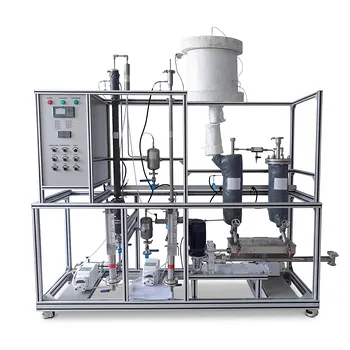
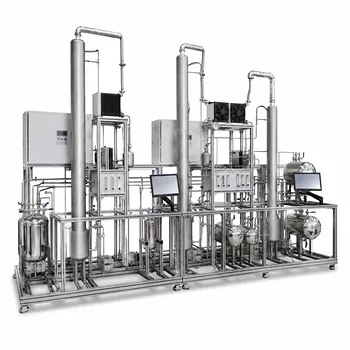
Methanol steam reforming (MSR) pilot plants are educationally and operationally superior to methane steam reforming systems for most university laboratories because they operate at dramatically lower temperatures (200–300°C vs. over 500°C), drastically cutting energy use, safety risks, and catalyst coking. This single difference cascades into safer student handling, simpler reactor materials, less stringent process control, and a sharper focus on fundamental reaction engineering principles without the distraction of high-temperature hazards or rapid catalyst deactivation.
The central advantage is thermal gentleness. Lower operating temperatures make MSR inherently safer, cheaper to build and run, and far more forgiving of operational mistakes—all while still demonstrating the core concepts of heterogeneous catalysis, kinetics, and hydrogen generation that form the backbone of a chemical engineering education.
The Safety and Simplicity of Lower Temperatures
A Fundamentally Milder Process
Methanol steam reforming proceeds at 200–300°C, while methane steam reforming demands temperatures above 500°C and often 700–900°C. This gap defines the pilot plant experience. At 250°C, standard electrical heating bands and off-the-shelf stainless steel components are sufficient. Above 600°C, you need specialized high-temperature alloys, advanced insulation, and rigorous thermal management.
Transformative Impact on Student Safety
In a teaching lab, a reactor operating at 800°C is an ever-present burn and ignition hazard. MSR’s low-temperature envelope transforms the risk profile. It allows students to interact directly with the equipment, take measurements, and even modify parameters without the same level of protective infrastructure or intimidating remote-operation barriers. The result is a hands-on learning environment where the focus stays on science, not on fear of injury.
Lower Energy Footprint and Simpler Utilities
Reaching and holding 800°C consumes substantial electrical power and often requires multi-zone, high-wattage heating systems. An MSR pilot plant’s modest thermal demand makes power requirements manageable for standard academic labs, avoiding costly facility upgrades. This also slashes warm-up and cool-down times, letting more student groups run experiments in a single lab session.
Minimizing Catalyst Deactivation: The Coke Problem
Why Methanol Resists Carbon Formation
Coke deposition is the bane of steam reforming catalysts. Methane, with its tendency to crack at high temperatures, is a prolific coke precursor. Methanol, by contrast, contains only one carbon atom and no carbon-carbon bonds. This structural simplicity means there is no C–C cleavage step, eliminating a major pathway to carbon formation. The primary reference explicitly notes that coke production is minimized, and the supplementary references confirm that ethanol and methane suffer from high coke formation rates.
Reduced Maintenance and Longer Catalyst Life
Less coking translates directly to operational advantages. In a methane pilot plant, catalyst beds can foul quickly, requiring frequent regeneration or replacement—an activity that is time-consuming, dirty, and pedagogically unproductive. In an MSR pilot plant, catalyst deactivation is significantly reduced, so laboratories spend less time repacking reactors and more time collecting meaningful kinetic data.
Clearer Kinetic Demonstrations
When a catalyst deactivates rapidly, students see a confusing mixture of intrinsic kinetics and deactivation dynamics. MSR’s stable operation yields cleaner concentration-vs-time curves, making it far easier to demonstrate classical concepts like activation energy, rate-determining steps, and effectiveness factors without the noise of a dying catalyst.
Reactor Design and Operational Flexibility
Simpler Materials of Construction
Methane steam reformers in industry operate at pressures up to 3.0–5.0 MPa and temperatures near the creep limit of many steels. Educational pilot plants for methane must be built from costly, high-grade alloys and require stress-welded, thick-walled tubes just to survive. An MSR pilot plant can be assembled from common 316 stainless steel at atmospheric or low pressure, dramatically lowering capital cost and making it feasible for students to assemble and modify modules themselves.
Less Demanding Process Control
Maintaining a stable temperature profile inside a 900°C, high-pressure reactor is a control engineering challenge requiring precise multi-zone temperature controllers and rapid-response gas preheaters. For MSR, the close coupling between heater setpoint and bed temperature is far tighter and more forgiving. Students can easily explore the effect of temperature, space velocity, and steam-to-carbon ratio without the experimental drift caused by thermal lags.
Rapid Startup and Turnaround
A typical MSR pilot plant can reach steady state in under 30 minutes. A methane unit may take hours just to reach thermal equilibrium. This fast cycling is critical in academic settings, where multiple student groups must rotate through experiments. It allows more iterations, more troubleshooting, and deeper learning within the constraints of a semester.
Educational Value: Focusing on Core Concepts
Unobscured Heterogeneous Catalysis
The primary reference highlights MSR’s suitability for demonstrating heterogeneous catalysis, reaction kinetics, and hydrogen generation safely. When a pilot plant fights high temperatures, coking, and leaks, the theory gets buried under operational firefights. With MSR, students can systematically study the role of the catalyst support, metal dispersion, or promoter—the type of crisp, publishable investigations that cement chemical engineering fundamentals.
Bridging to a Hydrogen-Focused Future
Methanol is a liquid at room temperature, making it a practical hydrogen carrier. Many MSR pilot plants are directly coupled to a polymer electrolyte membrane (PEM) fuel cell to produce clean electricity from hydrogen. This integrated system demonstrates the entire energy chain—chemical energy to hydrogen to power—without the compressed-gas hazards of methane. Educationally, this is a compelling narrative: renewable methanol feeds a low-temperature reformer, which powers a fuel cell, offering a tangible model of a future distributed energy system.
Understanding the Trade-offs
No single feedstock fits every teaching goal. It is critical to recognize where methane steam reforming still holds value.
- Industrial realism: Methane reforming dominates global hydrogen production. An educational methane pilot plant better prepares students for jobs at ammonia plants or petroleum refineries where SMR is the baseline technology.
- Scale-up thinking: The engineering challenges of methane—high-temperature heat transfer, refractory linings, nickel-based catalysts on spinel carriers—provide an essential lesson in industrial reactor design that a gentle MSR unit cannot fully replicate.
- Material toughness: A methane system forces students to confront thermal expansion, creep, and hydrogen embrittlement. If the curriculum’s core goal is to teach mechanical design for extreme conditions, a methane rig is superior.
The choice, therefore, is about pedagogical intent. If the goal is to teach chemical reaction engineering in a safe, data-rich environment, MSR wins decisively. If the goal is to mimic existing industrial plants, methane has its place.
Making the Right Choice for Your Laboratory
Your decision should be driven by what you need students to learn, not by the raw impressiveness of the hardware. Consider these practical recommendations.
- If your primary focus is fundamental reaction engineering and kinetics: Choose an MSR pilot plant. The cleaner data, stable catalyst, and rapid experimentation cycles deliver superior learning outcomes.
- If your primary focus is hands-on student safety and operational accessibility: MSR is the only sensible choice. Its low temperature and pressure remove a layer of risk that simply cannot be engineered away in a methane system at a university scale.
- If your primary focus is integrated hydrogen-to-power demonstrations: An MSR unit coupled to a PEM fuel cell shows the entire renewable‑hydrogen‑electricity loop elegantly, taking advantage of methanol’s liquid‑fuel convenience.
- If your primary focus is preparing students for heavy-industry reforming roles: A methane pilot plant provides irreplaceable familiarity with high‑temperature materials, fired heaters, and the operational rhythms of a classic SMR furnace.
Ultimately, the lower temperature, reduced coking, and forgiving operation of a methanol steam reforming pilot plant empower more students to spend more time learning the chemistry and process control that truly matter—turning a potentially dangerous high‑temperature puzzle into a transparent, educational instrument.
Summary Table:
| Feature / Parameter | Methanol Steam Reforming (MSR) | Methane Steam Reforming (SMR) |
|---|---|---|
| Operating Temperature | Low (200–300°C) | High (500–900°C) |
| Catalyst Coking & Deactivation | Minimized (longer life, cleaner kinetics) | High (frequent regeneration/replacement) |
| Safety & Risk Profile | Safe, hands-on student interaction | High burn/ignition hazard, remote operation |
| Material & Capital Cost | Standard stainless steel, lower cost | High-grade alloys, high-pressure rating |
| Startup & Cycle Time | Rapid (steady state in <30 mins) | Slow (takes hours to equilibrate) |
Upgrade Your Chemical Engineering Lab with LABPARK
Looking to equip your university, research institute, or enterprise with safe, high-performance teaching tools? LABPARK provides premium Educational and Vocational Unit Operations Pilot Plants tailored for chemical engineering, bioprocess & biotech, and environmental & water treatment.
Bring hands-on kinetics, heterogeneous catalysis, and hydrogen generation concepts to life safely and efficiently. Contact LABPARK today to discuss your laboratory configuration and get a customized solution!
Related Products
- Steam Methane Reforming Hydrogen Production and Purification Educational Pilot Plant
- Methanol Synthesis and Catalyst Performance Evaluation Educational Unit Operations Pilot Plant
- Carbon Dioxide Hydrogenation Methanol Synthesis Educational Unit Operations Pilot Plant
- Methane Cracking Educational Unit Operations Pilot Plant
- Carbon Dioxide Hydrogen Methanol Synthesis Educational Unit Operations Pilot Plant
People Also Ask
- How Do Temp, Pressure & S:C Ratio Affect Methane Reforming? Optimize Your Pilot Reactor
- How to Integrate WGS & Purification in Steam Reforming Pilot Plants to Protect Fuel Cells from CO Poisoning
- What are the differences between steam reforming and ATR in pilot plants? Key Design Guide
- How is carbon deposition controlled in steam reforming? The Critical Role of S/C Ratio
- What is the difference between allothermal and autothermal steam reforming in pilot plants?