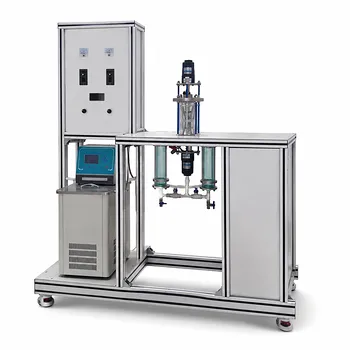
The single most critical factor is the physical nature of the solids you are separating—primarily their particle size and compressibility. Gravity filtration is the gentle, reliable workhorse for fragile, gelatinous precipitates or extremely fine particles that would instantly clog a filter under pressure. Vacuum filtration, conversely, uses a pressure differential to dramatically speed up the separation and produce a drier cake, but only when dealing with firm, crystalline solids that maintain an open pore structure under suction. The decision is not about which method is objectively "better," but which one aligns with your specific slurry's behavior and your process metrics.
Before selecting any hardware, you must first characterize your slurry. The core insight is that vacuum filtration fails catastrophically with compressible, fine solids because they form an impermeable skin, while gravity filtration fails economically with free-draining crystals because it’s painfully slow. Your choice is a direct function of the solids' tendency to blind the filter medium.
The Physics of Particle Behavior
The way a solid packs under force is the invisible governor of filtration. A method that works brilliantly for one slurry will be a sticky, clogged mess with another.
Particle Size and Cake Porosity
Larger, rigid particles (roughly >100 µm) naturally stack with gaps between them, creating a highly permeable cake. When vacuum is applied, fluid easily channels through these voids, accelerating the process without collapsing the structure.
Fines and colloids are a different story. Sub-micron particles can pack so tightly that any applied vacuum immediately compresses them into a dense, mud-like layer with near-zero permeability. The filter medium then sees a "filtration skin" that refuses to pass liquid, rendering the vacuum useless.
Gelatinous vs. Crystalline Solids
Gelatinous precipitates (like aluminum hydroxide) are highly compressible sponges. Under gravity, their fluffy, three-dimensional structure allows slow but steady drainage. Apply vacuum, and that structure collapses instantly, squeezing shut the very pathways the liquid needs.
Crystalline solids (like sodium chloride or coarsely precipitated calcium carbonate) are sharp, hard, and incompressible. They form a rigid framework that withstands negative pressure, making them ideal candidates for vacuum filtration. The vacuum not only increases throughput but actively pulls residual liquor from the interstices, giving a drier product.
Process Goals and Economic Drivers
Selecting a filtration method is not just a scientific decision; it’s an economic one defined by your target throughput and final product quality.
Speed and Throughput
Vacuum filtration is the clear winner when time is money. A free-draining, coarse crystal slurry that might take hours to filter by gravity can be dewatered in minutes with modest vacuum. In a pilot plant or production setting, this directly increases capacity.
However, the speed of gravity filtration can be deceptive. If your precipitation step naturally produces a granular solid, gravity may be prohibitively slow—not due to clogging, but simply because the driving force (a few centimeters of liquid head) is so weak. This makes vacuum an economic necessity even if the solid is borderline fine.
Final Cake Dryness
Vacuum filtration pulls entrained air through the cake after the bulk liquid is gone, displacing capillary moisture. This produces a much drier, crumbling cake that is easier to handle, weigh, and downstream process (e.g., drying, incineration).
Gravity filtration yields a typically wetter, pastier cake because the only moisture removal comes from slow drainage driven by hydrostatic head. If your next unit operation is a dryer, that extra moisture represents a massive energy penalty that can make vacuum’s speed advantage look small by comparison.
Understanding the Trade-offs
Ignoring the dark side of each method leads to failed batches, operator frustration, and the false conclusion that "filtration doesn't work."
The Blinding Problem with Vacuum
The most common vacuum filtration disaster is irreversible blinding. When a slurry contains broad particle size distribution or a fraction of fines, those tiny particles are pulled into the filter medium pores, permanently plugging them. The flow rate drops to zero, and the filter medium must be replaced or scoured clean.
"Run-through" is the other vacuum pitfall. With extremely fine, non-retaining particles, the solids simply pass right through the filter paper or sintered glass, contaminating the filtrate and ruining the separation. Gravity, by contrast, often allows a thin precoat of solids to naturally form, acting as a depth filter and catching those stragglers.
When Gravity Filtration is the Only Safe Choice
If you see a cloudy supernatant and a "puffy" sediment in a beaker, you likely have a gelatinous solid. Force-filtering this under vacuum will compact it into an impenetrable film on the paper, leading to zero flow and a torn filter being the only way to recover the solid. Gravity filtration, though slow, is the only reliable lab-bench method.
At pilot scale, this principle holds. Filter presses using moderate squeeze pressure might handle these sludges, but a simple gravity nutsche filter is often the first gently scaled-up option for tough, compressible materials before investing in expensive membrane-assisted equipment.
From Lab to Plant: Scaling Considerations
The final selection always has an eye on how the process will grow. Lab choices inform pilot choices, which inform production.
Matching Laboratory Methods to Industrial Equipment
Gravity filtration in a conical glass funnel is a direct conceptual model for a Nutsche filter or a gravity belt filter. These industrial units use similar low-pressure, gentle liquid heads and are reserved for the same difficult, blinding solids.
Buchner funnel vacuum filtration is the direct precursor to a rotary vacuum drum filter or a horizontal vacuum belt filter. Both leverage a continuous, applied vacuum to instantly pull a cake from a flowing slurry. Recognizing this link prevents the painful surprise of scaling up a lab-acceptable gelatinous gravity process into a vacuum-based production machine that would blind in minutes.
Making the Right Choice for Your Goal
Your decision pathway should be dictated by what you optimize for. Use these goal-oriented heuristics to select your starting point.
- If your primary focus is handling gelatinous, compressible, or colloidal solids: Avoid vacuum entirely in early trials. Stick with gravity filtration and accept a wetter cake; if scaling, explore gentle pressure filtration like a plate-and-frame press with low squeeze pressure.
- If your primary focus is maximum throughput and a dry, free-flowing cake: Run a rapid bench-scale vacuum test with coarse filter paper. If the filtrate is clear and the cake cracks open easily, vacuum is your baseline. Only revert to gravity if blinding or run-through occurs.
- If your primary focus is protecting a precious filtrate from particle contamination: Gravity filtration’s natural tendency to form a depth precoat can be an advantage. Test both methods and visually compare filtrate clarity—an instant turbidity under vacuum may push you back to gravity.
- If your primary focus is a scalable pilot process with predictable economics: Always characterize the slurry’s compressibility first. A simple bench test of filtration time versus pressure drop tells you whether you’re designing for a vacuum drum (incompressible) or a filter press (compressible). This single test prevents million-dollar scaling errors.
Your filtration method is not a preference; it’s a consequence of your solid’s mechanical personality. Respect that, and the clean separation will follow.
Summary Table:
| Feature | Gravity Filtration | Vacuum Filtration |
|---|---|---|
| Best For | Fragile, gelatinous, or fine particles | Firm, crystalline, or coarse solids |
| Compressibility | High (handles compressible solids) | Low (requires incompressible solids) |
| Throughput Speed | Slow, driven by hydrostatic head | Fast, driven by pressure differential |
| Cake Dryness | Wetter, pastier cake | Drier, crumbly cake |
| Scale-up Equipment | Gravity nutsche, gravity belt filters | Rotary drum, horizontal belt filters |
Looking to scale up your solid-liquid separation processes? LABPARK provides state-of-the-art Educational and Vocational Unit Operations Pilot Plants in chemical engineering, bioprocess & biotech, and environmental & water treatment. Designed specifically for universities, research institutes, and enterprises, our pilot systems bridge the gap between laboratory filtration theory and industrial reality. Contact us today to discuss how our pilot plants can enhance your research and training capabilities!
Related Products
- Gas-Solid Heterogeneous Separation Demonstration Educational Unit Operations Pilot Plant
- Hot Filtration Educational Unit Operations Pilot Plant Laboratory System
- Pressure Swing Adsorption Educational Unit Operations Pilot Plant
- Gallium and Indium Selective Extraction Educational Pilot Plant
- Bench Scale Dual Column Gas Separation and Capture Educational Pilot Plant
People Also Ask
- Why is pressure drop characterization critical in separation pilot plants? Key operational insights.
- What are the key thermodynamic considerations for gas mixture modeling? Expert Guide
- What are the primary operational objectives and physical requirements when running heterogeneous separation pilot plants?
- What are the material limitations of gas separation pilot plants? Key factors to consider.
- What are the trade-offs in olefin-paraffin separation? Optimize Pilot Plant Performance