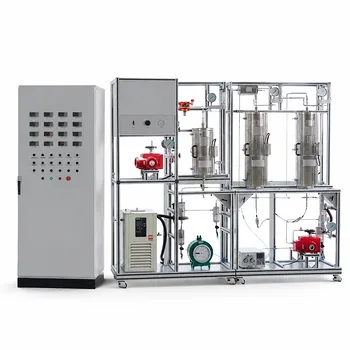
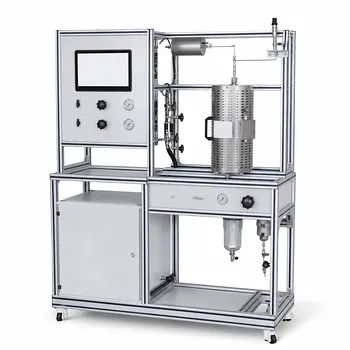
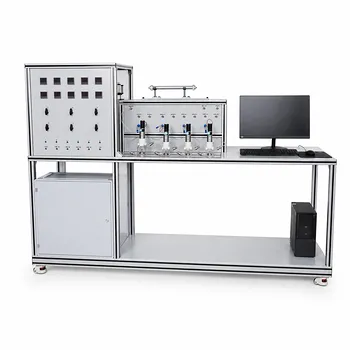
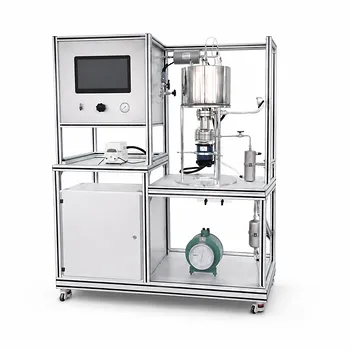
The answer to building a flexible reactor system starts with eight core modular blocks. These are the Gas Feed Module, the Liquid Feed Module, a Manifold Module, the Reactor Module, a Heater Module, an Effluent Module, an Analytical Module, and an Automation/Informatics Module. A system built on this modular architecture lets you freely reconfigure the setup for everything from rapid catalyst screening to detailed unit operations studies in a single platform.
Building a truly flexible reactor system is not about buying a single monolithic machine. It’s about assembling a kit of independent, interoperable modules that give you precise control over every variable—from reactant delivery to product analysis—so you can adapt to new experimental designs without rebuilding from scratch.
The Modular Architecture Explained
A modular reactor system separates the entire experimental workflow into physically and functionally distinct blocks. This separation is what enables the high flexibility needed in both catalyst screening and educational unit operations. Each module can be sized, swapped, or independently controlled without disrupting the others.
The Gas and Liquid Feed Modules
Controlled reactant delivery is the starting point of any reproducible experiment. These modules are dedicated to precisely metering gases and liquids into the system.
A Gas Feed Module typically uses mass flow controllers to deliver sweeping gases, reactants like hydrogen or CO, and internal standards. A separate Liquid Feed Module uses high-precision pumps to introduce liquid reactants at very low, controllable flow rates. Keeping them as distinct blocks allows you to independently scale gas and liquid delivery, a necessity when screening catalysts with varying feed compositions.
The Manifold Module
This is the distribution hub. It takes the combined or separate feed streams and routes them to the correct reactor position—or to multiple reactors in parallel.
For a high-throughput system, the manifold might split a single feed into 48 reactor lines, possibly divided into subsections (e.g., six subsections of eight reactors) to test different feed compositions simultaneously. At the lab or pilot scale, a modular manifold makes it simple to add or remove reactor lines or to bypass them entirely for maintenance.
The Reactor Module and Heater Module
This is where the controlled interaction occurs. The Reactor Module is the physical housing for your catalyst bed.
It’s designed for a standardized reactor matrix that facilitates plug-flow operation and fast loading/unloading. Individual reactors often contain catalyst volumes between 70 and 200 microliters. Crucially, you need individual temperature measurements inside the catalyst bed of each reactor to guarantee kinetic data integrity. The paired-but-separate Heater Module provides the precise thermal energy, often as an independently controlled furnace or heating jacket. Decoupling the heater from the reactor geometry lets you change reactor tube diameters or materials while keeping the same thermal control unit.
The Effluent and Analytical Modules
What happens to the products after the reaction is just as important. The Effluent Module manages downstream pressure, phase separation, and safe venting of the post-reaction stream.
It contains back-pressure regulators to maintain the reaction pressure and often a valve system for directing samples. The Analytical Module is the eyes of the system. It could be a gas chromatograph (GC), a mass spectrometer, or a combination. For maximum flexibility, the analytical module should be able to handle sequential sampling from multiple reactors, allowing you to monitor activity and selectivity over time with a single instrument.
The Automation and Informatics Module
Data without coordination is noise. This module is the brain that turns a collection of hardware into a unattended, multi-step testing platform.
It typically relies on a software environment like LabVIEW to interface with every other module. This block enables real-time monitoring and closed-loop control of temperatures, flow rates, pressures, and sampling sequences. It also manages safety alarm triggers, allowing the entire parallel reactor matrix to run 24/7. For a unit operations lab, this exposes users to the same process automation principles used in industry.
Addressing the Deeper Need: Reproducibility and Data Quality
A modular system isn't just about convenience. It directly solves the hidden challenge of reproducible flow patterns and accurate kinetic measurements, which are non-negotiable for reliable catalyst evaluation.
By standardizing the reactor module for plug-flow operation and placing temperature probes directly in the bed, you eliminate mass-transfer and temperature gradients that would otherwise obscure the true catalyst activity. The independent analytical module ensures that the measurement of conversion and selectivity is not influenced by process fluctuations upstream. This architecture is designed from the ground up to give you accurate kinetic feedback, not just a "working" reactor.
Understanding the Trade-offs
No design is perfect. A modular system requires careful engineering to avoid new problems.
- Interface Complexity: The connections between modules (fittings, dead volumes) must be meticulously designed. Poorly integrated modules introduce cold spots or mixing volumes that can degrade plug-flow behavior and analytical accuracy.
- Higher Initial Investment: A modular setup often has a higher upfront cost compared to a dedicated, single-purpose rig. The value is realized later through extended lifetime and reconfigurability.
- Software Integration Debt: Getting the automation module to talk seamlessly to hardware from different vendors is the most common pain point. Investing in a platform-agnostic informatics module from the start is critical.
Making the Right Choice for Your Goal
Your specific purpose dictates how you prioritize and scale these modules. Here is how to apply this architecture.
- If your primary focus is rapid parallel screening: Prioritize a manifold module that supports a high-density reactor matrix and an analytical module capable of fast sequential sampling, such as a multi-port GC. The automation module becomes non-negotiable for handling the data volume.
- If your primary focus is educational unit operations: Focus on a transparent, glass-walled reactor module and a highly visual automation interface. The goal is to make fluid dynamics and control logic tangible, so the module's visibility and manual override capability are as important as precision.
- If your primary focus is scaling fundamental kinetics: Sacrifice throughput for precision. Use single reactor modules with exceptional bed-temperature profiling and integrate a mass spectrometer for real-time, transient product analysis. The heater and analytical modules receive the bulk of the investment.
In every case, the modular approach ensures your system can grow and change with your research questions, turning a capital expense into a long-term experimental asset.
Summary Table:
| Modular Component | Primary Function | Key Benefit |
|---|---|---|
| Feed (Gas/Liquid) | Precise reactant metering & delivery | High reproducibility & independent scaling |
| Manifold | Stream distribution to reactor lines | Enables parallel screening & bypass options |
| Reactor & Heater | Catalyst housing & precise thermal control | Eliminates gradients; flexible configuration |
| Effluent & Analytical | Product sampling & downstream management | Real-time conversion & selectivity tracking |
| Automation & Informatics | System coordination & process control | Supports 24/7 unattended operation |
Build Your Flexible Pilot Plant with LABPARK
Are you looking to optimize your laboratory research or training capabilities? LABPARK provides premium Educational and Vocational Unit Operations Pilot Plants in chemical engineering, bioprocess & biotech, and environmental & water treatment.
We help universities, research institutes, and enterprises build highly flexible, modular, and scalable systems designed to improve data accuracy and process control.
Contact LABPARK today to discuss your custom reactor configuration and accelerate your research goals!
Related Products
- Multi-Reactor Educational Pilot Plant for Reaction Engineering Unit Operations
- Fixed Bed Gas Solid Catalytic Reaction Educational Pilot Plant
- Residence Time Distribution and Reactor Flow Characteristics Determination Educational Pilot Plant
- Tubular Reactor Flow Characteristics Determination Educational Unit Operations Pilot Plant
- 100L Continuous Loop Hydrogenation Educational Unit Operations Pilot Plant
People Also Ask
- How do educational unit operations pilot plants address safety and waste management when scaling up?
- How do educational unit operations pilot plants bridge theory and design? Bridge the Engineering Gap
- Why Compare Predicted and Experimental Excess Enthalpy? Key to Accurate Pilot Plant Scale-up
- Why Use PTFE & Hastelloy in Chemical Pilot Plants? Prevent Corrosion & Ensure Safety
- How to study gasification in pilot plants? Compare exit gas composition & efficiency