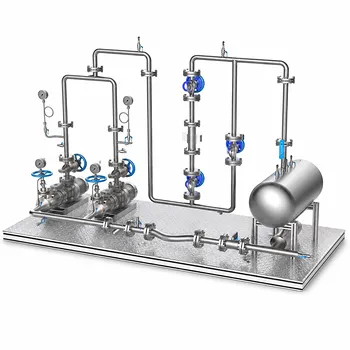
The semiflow batch model is a fundamental mode of operation in gas-liquid reactor training systems, where a stationary liquid phase is contacted by a continuously flowing gas stream. The liquid is assumed to be perfectly mixed, so its concentrations are uniform in space but decay over time as the gaseous reactant is absorbed and reacts. This process is modeled by a single ordinary differential equation (ODE) that tracks the dimensionless liquid-phase concentration as a function of time, driven by the instantaneous reaction rate (expressed via the Hatta number) and the total mass flux of the gaseous species crossing the interface into the bulk liquid.
The semiflow batch reactor is the instructional cornerstone for understanding gas absorption with chemical reaction. Its power lies in isolating the liquid-phase dynamics: a well-mixed, time-dependent system that reduces the complex coupled mass transfer–reaction problem to a tractable ODE, while still capturing the essential interplay between diffusion and kinetics through the Hatta number.
Defining Characteristics of the Semiflow Batch Model
The Gas Phase Flows Continuously, the Liquid Remains Stationary
In this configuration, the gas is fed to the reactor at a constant rate and exits after contacting the liquid.
The liquid phase is charged into the reactor at the start and is not replenished or withdrawn during the experiment.
This creates a true batch environment for the liquid, while the gas phase operates in a continuous, steady-flow mode.
The Liquid Phase is Assumed to be Well-Mixed
A core simplification is that the liquid is completely mixed, meaning concentration gradients within the liquid bulk are negligible.
Therefore, at any given moment, the concentration of the dissolved gaseous reactant and the liquid-phase reactant is the same everywhere inside the reactor.
This makes the liquid concentrations time-dependent, but not space-dependent.
Concentration Changes are Driven by Reaction and Mass Transfer
As the gaseous solute is absorbed, it undergoes a chemical reaction in the liquid bulk.
The instantaneous rate of change of the liquid-side concentration is governed by a competition between the rate of mass transfer across the gas-liquid interface and the rate of chemical consumption.
This interplay determines the overall uptake rate and the final composition of the liquid.
How the Model is Formulated in Training Systems
The Material Balance Becomes a Single Ordinary Differential Equation
Because the liquid is well-mixed, a macroscopic material balance over the entire liquid volume yields an ODE.
For a dissolved gas A reacting in the liquid, the balance can be written as:
Accumulation of A in liquid bulk = Rate of A entering from gas – Rate of A consumed by reaction
The accumulation term is ( V_L \frac{dC_{AL}}{dt} ), the mass transfer term involves the liquid-side mass transfer coefficient and interfacial area, and the reaction term depends on the intrinsic kinetics.
This ODE is then integrated over time to predict the liquid concentration profile.
Dimensionless Time and the Hatta Number Govern the Dynamics
To generalize the behavior, training models typically use dimensionless time ( \tau = t \cdot k_L a ) (where ( k_L a ) is the volumetric mass transfer coefficient).
The reaction contribution is encapsulated by the Hatta number (( Ha )), which compares the maximum possible reaction rate in the film to the maximum diffusional transport rate.
- For ( Ha < 0.3 ), the reaction is considered slow and occurs predominantly in the bulk liquid.
- For ( Ha > 3 ), the reaction is fast and takes place mainly within the mass transfer film, enhancing the absorption rate.
The ODE thus becomes a function of ( Ha ) and the instantaneous bulk concentration, powerfully demonstrating the reaction regime's impact on the overall process.
The Gas Phase is Often Modeled as Plug Flow
While liquid-side assumptions dominate the model, the gas phase is typically treated as plug flow, especially in bubble columns or short packed sections used in training rigs.
This means the gas composition changes along the column height, but because the liquid is batch, the gas outlet concentration evolves over time as the liquid becomes depleted or saturated.
The combination of gas plug flow and liquid complete mixing is a classic approximation that yields an analytical or easily integrable expression for the driving force in the mass transfer term.
Understanding the Trade-offs
The Well-Mixed Assumption Limits Applicability
The uniform liquid concentration assumption holds only for reactors with low height-to-diameter ratios or vigorous agitation.
In tall bubble columns or packed beds, axial concentration gradients can develop, and the model would then overpredict the overall reaction rate and underpredict the required residence time.
Instructors must explicitly state when this idealized model fails, guiding students toward more complex plug–plug or axial dispersion models.
The Batch Liquid Precludes Steady-State Insight
Semiflow batch operation cannot reach a true steady-state for the liquid; the system evolves continuously toward equilibrium or complete consumption.
This is intentional for kinetic studies—it allows measurement of time-dependent absorption rates—but it means the model does not directly teach steady-state continuous reactor design.
Training systems often pair this with a continuous-flow configuration to provide a complete picture.
Simplifications in Mass Transfer Coupling
The model assumes the mass transfer coefficient ( k_L ) and the specific interfacial area ( a ) remain constant throughout the experiment.
In reality, changes in liquid composition (e.g., salt formation, surfactant accumulation) can alter bubble size and coalescence behavior, shifting ( k_L a ).
Educational setups usually neglect these secondary effects to keep the focus on the core reaction–diffusion coupling, but they should be noted as real-world complications.
Making the Right Choice for Your Learning Goal
After understanding the characteristics and modeling framework, select the semiflow batch approach when its pedagogical strengths align with your objective:
- If your primary focus is teaching the fundamentals of gas–liquid mass transfer with reaction: Use the semiflow batch model. Its time-dependent ODE directly reveals how the Hatta number dictates whether the process is mass-transfer-limited or reaction-rate-limited.
- If your primary focus is comparing reaction regimes experimentally: Choose the semiflow batch with a fast-responding gas analysis. The evolving outlet gas concentration provides a clear fingerprint of instantaneous absorption rates, allowing students to distinguish slow, moderate, and fast reaction regimes.
- If your primary focus is scaling up to industrial continuous reactors: Be aware that the batch liquid model is a stepping stone. Extend it by coupling a flowing liquid phase and adding a spatial dimension to model continuous stirred tanks or plug-flow contactors.
The semiflow batch model, through its elegant simplification to a well-mixed, time-dependent ODE, remains the most effective starting point for building a deep, intuitive grasp of reactive gas absorption.
Summary Table:
| Feature | Phase Behavior | Modeling Assumption | Key Parameter / Equation |
|---|---|---|---|
| Gas Phase | Continuous flow | Treated as plug flow | Volumetric mass transfer coefficient ($k_L a$) |
| Liquid Phase | Stationary (batch) | Completely well-mixed (uniform bulk concentration) | Ordinary Differential Equation (ODE) for mass balance |
| Reaction Regime | Time-dependent | Diffusion-reaction coupling | Hatta number ($Ha$) |
| Limitations | No steady-state | No axial liquid gradients | Constant physical properties ($k_L$, $a$) assumed |
Bring Theory to Life with LABPARK Pilot Plants
Enhance your students' and researchers' understanding of complex gas-liquid reactor dynamics. LABPARK provides premium Educational and Vocational Unit Operations Pilot Plants in chemical engineering, bioprocess & biotech, and environmental & water treatment. Designed specifically for universities, research institutes, and enterprises, our training systems offer hands-on experience with real-world mass transfer and reaction kinetics modeling.
Ready to upgrade your laboratory? Contact LABPARK Today to request a customized product catalog or technical consultation!
Related Products
- Multi-Reactor Educational Pilot Plant for Reaction Engineering Unit Operations
- Gas Phase Mixing and Residence Time Distribution Determination Educational Unit Operations Pilot Plant
- Two-Dimensional Fluidization Hydrodynamics Educational Pilot Plant for Unit Operations Training
- Quantitative Dosing and Liquid Flow Control Educational Unit Operations Pilot Plant
- Multi-Modal Distillation Unit Operations Training Pilot Plant
People Also Ask
- How do educational unit operations pilot plants address safety and waste management when scaling up?
- How do educational unit operations pilot plants bridge theory and design? Bridge the Engineering Gap
- Why Compare Predicted and Experimental Excess Enthalpy? Key to Accurate Pilot Plant Scale-up
- How to study gasification in pilot plants? Compare exit gas composition & efficiency
- Why Use PTFE & Hastelloy in Chemical Pilot Plants? Prevent Corrosion & Ensure Safety