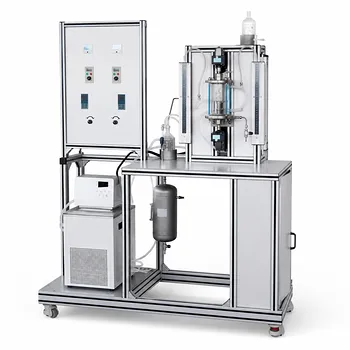
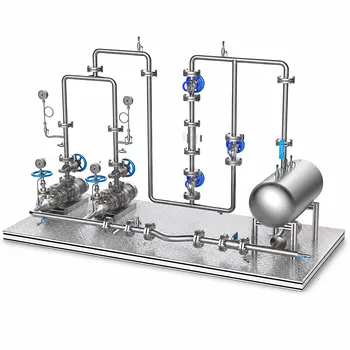
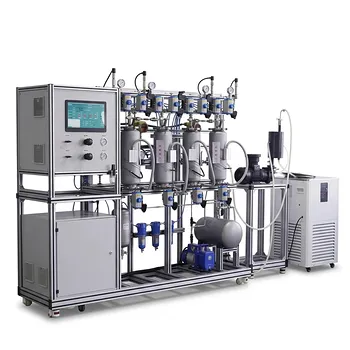
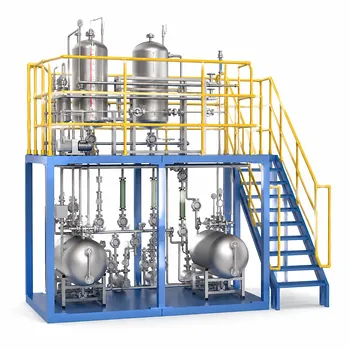
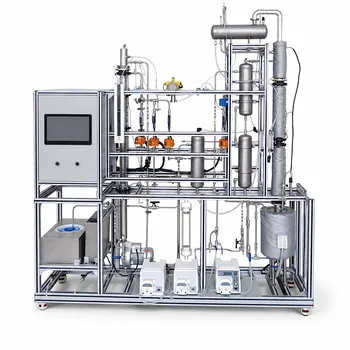
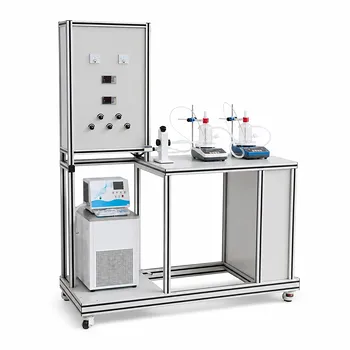
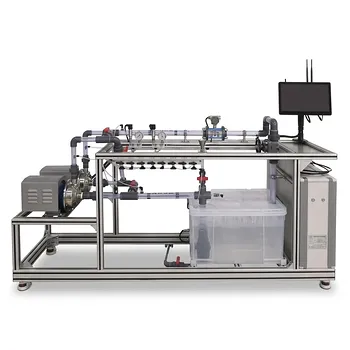
High-gravity processing turns a standard gas-liquid training system into a window on the future of chemical manufacturing. By integrating rotating packed beds that spin at high speeds, these systems deliver a tenfold or greater increase in mass and heat transfer while slashing equipment size and maintenance demands. Students and researchers immediately observe how counter-current flow over a spinning rotor intensifies separation and absorption, making the abstract promise of “process intensification” a tangible, measurable reality.
The core advantage is a radical improvement in transfer rates inside a dramatically smaller vessel, with fewer maintenance headaches. For training, this means you can demonstrate next-generation plant design—where compact, high-throughput devices replace bulky columns—all within a benchtop footprint.
Why High-Gravity Processing Changes the Game
It Embodies Process Intensification at Every Level
Traditional gas-liquid contactors rely on gravity alone to drive liquid through a tall column of packing. High-gravity (HiGee) technology replaces that slow, vertical journey with a rotor that multiplies the effective gravitational force, creating thin, fast-moving liquid films. The outcome is not just a faster reaction—it completely redefines what is possible in a given volume.
The Rotor Becomes the Classroom’s Most Powerful Teacher
Instead of reading about mass transfer coefficients, trainees watch them jump by orders of magnitude when the rotor spins up. The short contact times (often milliseconds) force a new way of thinking about kinetics and equilibrium, shifting the focus from residence time to the quality of interfacial contact. This is the exact mindset that modern plants use to debottleneck operations.
Key Technical Benefits Explained
Mass Transfer Rates That Reframe Design Rules
The centrifugal field inside a rotating packed bed stretches liquid into extremely thin films and tiny droplets, creating an interfacial area that can be 10–100 times larger per unit volume than in a conventional packed column. Because diffusion distances shrink and mixing is violent, the volumetric mass transfer coefficient skyrockets. This is the single biggest technical payoff: you can achieve the same separation in a device that is a fraction of the height of a traditional column.
Shorter Gas–Liquid Contact Times Without Sacrificing Performance
Counter-current flow is maintained while the liquid traverses the packing in just a few rotations. This means reactions and absorptions that are diffusion-limited see a huge boost, while unwanted side reactions have less time to form. In training, students can measure how performance holds steady or improves even as contact time drops, illustrating a critical design lever.
Drastically Reduced Physical Footprint
Because the rotor packs high surface area into a small disk, a HiGee unit replaces towers that might otherwise stretch several meters tall. This makes it possible to set up a complete absorption or stripping experiment on a lab bench. The implication for future plants—offshore platforms, modular factories, mobile skid-mounted units—becomes instantly obvious the moment they see the size of the device.
Lower Maintenance Requirements in Practice
Rotating packed beds are frequently described as requiring less maintenance than their gravity-fed counterparts. The high-speed liquid flow helps keep surfaces clean, reducing fouling and the downtime needed for packing replacement. There are still bearings and seals to monitor, but the overall maintenance burden drops because there are no tall, hard-to-reach packed beds to service.
How This Translates to Training Systems
A Microcosm of Modern Plant Design
Training systems equipped with a HiGee contactor expose learners to the engineering principles that drive compact, modular chemical plants. They experience firsthand how intensification decouples throughput from volume, and why this matters for carbon capture, solvent regeneration, and offshore gas processing. The lesson is not just about fluid dynamics—it’s about capital efficiency and sustainability.
Data-Rich Experiments in Minimal Space
Because the unit is small and fast-responding, students can run multiple experiments in a single session. Changing rotor speed, liquid flow, or gas load produces immediate shifts in pressure drop, separation efficiency, and mass transfer coefficients. This accelerates learning cycles and turns abstract dimensionless numbers into something they can feel under their hand on the control panel.
Connecting Theory to Industry Trends
Process industries are under constant pressure to reduce equipment size, weight, and solvent inventory. A high-gravity training system becomes a direct bridge to those conversations. Every data point collected underscores why spinning packed beds are finding their way into new decarbonization and purification projects worldwide.
Understanding the Trade-offs
Rotating Equipment Adds Mechanical Complexity
While maintenance demands are often lower than for tall columns, the rotor, shaft, bearings, and seals still represent moving parts that can wear, vibrate, or leak. Trainees must learn proper startup and shutdown procedures, balancing techniques, and the limits of mechanical seals—skills that are valuable but add a layer of instruction beyond pure chemistry.
Higher Capital Cost for the Training Unit
A high-gravity contactor is a precision-engineered piece of machinery. The initial investment is typically higher than a simple glass column packed with Raschig rings. However, when measured against the educational value—the ability to demonstrate intensified processes, complete quicker experiments, and occupy minimal floor space—the premium often pays for itself in curriculum richness and student engagement.
Not a One-to-One Replacement for Gravity Columns
Some large-scale separations still favor traditional columns due to decades of operational experience and straightforward scalability. A training system that only features HiGee would miss teaching the baseline. Ideally, it complements a conventional column, allowing side-by-side comparison so that students learn where each technology excels.
Making the Right Choice for Your Training Lab
Choose a high-gravity processing module based on what you most need your students to carry into their careers.
- If your primary focus is demonstrating process intensification and modular plant concepts: A HiGee system will be your most convincing piece of equipment, showing how mass transfer can be turbocharged in a tiny footprint.
- If your primary focus is teaching troubleshooting of rotating machinery alongside chemical principles: The added mechanical elements of a rotating packed bed give students real experience with seals, vibration monitoring, and balance.
- If your primary focus is maximizing experimental throughput in a crowded lab: The fast dynamics and small size let multiple groups run complete absorption or stripping tests in a single afternoon.
- If your primary focus is linking curriculum to sustainable process design: Use it to prove that smaller, high-efficiency contactors can lead to lower solvent inventory, safer operation, and a smaller carbon footprint.
High-gravity processing doesn’t just teach gas-liquid contact—it places your trainees at the intersection of innovation and practicality, ready to build the compact, efficient plants the world needs next.
Summary Table:
| Feature | Traditional Gas-Liquid Systems | High-Gravity (HiGee) Systems |
|---|---|---|
| Driving Force | Gravity alone | Centrifugal force (rotating packed bed) |
| Mass Transfer Rate | Baseline efficiency | 10–100x higher volumetric coefficient |
| Equipment Footprint | Large (tall vertical columns) | Extremely compact (benchtop scale) |
| Contact Time | Longer residence times | Milliseconds (fast kinetics) |
| Primary Maintenance | Packing fouling & structural access | Rotating seals, bearings & vibration |
Bring Next-Generation Process Intensification to Your Lab with LABPARK
Are you looking to bridge the gap between classic chemical engineering theory and modern industrial practice?
LABPARK provides state-of-the-art Educational and Vocational Unit Operations Pilot Plants in chemical engineering, bioprocess & biotech, and environmental & water treatment. We help universities, research institutes, and enterprises equip their facilities with advanced, space-saving training systems that simulate real-world high-gravity processing and separation technologies.
Ready to elevate your training and research capabilities? Contact LABPARK today to request a quote or explore custom configurations!
Related Products
- Two Phase Flow Pattern Velocity Resistance Measurement Educational Pilot Plant
- Two-Dimensional Fluidization Hydrodynamics Educational Pilot Plant for Unit Operations Training
- Dual-Drive Stirred Gas-Liquid Mass Transfer Coefficient Determination Pilot Plant
- Liquid-Liquid Mass Transfer Coefficient Determination Educational Pilot Plant
- Chemical Pipeline Assembly and Fluid Transport Practical Training Unit Operations Pilot Plant
People Also Ask
- How to update chemometric calibration models in pilot plants? Best practices for process engineers.
- Why is continuous measurement preferred over manual sampling in pilot plants? Get real-time kinetic insights.
- Why is Peng-Robinson preferred over SRK? Enhance thermodynamic modeling in educational pilot plants.
- How does gas velocity affect static elevation pressure drop? Master the Flanigan Method
- What limits the homogeneous flow liquid ratio in pilot plants, and how is it addressed?