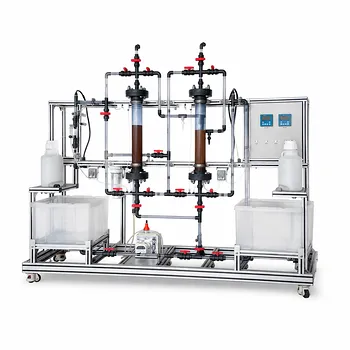
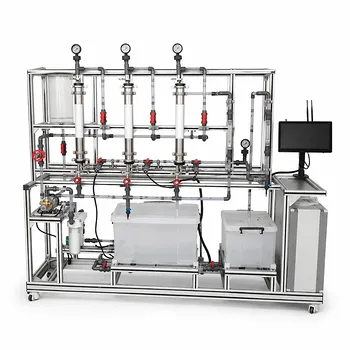
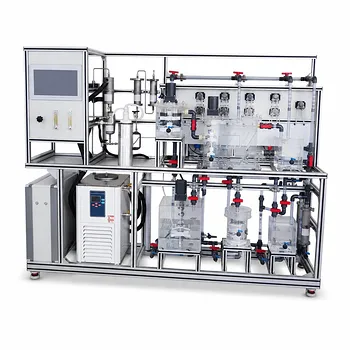
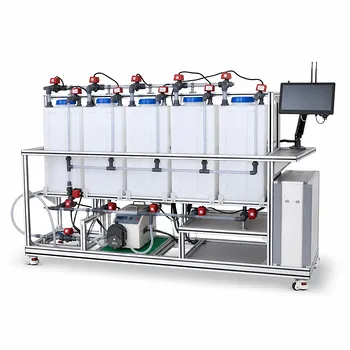
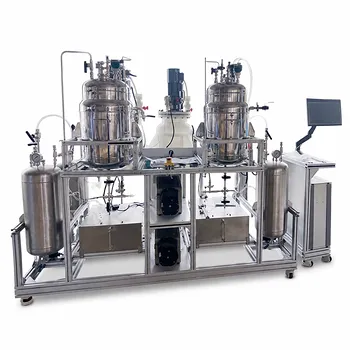
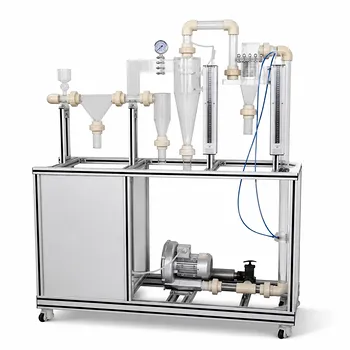
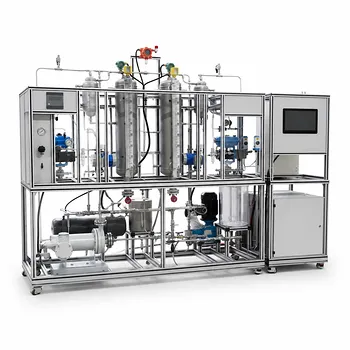
Real-time fluorescence monitoring directly answers one of the most stubborn challenges in treatment pilot plants: closed-loop, instant chemical dosing control. By tracking fluorescent-active substances—from industrial antibiotics to algal pigments—these systems continuously verify discharge quality and adjust oxidant injection on the fly, slashing both environmental risk and operational waste.
Pilot plants are not just miniature treatment lines; they are high-stakes proving grounds. Fluorescence-based monitoring transforms them into precision testbeds, where you can simulate full-scale automation, lock in compliance, and train operators with the same real-time feedback that prevents catastrophic over- or under-dosing at scale.
Turning Real-Time Data into Direct Process Control
The core advantage is moving from periodic sampling to a live, self-correcting loop. In an effluent stream, that capability changes the economics of treatment entirely.
Instant Oxidant Dosing with Fluorescent Tracers
Laser-induced fluorescence (LIF) and related techniques detect fluorescent active substances as they flow through a holding tank. The signal directly drives a chemical feed pump, so oxidant injection rises precisely when contaminant load spikes and drops when it recedes. This eliminates the lag time that causes the classic seesaw between overdosing (wasting chemicals) and underdosing (violating discharge permits).
Continuous Discharge Verification
The same optical fingerprint that controls dosing also serves as the final gatekeeper. A fluorescence rise at the outfall immediately signals treatment breakdown, allowing operators to divert effluent before it leaves the plant. For contaminants like antibiotic residues, where even trace releases can fuel antimicrobial resistance, that real-time check is a cost-effective compliance shield.
Proactive Biofouling and Algae Management
In membrane bioreactors or recirculating systems, native fluorophores from chlorophyll and microbial byproducts reveal fouling trends long before pressure drops or visual clues appear. The monitoring system can trigger a backwash or adjust biocide dosing based on a measured biological threshold rather than a fixed schedule, extending membrane life and lowering maintenance labor.
Why Fluorescence Outperforms Legacy Monitoring in Pilot Plants
A pilot plant’s value lies in its ability to reveal how a full-scale process will really behave. Real-time fluorescence unlocks insights that slower or less sensitive methods miss.
Sensitivity Where It Counts
Many industrial waste streams require part-per-billion or even sub-parts-per-billion detection limits for high-potency actives. Near-infrared (NIR) spectroscopy—while rugged—often lacks the dynamic range needed at these trace levels. Photoluminescent sensing, by contrast, can reach approximately 10⁻¹² M detection under suitable conditions, making it a far better fit for bioreactors and water treatment units where NIR simply cannot see the target analyte.
Long-Term Measurement Stability
Conventional intensity-based fluorescence sensors suffer from calibration drift caused by excitation light fluctuations, dye leaching, and photobleaching. Time-resolved, phase fluorimetry measures the fluorescence lifetime and phase angle—intrinsic molecular properties that do not depend on probe concentration or lamp brightness. This produces highly reproducible, reversal-error-free measurements over multi-day pilot runs, removing a major source of data noise when trying to compare treatment strategies.
A Predictive Sandbox for Full-Scale Deployment
By replicating industrial cycling, shock loads, and cleaning sequences, a fluorescence-equipped pilot plant generates the exact data sets engineers need to model full-scale chemical consumption, discharge risk, and sensor fouling rates. It turns the pilot from a simple verification tool into a dynamic simulation engine that derisks capital investment.
Unlocking Educational Value and Workforce Readiness
Pilot plants built for academic or vocational training gain a second advantage: they become fully instrumented “classrooms on a process line.”
Hands-On Experience with Modern Process Analytical Technology
Students can monitor pH, conductivity, and specific fluorescent pollutants simultaneously, then write the logic that automates neutralization or oxidant dosing based on live fluorescence thresholds. That direct experience with automated data acquisition and closed-loop control prepares operators and engineers for Industry 4.0 water treatment jobs, building muscle memory that a textbook never can.
Safe Simulation of Failure Modes
Because the plant is not connected to a public waterway, trainers can deliberately introduce matrix interferences, quenching agents, or sensor foulants. Students learn to diagnose—and correct—measurement failures in a controlled environment, gaining the kind of troubleshooting intuition that usually takes years on a live plant floor.
Understanding the Trade-offs and Managing Risks
Fluorescence monitoring is powerful but not plug-and-play. Its effectiveness hinges on understanding and controlling the sample matrix.
Matrix Effects Can Mask the Signal
Molecular-level interferences like dynamic quenching (often from dissolved oxygen or halogens such as chloride) and static quenching can slash fluorescence intensity. At higher concentrations, the inner-filter effect—where the sample reabsorbs emitted light before it reaches the detector—distorts the dose-response curve. No algorithm can fully compensate for an uncharacterized matrix, so a thorough front-end study is non-negotiable.
Photobleaching and Thermal Drift in At-Line Setups
Continuous excitation can exhaust the fluorophore, especially in stagnant flow cells. Prolonged illumination also introduces thermal artifacts. The fix often involves modulating the optical power and pulse rate, agitating the sample, or adding a simple temperature control loop. For aggressive streams, on-line sample conditioning—filtering, dilution, or flow regulation—may be the only way to keep the optics clean and the signal stable.
When Offline Confirmation Is Still Required
Real-time sensors guide process decisions, but pilot plant validation protocols often mandate periodic grab-sample analysis. The fluorescence trend chart acts as a “first responder,” while the accredited lab result provides the legal record. Balancing these two streams of information prevents the false sense of security that can arise from any single-point measurement.
Making the Right Choice for Your Pilot Plant
The specific advantage you harness depends on your primary goal for the facility. Align the technology to that goal, and the return becomes self-evident.
- If your primary focus is optimizing chemical dosing and cutting operating costs: Use a fluorescence-based control loop to match oxidant or biocide injection directly to real-time contaminant load, avoiding the 20–50% chemical waste common to timer-based systems.
- If your primary focus is turning the pilot plant into an advanced training platform: Install a fluorescence PAT suite and build curriculum around sensor maintenance, matrix troubleshooting, and closed-loop programming, giving students the exact skills modern utilities demand.
- If your primary focus is validating a sensitive assay for trace pollutants: Pair phase fluorimetry with on-line sample conditioning to achieve the low detection limits NIR cannot touch, while using the pilot’s controlled environment to document measurement repeatability for regulatory reviewers.
- If your primary focus is protecting expensive membranes or biofilters: Monitor native algal and microbial fluorescence to trigger early, condition-based maintenance, making membrane replacement a predictable expense rather than an emergency.
Real-time fluorescence monitoring, when matched to a specific control or learning objective, turns a pilot plant into the most honest mirror of full-scale performance you can own.
Summary Table:
| Key Advantage | Process Impact | Primary Application |
|---|---|---|
| Closed-Loop Dosing | Automatically adjusts oxidant feed based on live load | Cutting chemical waste |
| High Sensitivity | Detects trace pollutants down to ppb/sub-ppb levels | Validating micro-pollutant assays |
| Biofouling Prevention | Identifies organic/algal buildup before pressure drops | Protecting membranes & biofilters |
| Hands-On Training | Simulates live process control & troubleshooting | Academic & vocational education |
Bring Industry 4.0 Precision to Your Training & Research
Ready to equip your facility with advanced process control? LABPARK provides state-of-the-art Educational and Vocational Unit Operations Pilot Plants in chemical engineering, bioprocess & biotech, and environmental & water treatment.
Designed for universities, research institutes, and enterprises, our systems enable you to:
- Simulate real-world industrial automation and closed-loop dosing control.
- Provide hands-on operator training with live process analytical technology (PAT).
- Derisk capital investments with accurate, scale-up data.
Contact LABPARK today to customize your pilot plant!
Related Products
- Solid Waste Pyrolysis and Refining Educational Pilot Plant for Unit Operations
- Ion Exchange Water Purification Educational Pilot Plant for Engineering Unit Operations
- Multifunctional Membrane Separation Educational Pilot Plant with Ultrafiltration, Nanofiltration, Reverse Osmosis
- Rising and Falling Film Evaporation Educational Unit Operations Pilot Plant
- Multi-Functional Special Distillation Educational Pilot Plant
People Also Ask
- How do educational unit operations pilot plants bridge theory and design? Bridge the Engineering Gap
- How do educational unit operations pilot plants address safety and waste management when scaling up?
- When to transition from PID to adaptive control in pilot plants? Key process indicators.
- Why is the chemical plant startup schedule crucial? De-risk scale-up with pilot plants.
- Why Compare Predicted and Experimental Excess Enthalpy? Key to Accurate Pilot Plant Scale-up