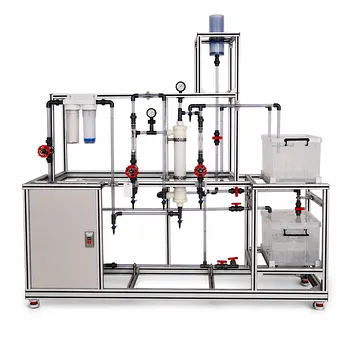
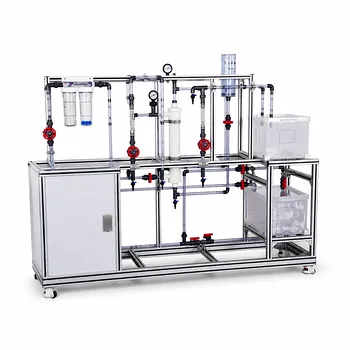
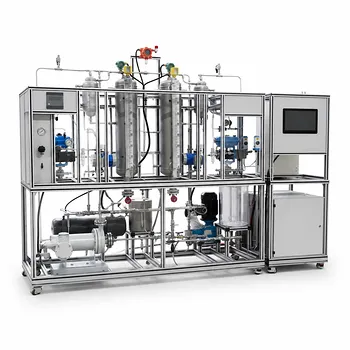
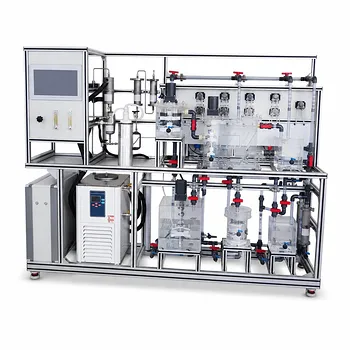
The core educational opportunity of an organophilic membrane pilot plant lies in its ability to demonstrate real-world separation of volatile organic compounds (VOCs) from both gas and liquid waste streams. In gas-phase training, students can recover high-value monomers—such as ethene, propene, or vinyl chloride—and capture gasoline vapors from exhaust air to meet emission standards. For liquid streams, they investigate the up-concentration of aroma components or the recovery of organic solvents from wastewater, using pervaporation and directly comparing its efficiency and economics against competing processes like steam stripping or biological treatment.
The organophilic membrane pilot plant transforms textbook environmental engineering into actionable skill. It lets students witness VOC recovery from air and water in a single unit, while critically evaluating membrane performance against conventional separation technologies—building the judgement needed to design sustainable, circular treatment trains.
Why an Organophilic Membrane Pilot Plant Is a Training Powerhouse
Bridging Theory and Real-World Operation
Students move beyond abstract mass-transfer equations. They configure and operate a pressurized, vacuum-assisted system themselves. This direct engagement demystifies how partial pressure driving forces, condensation on the permeate side, and retentate recycle work together. The result is an intuitive grasp of how industrial plants capture solvent vapors and purify effluent without relying on energy-intensive phase changes.
Gas-Phase Applications: Recovering Value from Waste Streams
Solvent Recovery and Emission Control
A primary application is simulating the recovery of valuable monomers and gasoline vapors from nitrogen or air streams. The pilot plant compresses the feed to raise the VOC partial pressure to saturation. A vacuum pump then draws the permeate—now highly enriched in organics—through the membrane, while the cleaned retentate can be discharged or reused. This directly mirrors processes in polymer manufacturing, coating plants, and fuel terminals, showing how emission standards and material recycling can be achieved simultaneously.
Understanding Pressure-Driven Separation
Students learn that effective gas separation relies on maintaining a steep partial pressure gradient. Compressing the feed side and pulling a vacuum on the permeate side creates the necessary driving force. By adjusting these parameters, students observe firsthand how recovery rates and energy consumption change, connecting operational decisions to both economics and environmental compliance.
Liquid-Phase Applications: Pervaporation as a Selective Tool
Recovering High-Value Aroma Components and Organic Solvents
On the liquid side, the same organophilic membrane unit can be run in pervaporation mode. A heated feed solution containing dilute organics—such as fruit aroma compounds or process solvents—flows past the membrane. The organophilic layer selectively permeates the organic molecules, which are then condensed on the vacuum side. Students see how a waste stream becomes a concentrated, reusable product.
Benchmarking Against Traditional Processes
The primary educational leap comes from direct comparison. Students can run side-by-side economic and efficiency analyses of pervaporation versus steam stripping or biological treatment. They measure chemical oxygen demand (COD) reduction, energy input, and product purity, revealing exactly where membrane processes outperform conventional methods and where they fall short. This rigorous comparison is the foundation of sound engineering decision-making.
Understanding the Trade-Offs
No single technology fits every scenario. An organophilic membrane pilot plant makes those trade-offs tangible.
The Selectivity–Permeability Dilemma
Highly selective membranes often deliver lower flux, requiring more surface area. Students can test modules with different properties to see that maximizing recovery of one target solute may slow overall throughput, a critical lesson for scaling up.
Membrane Fouling and Longevity
Real feed streams contain suspended solids, salts, or competing organics that foul the membrane. Students will witness performance decline over time and then test mitigation strategies—backwashing, chemical cleaning, or pretreatment adjustments. This hands-on troubleshooting builds readiness for industrial operation where fouling is a primary cost driver.
Energy and Operational Costs
While pervaporation avoids the high thermal input of distillation, it still demands vacuum generation and frequent membrane replacement. Budget analysis exercises reveal that the optimal choice depends on feed concentration, target purity, and local energy prices—exactly the kind of holistic thinking employers seek.
Operational Insights for a Well-Rounded Education
Membrane Fouling and Mitigation Strategies
Beyond simple observation, students design fouling experiments by varying crossflow velocity, temperature, and cleaning cycles. They learn to interpret pressure-drop trends and permeate quality changes, skills directly transferable to reverse osmosis or ultrafiltration plants.
Impact of Feed Composition and Pretreatment
The pilot plant lets students spike feeds with different organic mixtures or background salts. They quickly see how co-solvents or emulsifiers can alter membrane affinity and separation efficiency, underscoring why industrial plants must invest in upstream filtration or chemical conditioning.
Integrating with Other Unit Operations
Organophilic membranes seldom work alone. In a comprehensive environmental training setup, students combine the membrane unit with adsorption columns or ion exchange beds to treat complex effluents. This teaches the logic of process sequencing: using membranes for bulk organic removal before polishing with ion exchange to meet strict discharge limits for heavy metals.
Making the Right Choice for Your Training Goals
Use these focus areas to tailor the pilot plant’s curriculum to your specific learning outcomes.
- If your primary focus is industrial emission control: Emphasize gas-phase monomer and gasoline vapor recovery, exploring how vacuum and compression settings directly influence compliance and product reuse.
- If your primary focus is resource recovery and the circular economy: Concentrate on liquid pervaporation for recovering high-value aroma compounds or solvents, and compare the revenue from recovered products against treatment costs.
- If your primary focus is process economics and optimization: Let students run full cost-vs.-benefit analyses against steam stripping or biological treatment, using real data from the unit to project capital and operating expenses at scale.
- If your primary focus is hands-on troubleshooting: Center the course on fouling studies, cleaning protocol design, and the impact of varying feed composition—converting lab hours into practical problem-solving experience.
An organophilic membrane pilot plant gives students a single, powerful platform to master the complex interplay of separation science, economic trade-offs, and environmental stewardship that defines modern waste treatment engineering.
Summary Table:
| Application Phase | Process & Technology | Key Student Focus & Learning Outcomes |
|---|---|---|
| Gas-Phase | VOC & Monomer Recovery | Capture gasoline vapors and monomers; optimize partial pressure driving forces. |
| Liquid-Phase | Pervaporation | Recover high-value aroma compounds and solvents; evaluate COD reduction. |
| Operational | Troubleshooting & Economics | Analyze membrane fouling, design cleaning cycles, and run cost-benefit analyses. |
Elevate Your Engineering Curriculum with LABPARK
Ready to bring hands-on, industrial-scale separation training to your lab? LABPARK provides premium Educational and Vocational Unit Operations Pilot Plants in chemical engineering, bioprocess & biotech, and environmental & water treatment.
Designed specifically for universities, research institutes, and enterprises, our pilot plants bridge the gap between theoretical mass transfer and real-world process optimization. By integrating LABPARK systems into your program, you can equip your students with the practical skills needed to design sustainable, circular treatment technologies.
Contact LABPARK today to discuss your training goals and request a customized technical proposal!
Related Products
- Ultrafiltration Membrane Separation Educational Pilot Plant
- Multifunctional Membrane Separation Educational Pilot Plant with Ultrafiltration, Nanofiltration, Reverse Osmosis
- Multi-Functional Membrane Separation Educational Pilot Plant for Unit Operations Lab
- Hollow Fiber Ultrafiltration Membrane Separation Educational Pilot Plant
- Multi Functional Membrane Crystallization Educational Unit Operations Pilot Plant
People Also Ask
- How do PEI, PVDF, and PSU membranes compare in pilot plants? Find the best fit.
- Pervaporation vs. Vapor Permeation: Handling Suspended Solids in Membrane Pilot Plants
- Why Use a Membrane Separation Pilot Plant vs. Lab Testing? Avoid Costly Scale-Up Failures
- Isotropic vs. Anisotropic Membranes: How to Choose the Best Pilot Plant Modules
- How do membrane pilot plants demonstrate synthetic vs biological membrane advantages?