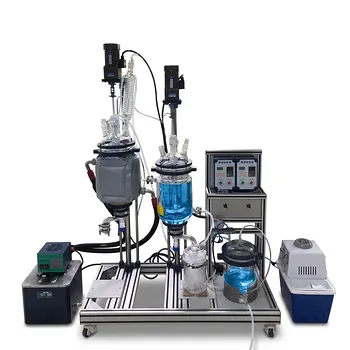
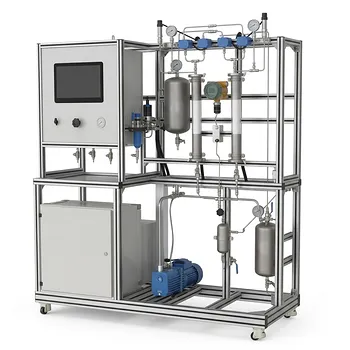
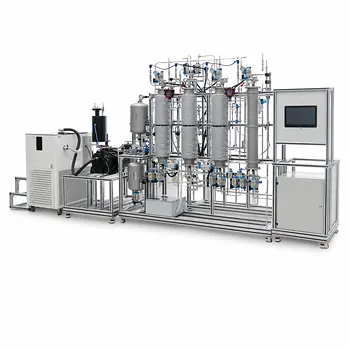
The shape of a single molecule can dictate the height of a distillation column.
In separation process pilot plants, the molecular geometry arising from hybridizations like sp³d (trigonal bipyramidal) and sp³d² (octahedral) directly dictates a compound’s polarity, symmetry, boiling point, and molecular volume. These properties, in turn, define the vapor–liquid equilibrium and mass transfer coefficients that are the engineering heart of any separation unit. This knowledge allows you to predict solvent selectivity, choose the right packing materials, and dial in operating conditions long before the first valve is opened.
The true influence of molecular geometry lies in the way it simultaneously controls both the thermodynamic possibility of a separation (through boiling points and vapor pressures) and the kinetic reality of achieving it (through diffusion and mass transfer). Understanding this dual role lets you bridge the gap between a Lewis structure and a profitable pilot-plant run.
The Molecular Foundation: Geometry and Properties
Before any separation can be designed, the molecule’s shape must be decoded into the physical properties that govern how it behaves in a pilot plant.
Polarity and Symmetry: The Intermolecular Force Balance
sp³d trigonal bipyramidal molecules (such as PF₅) are inherently non‑polar if all equatorial and axial positions are identical, because the individual bond dipoles cancel.
sp³d² octahedral molecules (like SF₆) are also perfectly symmetric and non‑polar.
When the shape is symmetric, only weak London dispersion forces exist between molecules. That means lower boiling points and higher vapor pressures—making these compounds easier to vaporize in a distillation column but harder to selectively condense. If one substituent differs, symmetry breaks, a net dipole moment appears, and suddenly you must account for stronger dipole–dipole or even hydrogen‑bonding forces. In a pilot plant, this directly changes the required reboiler duty and the slope of the equilibrium curve.
Boiling Point and Vapor Pressure: The Separation Energy Requirement
The geometry sets the boiling point. Think of ortho‑nitrophenol versus para‑nitrophenol: a difference in intramolecular versus intermolecular hydrogen bonding—a geometric consequence—creates a 40 °C gap in boiling point.
For sp³d and sp³d² molecules, a bulky, symmetrical shape stacks poorly, reducing solid‑phase stability and often lowering melting points. In a pilot‑scale fractional distillation, that translates to a shorter column section, lower reflux ratios, and gentler temperature gradients compared to asymmetric isomers that boil much higher. Vapor pressure curves—the very data you use to simulate the column—are fingerprints of molecular shape.
Molecular Volume and Shape: Mass Transfer and Packing Considerations
An octahedral SF₆ molecule is a large, rigid sphere; a trigonal bipyramidal PF₅ is a paddle‑wheel. Their molecular volumes and aspect ratios directly influence how fast they diffuse through a gas film or into a liquid solvent.
Diffusivity scales inversely with molecular volume, so a larger sp³d² molecule transfers mass more slowly. In a packed column, that means you need lower superficial velocities, deeper packing beds, or structured packings with more open flow channels to keep the Height Equivalent to a Theoretical Plate (HETP) economical. The shape also determines if the molecule can wedge into a zeolite pore or a polymeric membrane—a critical factor when selecting adsorbents or membranes for pilot‑scale separations.
From Molecular Shape to Pilot Plant Operation
Once you have the thermodynamic and transport fingerprints of a geometry, you apply them to the three workhorses of separations.
Distillation Column Design: Tray Spacing and Reflux Ratios
For a symmetric sp³d² compound with a low boiling point, you could operate a shorter, fatter column with relatively low reflux.
But introduce a polar substituent—say, replacing one fluorine in SF₆ with a chlorine—and the boiling point jumps. Now the pilot plant must increase tray count, tighten temperature control, and perhaps switch from trays to high‑efficiency structured packing to handle the new equilibrium shape. The vapor‑liquid equilibrium curve flattens near the azeotrope, and the separation suddenly demands a solvent or pressure‑swing approach—all triggered by a single valence‑shell expansion.
Solvent Selection in Liquid–Liquid Extraction
Geometry rules solubility. A large, non‑polar octahedral molecule will partition aggressively into a non‑polar organic phase. If you need to extract it from an aqueous stream, you pick a solvent whose own shape and polarity complement that geometry—often a hydrocarbon or fluorinated solvent that can wrap around the spherical solute.
Conversely, a distorted trigonal bipyramidal molecule with a lone pair in an equatorial position can act as a Lewis base. You might choose an acidic extractant that coordinates to that electron density, an interaction that only exists because of the axial–equatorial asymmetry.
Gas Absorption and Mass Transfer Coefficients
In a packed absorption column, the gas‑side mass transfer coefficient (kG) is sensitive to molecular size. The large kinetic diameter of an sp³d² molecule means it diffuses slowly through the gas film. To maintain the same removal efficiency, the pilot plant must reduce the gas flow rate or increase packing surface area.
This directly influences the column diameter and pressure drop, proving that a molecular orbital diagram ultimately dictates the size of the blower and the cost of the skid.
Understanding the Trade‑offs
Using geometry as a predictive tool is powerful, but it has sharp limits.
The Danger of Single‑Molecule Thinking
A pure compound’s shape predicts its pure‑component vapor pressure perfectly, but real pilot‑plant streams are mixtures. Non‑idealities like azeotropes and activity‑coefficient excursions can completely override the neat boiling‑point signal. Relying on geometry alone without confirming mixture data can lead to a column that never achieves specification.
Packing Selectivity vs. Throughput
A structured packing chosen for its high surface area may trap large octahedral molecules in its micro‑channels, causing flooding at rates far below design. While the shape calls for careful mass transfer attention, overcompensating with ultra‑tight packing creates a pressure‑drop nightmare. The pilot plant becomes a filter, not a separator.
Oversimplifying Molecular Volume
Treating molecular volume as a static sphere ignores conformational flexibility. Some sp³d molecules exhibit pseudorotation, where axial and equatorial ligands exchange rapidly. The effective diffusing species is not a rigid body; this can make mass‑transfer predictions based on a frozen geometry unreliable, especially in gas‑phase separations at elevated temperatures.
Making the Right Choice for Your Pilot Plant
Apply the molecular geometry lens deliberately and in concert with mixture thermodynamics and pilot‑scale realities.
- If your primary focus is predicting distillative separation feasibility: Use the symmetry and polarity of sp³d/sp³d² compounds to estimate boiling‑point trends, then immediately validate with a bubble‑point cell running the actual feed mixture.
- If your primary focus is selecting a mass‑transfer packing: Let molecular volume guide the initial choice of packing type and size, but run a pressure‑drop curve to ensure the large molecules don’t cause premature flooding.
- If your primary focus is scaling a liquid–liquid extraction: Map the molecular geometry to solubility parameters and hydrogen‑bonding potential to narrow your solvent candidates, then measure the partition coefficient in a simple shake‑flask test before committing to pilot‑scale hardware.
- If your primary focus is troubleshooting an existing pilot plant: When a separation fails to meet spec, ask whether an unexpected change in molecular symmetry—perhaps a side reaction introducing a polar ligand—has altered the effective boiling point or mass‑transfer rate.
A few valence‑shell electrons and their spatial arrangement can make the difference between a pilot plant that hums with precision and one that demands constant re‑optimization. Treat the molecule’s shape as the first domino in a long chain of engineering decisions.
Summary Table:
| Molecular Property | Separation Process Impact | Pilot Plant Design Choice |
|---|---|---|
| Symmetry & Polarity | Shifts boiling points & vapor-liquid equilibrium (VLE) | Determines column height, tray count, & reflux ratios |
| Molecular Volume & Shape | Affects diffusivity & mass transfer coefficients | Dictates packing type, bed depth, & gas flow rates |
| Solute Geometry | Drives solubility & partition coefficients | Guides solvent selection for liquid-liquid extraction |
Optimize Your Separation Workflows with LABPARK
Bridging the gap between molecular chemistry and pilot-scale chemical engineering requires precise, reliable equipment. LABPARK provides premium Educational and Vocational Unit Operations Pilot Plants in chemical engineering, bioprocess & biotech, and environmental & water treatment designed specifically for universities, research institutes, and enterprises.
Whether you are demonstrating thermodynamic principles in a classroom or scaling up complex extraction processes, our high-quality pilot plants ensure accurate data collection and robust operation.
Ready to elevate your engineering lab? Contact LABPARK today to discuss your custom pilot plant requirements!
Related Products
- Multifunctional Membrane Separation Educational Pilot Plant with Ultrafiltration, Nanofiltration, Reverse Osmosis
- Multi-Functional Membrane Separation Educational Pilot Plant for Unit Operations Lab
- Gas-Solid Heterogeneous Separation Demonstration Educational Unit Operations Pilot Plant
- Carbon Material Thermal Pretreatment Multiphase Separation Educational Pilot Plant
- Bench Scale Dual Column Gas Separation and Capture Educational Pilot Plant
People Also Ask
- Pervaporation vs. Vapor Permeation: Handling Suspended Solids in Membrane Pilot Plants
- How do PEI, PVDF, and PSU membranes compare in pilot plants? Find the best fit.
- What are the trade-offs of polymer vs inorganic membranes in teaching pilot plants? Key laboratory comparison.
- What are the key flow configuration loops in membrane pilot plants? Optimize Performance
- What are the advantages of membrane separation in pilot plants? Efficient Organic Vapor Recovery