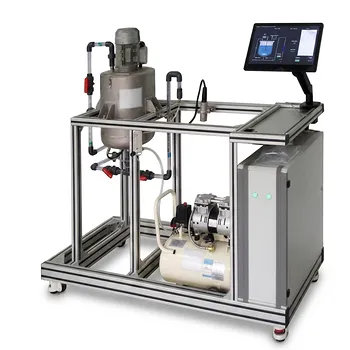
Educational unit operations pilot plants help researchers turn dehydration and concentration into measurable, controllable experiments. By adjusting temperature, moisture content, water activity, oxygen concentration, pressure, and residence time, researchers can observe how processing conditions affect lipid oxidation, vitamin degradation, and other chemical changes. The resulting data can be used to quantify degradation kinetics, validate mathematical models, and identify operating conditions that preserve nutrients and product quality.
Dehydration and concentration do more than remove water: they change the chemical environment of the product. Pilot plants make those changes controllable and measurable, allowing researchers to connect specific operating conditions with nutrient loss and chemical deterioration.
Why Dehydration and Concentration Cause Chemical Changes
Water Removal Changes the Reaction Environment
Dehydration reduces moisture, while concentration removes solvent and increases the relative concentration of dissolved components. These changes can alter water activity, which directly affects the rates of chemical and biological reactions.
Water activity is not identical to total moisture content. A pilot plant allows researchers to evaluate how the product responds to controlled moisture conditions rather than assuming that all water has the same chemical effect.
Heat Can Accelerate Nutrient Degradation
Evaporation and dehydration often involve heat transfer. As temperature rises, temperature-sensitive nutrients such as vitamins may degrade more rapidly, depending on the product matrix and exposure time.
Pilot plants allow researchers to vary temperature and residence time systematically. This makes it possible to distinguish whether nutrient loss is primarily associated with high temperature, prolonged exposure, or the interaction between both factors.
Oxygen Can Drive Oxidative Reactions
Changes in oxygen concentration are especially important for products containing lipids or other oxidation-sensitive compounds. Exposure to oxygen can promote lipid oxidation, affecting nutritional value, flavor, color, and storage stability.
Controlled-atmosphere vessels or carefully managed process conditions can help researchers compare oxidation under different oxygen levels. This clarifies how much of the observed quality loss is attributable to thermal exposure versus oxidative reactions.
How Pilot Plants Help Quantify Nutrient Loss
Researchers Control the Variables That Matter
Educational and research pilot plants provide physical control over variables such as:
- Temperature
- Moisture level
- Water activity
- Oxygen concentration
- Pressure
- Residence time
- Flow rate and operating mode
Controlling these parameters enables researchers to change one factor at a time or evaluate several factors through a structured design of experiments.
Samples Can Be Compared Across Processing Conditions
Researchers can collect samples before, during, and after dehydration or concentration. Comparing their chemical composition and nutrient content reveals how much change occurred under each operating condition.
This approach supports measurements of nutrient retention, oxidation, and other degradation indicators. It also helps connect chemical outcomes to actual process history rather than to a single final product measurement.
Degradation Kinetics Can Be Estimated
When researchers measure chemical changes at different temperatures, moisture levels, oxygen concentrations, or residence times, they can estimate the kinetics of thermal degradation and oxidative reactions.
These kinetic relationships support predictions of how nutrient retention may change when process conditions are modified. They also provide a stronger basis for selecting operating conditions during later scale-up.
How Pilot Plants Improve Process Models
Physical Data Validate Mathematical Models
Computer simulations can estimate heat and mass transfer, reaction rates, and concentration behavior, but they simplify real equipment. Pilot plants provide empirical data against which those models can be tested.
Researchers can compare predicted and measured temperature profiles, moisture removal, residence time, nutrient loss, and chemical reaction behavior. Discrepancies may reveal practical effects such as heat loss, fluid-flow behavior, or fouling that a simplified model does not capture.
Dynamic Operation Reveals Time-Dependent Effects
Batch and dynamic pilot plant modules allow users to follow changes in temperature, pressure, conversion, and material holdup over time. This is important because nutrient degradation may continue throughout a process rather than occur only at a single operating point.
Transient data help researchers determine whether a shorter cycle, a different heating profile, or improved process control could reduce cumulative exposure to damaging conditions.
Scale-Up Decisions Become More Defensible
Laboratory equipment can demonstrate whether a reaction occurs, but pilot-scale equipment provides a more realistic representation of industrial operation. It exposes researchers to the heat-transfer, mass-balance, energy-balance, and control issues that influence actual performance.
This bridge between laboratory studies and industrial processing reduces reliance on unverified assumptions when selecting full-scale dehydration or concentration conditions.
How Experimental Design Identifies Better Conditions
Process Variables Can Be Classified
Using Quality by Design and cause-and-effect approaches, researchers can distinguish between:
- Controllable parameters, such as temperature or pressure
- Experimental variables, intentionally changed during testing
- Noise factors, which introduce uncontrolled variation
This classification helps researchers identify which factors are most likely to influence nutrient retention and chemical stability.
Design of Experiments Shows Interactions
A structured design of experiments can reveal whether variables act independently or interact. For example, the effect of temperature may depend on moisture level, oxygen concentration, or residence time.
Understanding these interactions is more useful than identifying a single “best” temperature in isolation. It helps establish a robust operating region in which product quality remains acceptable despite normal process variation.
Operating Limits Can Be Established
Pilot-scale testing can identify conditions under which oxidation or thermal degradation becomes unacceptable. Researchers can then define practical limits for temperature, residence time, moisture, or oxygen exposure.
These limits support process optimization aimed at maximizing nutrient retention while still achieving the desired concentration or dehydration endpoint.
Understanding the Trade-offs
Faster Processing May Increase Thermal Stress
Increasing temperature can accelerate water removal and improve throughput, but it may also increase vitamin degradation and unwanted side reactions. The fastest process is therefore not necessarily the process that produces the highest-quality product.
Researchers must evaluate removal efficiency alongside chemical stability and nutrient retention.
Concentration Can Increase Reactant Contact
As water is removed, dissolved compounds become more concentrated and may be brought into closer chemical contact. Depending on the product, this can increase the likelihood of reactions such as lipid oxidation, sugar caramelization, or Maillard reactions.
These reactions can affect texture, flavor, nutritive value, and the formation of undesirable derivatives.
Pilot Results Still Require Careful Interpretation
Pilot plants provide stronger evidence than simulations alone, but they do not automatically reproduce every full-scale condition. Differences in equipment geometry, heat transfer, fluid dynamics, and fouling can affect how results translate to industrial systems.
Researchers should therefore use pilot data to validate and refine models, while explicitly accounting for scale-dependent behavior.
Making the Right Choice for Your Goal
Pilot plants are most valuable when the experiment connects controlled process conditions with chemical and nutritional measurements.
- If your primary focus is nutrient retention: Compare temperature, moisture, water activity, and residence time to identify conditions that minimize vitamin degradation.
- If your primary focus is oxidative stability: Control and compare oxygen exposure while monitoring lipid oxidation across the process.
- If your primary focus is process optimization: Use structured experiments to map operating variables to concentration or dehydration performance and product quality.
- If your primary focus is scale-up: Collect heat-transfer, mass-balance, energy-balance, and reaction-kinetic data to validate process models against physical performance.
- If your primary focus is process control: Use batch or dynamic operation to study how changing temperature, pressure, and material holdup affect degradation over time.
With controlled pilot-scale experiments, researchers can replace assumptions about nutrient loss with measurable relationships between operating conditions, chemical reactions, and final product quality.
Summary Table:
| Research focus | Controlled variables | Key measurements | Practical outcome |
|---|---|---|---|
| Nutrient retention | Temperature, moisture, water activity, residence time | Vitamin content and degradation rate | Identify conditions that preserve nutrients |
| Oxidative stability | Oxygen concentration, temperature, residence time | Lipid oxidation, flavor, color, and storage stability | Reduce oxidation-related quality loss |
| Process optimization | Temperature, pressure, flow rate, and operating mode | Moisture removal, concentration, and product quality | Establish an efficient operating range |
| Model validation | Heat transfer, mass balance, energy balance, and reaction conditions | Predicted versus measured process performance | Improve process models and scale-up decisions |
| Process control | Dynamic temperature, pressure, and material holdup | Time-dependent chemical and nutritional changes | Limit cumulative exposure to damaging conditions |
Improve Process Performance with LABPARK Pilot Plants
Need reliable data on nutrient retention, oxidation, or chemical degradation? Contact LABPARK to discuss an educational or vocational unit operations pilot plant for your application.
LABPARK provides pilot plants for chemical engineering, bioprocess and biotechnology, and environmental and water treatment research. Our systems help universities, research institutes, and enterprises control variables such as temperature, pressure, moisture, oxygen concentration, flow rate, and residence time. With realistic pilot-scale operation, your team can measure process performance, validate models, identify quality limits, and make better-informed scale-up decisions.
Tell us about your dehydration, concentration, or related process requirements, and LABPARK can help you select a suitable pilot plant configuration for practical training, experimental research, process optimization, and industrial development.
Related Products
- Multi-Reactor Educational Pilot Plant for Reaction Engineering Unit Operations
- Multi-Functional Membrane Separation Educational Pilot Plant for Unit Operations Lab
- Electrolytic Hydrogen Production Educational Unit Operations Pilot Plant
- Comprehensive Fluid Mechanics Educational Unit Operations Pilot Plant
- Multi-Functional Drying Educational Unit Operations Pilot Plant
People Also Ask
- How do reactor pilot plants define QbD design space? Master chemical process scale-up.
- When configuring a reactor unit operations pilot plant for highly exothermic reactions, how to prevent thermal runaway?
- How do metal ion-catalyzed reaction mechanisms inform chemical engineering pilot plant design? From kinetics to scale-up
- What role do educational pilot plants play in scaling green chemistry? Bridging the Lab-to-Industry Gap
- What are the barriers to process intensification & how do pilot plants help?