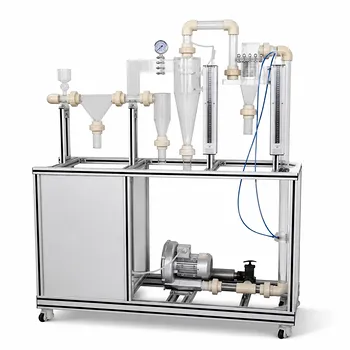
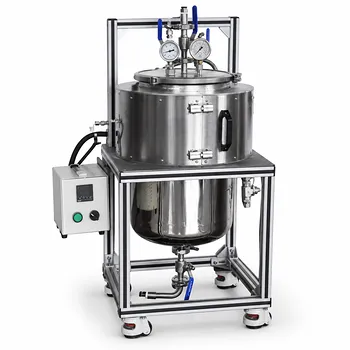
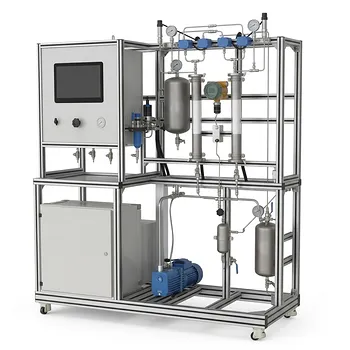
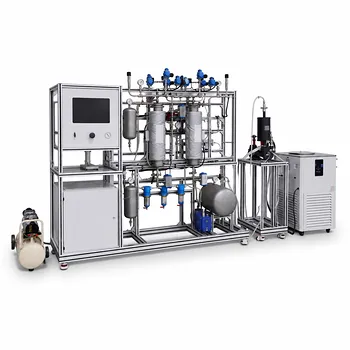
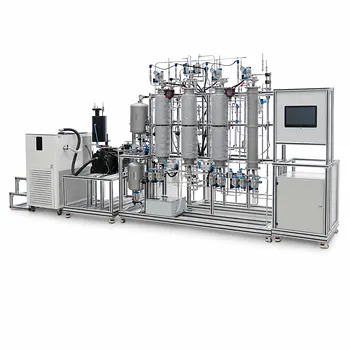
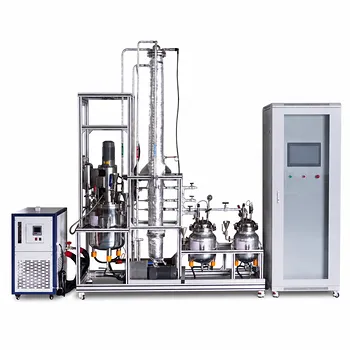
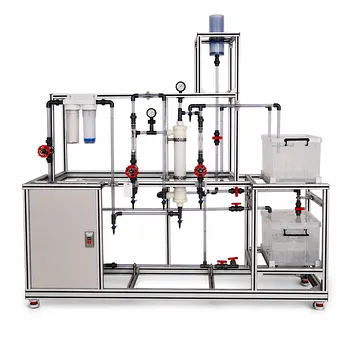
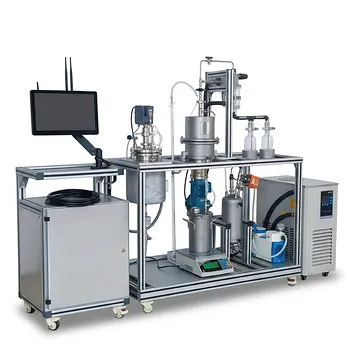
When theory meets the real world, the true lesson is in the choices engineers make under pressure. In vocational and university curricula, separation unit operations pilot plants that combine catalytic reactors with distillation columns teach the integration of chemical reactions and physical separation by letting students directly operate a hybrid process. They observe that for close-boiling, hard-to-separate mixtures, a selective chemical reaction step—followed by conventional fractionation—is often far more economical than distillation alone, turning a fundamental engineering concept into a visceral, data-driven experience.
The core insight: Coupling a reactor with a separation train transforms an energy-intensive purification task into a manageable, cost-effective sequence. The pilot plant makes the invisible—like the economic burden of a large reflux ratio—visible through real-time data, showing that chemical conversion can solve a physical separation problem.
The Educational Power of Integrated Pilot Plants
A stand-alone distillation column teaches phase equilibrium. An isolated reactor teaches kinetics. Combining them in a single pilot plant teaches something far more valuable: process synthesis and economic decision-making.
Bridging the Gap from Unit Operation to Process
Textbooks separate chemistry and physical transport for clarity, but industry never does. A pilot plant with a reactor–distillation sequence forces students to manage both simultaneously.
They learn that the performance of the reactor (conversion, selectivity, by-product formation) directly determines the load and difficulty on the downstream separator. This creates a design feedback loop that no simulation can fully capture.
Making Scale and Time Real
Batch or continuous operation demonstrates that separation often dominates capital and operating cost. Running a binary distillation is straightforward. Running it when the feed composition shifts because the reactor upsets teaches process resilience.
Students calculate stage efficiency and energy balances on the same unit, seeing how a small reaction improvement can slash reboiler steam demand. The economic trade-off becomes a physical reality they experience at the control panel.
A Real-World Example: Ethylene Recovery from Steam Cracking
The most powerful teaching scenario uses a familiar industrial challenge: purifying ethylene from a steam cracker’s effluent. Here, acetylene is a troublesome impurity because it poisons polyethylene catalysts and has a boiling point almost identical to ethylene.
The Purification Problem
Separating acetylene from ethylene by distillation alone is technically possible but economically disastrous. The close relative volatility demands a tall column, a massive reflux ratio, and enormous energy consumption.
In a typical pilot plant, students first simulate this scenario. They measure the tray-by-tray composition and see the diminishing returns of adding more stages, experiencing the limits of physical separation.
Inserting a Chemical Solution
The curriculum then introduces a catalytic hydrogenation reactor before the distillation column. The reactor selectively converts acetylene into additional ethylene.
This chemical reaction step transforms the separation: the impurity is eliminated, not just moved. The downstream distiller’s job becomes simple fractionation of ethylene from heavier compounds. Students immediately see the column’s reboiler duty drop and the reflux requirement collapse, a direct demonstration of cost savings.
From Reaction to Recovery: Mapping the Process Flow
A well-designed educational pilot plant makes the material flow transparent, often using glass sections so students can observe phase interfaces and flow regimes.
The Integrated Hardware
A typical setup includes a stirred-tank or tubular reactor with precise temperature control, a gravity separator to remove any liquid product or aqueous phase, and a fractionating column operating under vacuum. Online temperature, pressure, and flow sensors at every stage feed a data-acquisition system.
Students trace how a stream’s composition evolves: raw mixed olefins → reactor for selective conversion → vaporizer → distillation train. They learn that the separation problem is defined long before the feed enters the column, inside the reactor.
Visualizing the Economics
By altering catalyst temperature or hydrogen feed ratio, students change the reactor’s acetylene conversion. They then watch the distillation column’s energy consumption and product purity respond.
This exercise cements a critical engineering principle: the optimal process is not a perfect reactor or a perfect column, but the cheapest combination of the two. They can plot “reaction severity” against “separation cost” to find the economic minimum, a lesson in trade-offs that stays with them.
Extending the Concept to Other Separation Systems
While distillation–hydrogenation is a perfect teaching case, the integration principle applies broadly. Supplementary pilot plants that merge reactors with liquid-liquid extraction, membrane units, or absorption towers teach the same core idea.
Reactive Extraction and Absorption
In a liquid-liquid extraction column coupled with a reactor, students see how a chemical reaction in the aqueous phase (e.g., deprotonation of an organic acid) enhances partitioning into the organic phase. The chemical step creates a driving force that mass transfer alone cannot provide.
Similarly, reactive absorption—for instance, removing CO₂ with amines—shows that a reversible chemical bond transports a gas far more efficiently than physical solubility. Students measure mass transfer coefficients with and without the reaction, quantifying the synergy.
Ion Exchange and Bioprocesses
Membrane filtration or chromatography units integrated with an enzymatic reactor teach the same logic in a biotech context. The reactor produces a dilute product stream; the separation unit concentrates and purifies it. Students grapple with real-time fouling, pressure drops, and the delicate balance between conversion and separation capacity.
Understanding the Trade-offs and Pitfalls
An uncritical advocacy of “reaction plus separation” is dangerous. The pilot plant must also teach when this integrated approach fails or is suboptimal.
Added Complexity and Control
Introducing a reactor adds a new set of failure modes and control loops. Students see that a catalyst deactivation event propagates downstream, contaminating the product and ruining the column’s steady state. The plant suddenly requires much more operator attention than a simple distillation alone.
Side Reactions and Product Loss
The same catalytic step that removes acetylene can over-hydrogenate ethylene to ethane, reducing valuable product. The pilot plant makes this selectivity challenge tangible. Students discover that an overly aggressive reaction steals yield—a pure separation is sometimes cleaner.
When Distillation Alone Wins
If the relative volatility is not prohibitively low, distillation alone may be simpler, safer, and more robust. The pilot plant can be configured to run without the reactor, allowing a direct comparison of lifecycle costs, maintenance burden, and operability.
Making the Right Choice for Your Curriculum
A pilot plant that integrates reaction and separation is a versatile teaching tool, but its impact depends on how it is embedded in the learning objectives. Tailor the exercises to the students’ future roles.
- If your primary focus is process design: Use the plant to run a full economic optimization experiment, varying reactor conditions and column parameters to find the minimum total annualized cost.
- If your primary focus is control and automation: Emphasize the cascade of reactor outlet composition to distillation feed-forward control, testing students’ ability to manage a multi-unit dynamic system.
- If your primary focus is sustainable engineering: Challenge students to minimize energy and solvent use by comparing pure physical separation against reactive separation pathways, quantifying the CO₂ reduction.
- If your primary focus is scale-up and troubleshooting: Task students with diagnosing why product purity drops—is it catalyst deactivation, a tray flooding, or a faulty temperature sensor—and let them propose evidence-based corrective actions.
When students operate a physical pilot plant that marries a reactor with a separator, they stop thinking in silos. They begin designing processes where each decision in the reaction stage is a bet on the separation stage, and that integrated mindset is precisely what the chemical industry demands.
Summary Table:
| Teaching Concept | Physical Setup | Learning Outcome |
|---|---|---|
| Process Synthesis | Reactor + Distillation column | Understanding feed composition & downstream load |
| Economic Trade-offs | Energy duty vs. reaction conversion | Finding the cheapest combination of reaction & separation |
| System Dynamics | Integrated control loops | Managing reactor upsets and column stability |
Empower the Next Generation of Chemical Engineers with LABPARK
Bridge the gap between theoretical chemistry and physical separation. LABPARK provides state-of-the-art Educational and Vocational Unit Operations Pilot Plants in chemical engineering, bioprocess & biotech, and environmental & water treatment designed for universities, research institutes, and enterprises.
Equip your students with the tools to master process synthesis, dynamic control, and real-world system optimization. Contact us today to request a quote or customize your pilot plant!
Related Products
- Multi-Functional Membrane Separation Educational Pilot Plant for Unit Operations Lab
- Gas-Solid Heterogeneous Separation Demonstration Educational Unit Operations Pilot Plant
- Hot Filtration Educational Unit Operations Pilot Plant Laboratory System
- Bio-fermentation Ethanol Production Practical Training Unit Operations Pilot Plant
- Pressure Swing Adsorption Educational Unit Operations Pilot Plant
People Also Ask
- What are the key differences in membrane configurations? Choose the Right Unit Operations Pilot Plant
- How Do Pervaporation, Vapor, and Gas Permeation Differ in Pilot Plants? Key Comparison
- What are the advantages of membrane separation pilot plants? Energy-saving process intensification.
- Pervaporation vs. Vapor Permeation: Handling Suspended Solids in Membrane Pilot Plants
- How do PEI, PVDF, and PSU membranes compare in pilot plants? Find the best fit.