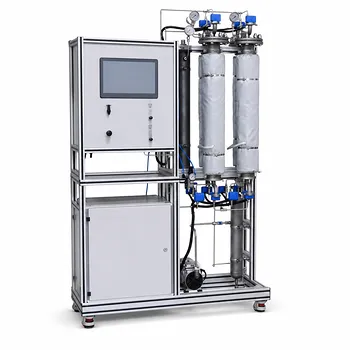
Lime and soda ash dosages in a precipitation softening pilot plant are not guesswork—they are precise, stoichiometric calculations.
You calculate them directly from your water’s alkalinity (M-value), magnesium hardness (MgH), and total hardness (TH), all expressed as ppm CaCO₃. The required lime dose is (M + MgH) × 0.74 ppm (as Ca(OH)₂), and the required soda ash dose is (TH – M) × 1.06 ppm (as Na₂CO₃), with the soda ash addition only needed when the total hardness exceeds the M-alkalinity. These formulas are the foundational blueprint for softening, and running them in a pilot plant lets you fine-tune the dose to actual effluent quality targets.
The core insight: Softening dosing hinges on mapping water chemistry directly to chemical equivalents. The lime dose handles all alkalinity and magnesium, while the soda ash dose mops up the non‑carbonate hardness. But the calculated values are just the starting point—pilot testing reveals how your specific water’s reaction kinetics, temperature, and mixing conditions shift the real demand, especially for magnesium removal and coagulant aid.
Breaking Down the Chemistry Behind the Calculations
The formulas are rooted in simple, elegant stoichiometry. Understanding what each parameter represents is the key to applying them correctly.
Why Alkalinity (the M‑Value) Drives Lime Demand
Alkalinity, measured by titration to the methyl‑orange endpoint, represents the water’s bicarbonate (and carbonate) buffering. In softening chemistry, every equivalent of bicarbonate alkalinity (expressed as CaCO₃) theoretically consumes one equivalent of hydrated lime to form calcium carbonate precipitate. The factor 0.74 (derived from 37/50) converts the mass of alkalinity‑as‑CaCO₃ to the mass of Ca(OH)₂ needed. So if your water has 150 ppm M‑alkalinity, the baseline lime need for carbonate hardness alone is 150 × 0.74 = 111 ppm.
How Magnesium Hardness Doubles the Lime Burden
Magnesium precipitates as Mg(OH)₂, not as a carbonate. Removing each equivalent of magnesium ions requires one equivalent of lime to raise the pH and another equivalent to provide the hydroxide ions. That’s why the lime formula adds the full MgH value to the M‑alkalinity. A water with 150 ppm M‑alkalinity and 50 ppm MgH demands (150+50) × 0.74 = 148 ppm of lime—a 33% increase. Ignoring magnesium is one of the most common mistakes in pilot‑plant dose design.
The Soda Ash Trigger: When Total Hardness Exceeds Alkalinity
If total hardness (TH) is less than or equal to the M‑value, all hardness is carbonate–based, and lime alone handles the job. Soda ash only enters the picture when TH > M, signalling permanent (non‑carbonate) hardness from sulfates or chlorides. The difference (TH – M) represents the calcium and magnesium not balanced by bicarbonate. Each equivalent of that permanent hardness requires one equivalent of soda ash (Na₂CO₃) to form insoluble CaCO₃, giving the factor 1.06 (53/50).
From Theory to Operation: Pilot‑Scale Monitoring That Makes or Breaks Softening
A calculated dose on paper can be useless if you don’t control the key operating levers that a pilot plant is designed to explore.
The (2P–M) Alkalinity Sweet Spot for Magnesium Removal
After lime addition, the hot process relies on a free‑alkalinity reserve to drive Mg(OH)₂ precipitation to completion. This residual is measured as the differential (2P – M), where P is the phenolphthalein alkalinity. The ideal window is 12–18 ppm as CaCO₃. Below this range, magnesium removal stalls; above it, you’re wasting chemicals and may get a brittle, slow‑settling floc. Piloting lets you map exactly how much excess lime over the stoichiometric dose is needed to hold that 2P–M range for your water’s temperature and ion matrix.
Coagulants and Silica Control as Hidden Dose Adjusters
Even with perfect softening chemistry, the fine calcium carbonate crystals can stay in suspension. Ferric sulfate or aluminium salts are often dosed to form gelatinous flocs that sweep particles down in the clarifier. More subtly, in high‑silica waters, a magnesium‑based additive (like magnesia) is used to coprecipitate silica, often requiring you to deliberately leave some extra magnesium in the raw water or add it as MgO. This shifts the effective MgH in your lime formula and must be accounted for in the pilot‑plant data log, not just the initial calculation.
Common Pitfalls and Trade‑Offs in Piloting
Every benefit of the lime‑soda process comes with a consequential trade‑off that a pilot plant must quantify.
- Sludge handling: The reactions produce a large volume of CaCO₃ and Mg(OH)₂ sludge. A higher dose that guarantees effluent quality dramatically increases sludge disposal costs. The pilot data tells you exactly where the dose‑quality curve flattens.
- Temperature sensitivity: Cold water slows reaction kinetics and crystal growth. If your pilot runs at winter inflow temperatures, you may need a higher lime dose and longer retention time than the formula assumes.
- Overdosing lime: Attempting to force magnesium removal by pushing the 2P–M above 18 ppm can cause post‑precipitation in filters or distribution lines, leading to cemented sand media and milky water.
- Incomplete mixing: Short‑circuiting in the pilot‑scale flash mixer can create localised high‑pH zones that precipitate Mg(OH)₂ too early, wasting lime and creating a sticky floc that fouls downstream equipment.
Making the Right Choice for Your Pilot‑Plant Goal
Your pilot‑study objective determines how you adapt and challenge the base formulas. Use the following focus areas to guide your test plan.
- If your primary focus is maximum hardness removal: Start with the stoichiometric formulas exactly, then incrementally raise the lime dose until the 2P–M sits at 16–18 ppm and measure the corresponding soda ash response—record the dose where effluent TH no longer drops.
- If your primary focus is cost optimisation: Run a matrix that deliberately under‑doses lime by 5–10 % from the calculated value and correlate the loss in removal efficiency with chemical savings. Include sludge‑disposal costs in that equation.
- If your primary focus is silica reduction: Baseline the raw water silica and test lime‑softening both with and without a supplementary magnesium source, while maintaining the same 2P–M window. This gives you a silica‑removal isotherm specific to your water.
- If your primary focus is robust, transferable design parameters: Vary retention time, mixing intensity, and temperature across multiple runs while keeping the stoichiometric cores constant, so you can build a kinetic model for full‑scale sizing.
The formulas are your map—but only systematic piloting teaches you how to navigate the real terrain of your water.
Summary Table:
| Parameter | Formula / Target Value | Process Purpose |
|---|---|---|
| Lime Dose (as Ca(OH)₂) | (M + MgH) × 0.74 ppm |
Neutralizes bicarbonate alkalinity and precipitates magnesium |
| Soda Ash Dose (as Na₂CO₃) | (TH – M) × 1.06 ppm (if TH > M) |
Precipitates non-carbonate calcium hardness |
| Free-Alkalinity Reserve | 2P – M = 12–18 ppm as CaCO₃ |
Drives magnesium removal to completion |
Optimize Your Water Treatment Testing with LABPARK
Validating stoichiometric calculations like lime-soda softening requires robust, reliable equipment. LABPARK provides state-of-the-art Educational and Vocational Unit Operations Pilot Plants in chemical engineering, bioprocess & biotech, and environmental & water treatment for universities, research institutes, and enterprises.
Our systems allow you to safely test reaction kinetics, analyze sludge handling, and optimize chemical dosing under real-world conditions. Ready to elevate your lab or training facility? Contact us today to discuss your pilot plant needs!
Related Products
- Rising and Falling Film Evaporation Educational Unit Operations Pilot Plant
- Dual-Mode Rectification Pilot Plant for Practical Training Unit Operations
- Supercritical High-Gravity Flash Evaporation Educational Unit Operations Pilot Plant
- Natural Product Extraction Unit Operations Training Pilot Plant
- Constant Pressure Filtration Educational Unit Operations Pilot Plant
People Also Ask
- How can pilot plants help students understand critical process parameters? Hands-On Extraction & Filtration
- How do vocational unit operations pilot plants assist in safety training? Master Process Compliance
- How do educational unit operations pilot plants help students? Bridge Theory & Practice
- How to Demonstrate Subsonic to Supersonic Gas Transition in a CD Nozzle Pilot Plant
- How do cost-capacity exponents vary across chemical equipment? Scaling insights.