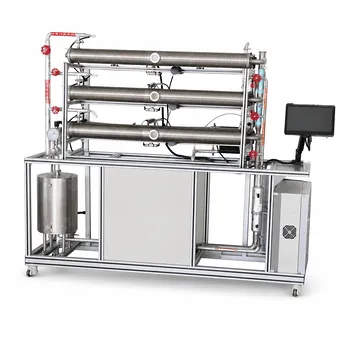
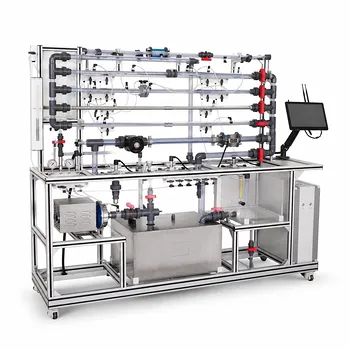
For personnel training, vocational unit operations pilot plants are the definitive bridge between theoretical safety rules and life-saving industrial instinct. These hands-on platforms provide a risk-free environment where operators can trigger, observe, and control hazardous scenarios—like a pressure spike or a chemical release—without dire real-world consequences. They transform abstract regulatory checklists into critical, practiced motor skills for both process safety and environmental compliance.
The core challenge in industrial training is not just knowing the regulations but building an automatic, correct response to danger. Vocational pilot plants solve this by allowing trainees to safely fail, diagnose, and correct process deviations, directly addressing the gap between classroom theory and the high-stakes reality of a live plant.
Beyond the Fume Hood: Confronting Industrial-Scale Hazards
Benchtop chemistry teaches caution, but it cannot fully prepare a person for the kinetic energy and complexity of an industrial process.
Experiencing Contained Failures
Modern pilot plants are equipped with industrial-grade safety relief valves, rupture discs, and automated emergency shutdown (ESD) systems. Instructors can intentionally simulate cooling water failure or a blocked valve.
The trainee doesn't just read about these events; they see the pressure rise on the gauge, hear the alarm, and watch the automated safety interlock engage. This builds an unshakeable, visceral understanding of hazard mitigation that no slide deck can replicate.
Scaling Up Hazardous Reactions Safely
A synthesis involving toxic gas or an exothermic runaway in a benchtop fume hood is a high-risk, manual affair. A vocational pilot plant encloses this same chemistry within an instrumented, controlled system.
The plant features integrated gas scrubbers, automatic dosing pumps, and real-time sensor arrays. The trainee learns how to safely manage volatile byproducts and hazardous reagents at a realistic scale, replacing manual handling with automated safety protocols.
The Physical Classroom for Environmental Compliance
Environmental stewardship shifts from a permit requirement to a hands-on process when trainees interact with dedicated treatment systems.
Practicing Pollution Control Techniques
Dedicated environmental and water treatment pilot plants are not mere demonstrations; they are functioning microcosms of industrial remediation. Trainees operate processes like gas absorption, stripping, and filtration to physically remove a contaminant stream.
This turns "compliance" from a legal concept into a measurable operational goal. The operator learns to adjust parameters in real-time to meet a discharge specification, building practical troubleshooting skills for pollution control that directly translate to a full-scale facility.
Optimizing for Resource Efficiency
Sustainability is another layer of environmental compliance. These pilot plants allow trainees to identify and fix energy loss points, such as unoptimized heat exchange, or to optimize resource recycling loops.
By running the process, a trainee can pinpoint exactly where water or heat is wasted and actively change the process to correct it. This builds a mindset of continuous environmental improvement, a core requirement of modern industrial practice.
Deconstructing the Plant: How the Platform Delivers Its Lessons
The physical design and instrumentation of the pilot plant are the curriculum itself, making abstract engineering concepts tangible.
Mastering the P&ID as a Living Map
A Piping and Instrumentation Diagram (P&ID) is a complex schematic until a trainee traces its lines on a real pilot plant. The plant becomes the physical representation of the diagram.
By operating a control valve and witnessing the downstream pressure drop and flow change on a digital screen, the observer connects the symbol to its real-world function. Understanding this dynamic relationship is fundamental to maintaining process stability and diagnosing system upsets safely.
Conducting a Risk-Free Process Hazard Analysis (PHA)
Conducting a PHA is a core safety planning skill. In a pilot plant session, an instructor can simulate a specific deviation, and then the students perform a PHA on that live, evolving scenario.
They identify the hazard, evaluate the existing safeguards like relief valves, and observe the physical system's automated response. This interactive approach transforms a formal analytical procedure into a dynamic, problem-solving exercise, solidifying a proactive approach to risk mitigation.
Integrating Process Analytical Technology (PAT) for Quality and Safety
Process control is a core safety and quality function. These plants integrate PAT tools—inline sensors and automated data acquisition—that mirror modern pharmaceutical and chemical manufacturing.
Trainees program control loops and analyze how one parameter, like temperature, directly impacts a critical quality attribute. This training demonstrates how continuous process verification enhances safety and reduces reliance on end-product testing, a core tenet of modern quality assurance.
Understanding the Trade-offs
While invaluable, the pilot plant learning model comes with inherent limitations that a training program must address.
The Gap Between Simulation and Reality
A simulated failure, however realistic, does not carry the same psychological weight of a genuine emergency with real consequences. The pilot plant environment is inherently controlled.
The primary trade-off is between safety and authentic stress inoculation. A skilled instructor must explicitly bridge the gap, ensuring the trainee understands that the focused calm of the pilot plant must be replicated when the stakes are life-threatening, not just academic.
Investment in Resource-Intensive Training
This level of training demands a significant investment in sophisticated, industrial-grade equipment and in the expert instructors who can intelligently simulate failures and guide analysis.
For an organization, the trade-off is between this high upfront cost and the long-term value of operators who can prevent a single catastrophic event. The benefit is realized through accident prevention and operational efficiency, not in the training budget line item.
How to Apply This to Your Training Goal
The specific benefit you extract depends on your primary learning objective. Focus your training on the application that matters most.
- If your primary focus is risk-free emergency training: Prioritize sessions where instructors simulate process deviations like cooling failure or a pressure spike. Your goal is to burn the automated response and the physical feel of the hazard into muscle memory.
- If your primary focus is hands-on environmental compliance: Dedicate time to the water treatment and pollution control pilot plants. Focus on operating the equipment to adjust and measure effluent quality until meeting a discharge limit becomes a practiced, repeatable skill.
- If your primary focus is building a quality-by-design instinct: Deeply engage with the PAT tools and DCS interfaces. Your objective is to dynamically link process parameters to final product quality, moving your team's mindset from a reactive testing department to a proactive control function.
- If your primary focus is developing fundamental operational intuition: Start with tracing the P&ID and manually controlling valves to see dynamic system changes. You’re building the foundational understanding of how every component interacts, which is the bedrock of all safe and efficient operation.
With the right focus, a vocational pilot plant transforms a novice technician into a safety-conscious, environmentally-aware process professional before they ever set foot in a live facility.
Summary Table:
| Training Focus | Key Hands-On Activity | Learning Outcome |
|---|---|---|
| Process Safety | Simulating cooling failures, pressure spikes & ESD shutdown | Visceral hazard mitigation & muscle memory |
| Environmental Compliance | Operating gas scrubbers, absorption & wastewater treatment | Practical pollution control & resource efficiency |
| Plant Operations | Tracing P&IDs, adjusting control valves & DCS loops | Dynamic system troubleshooting & P&ID mastery |
| Quality Control (PAT) | Programming control loops with real-time inline sensors | Proactive risk control & continuous process verification |
Ready to elevate your training programs? LABPARK provides state-of-the-art Educational and Vocational Unit Operations Pilot Plants in chemical engineering, bioprocess & biotech, and environmental & water treatment. Designed specifically for universities, research institutes, and enterprises, our pilot plants bridge the gap between classroom theory and real-world safety. Contact LABPARK today to customize a pilot plant solution that builds critical, hands-on operational skills for your team!
Related Products
- Three-Tube Heat Transfer Educational Pilot Plant for Unit Operations Training
- Multi-Functional Drying Educational Unit Operations Pilot Plant
- Multi-Reactor Educational Pilot Plant for Reaction Engineering Unit Operations
- Carbon Dioxide Hydrogen Methanol Synthesis Educational Unit Operations Pilot Plant
- Multimodal Absorption and Desorption Pilot Plant for Unit Operations Training
People Also Ask
- When is ε-NTU preferred over LMTD in pilot plants? Predict heat exchanger performance without iteration.
- How to Verify Air-Side Heat Transfer Coefficient with a Pilot Plant? Practical Lab Guide
- What engineering trade-offs must students analyze in a heat transfer pilot plant? Balance performance & cost.
- How to configure heat transfer pilot plants for pinch analysis? Teach energy recovery.
- How can a heat transfer pilot plant demonstrate waste heat recovery? Learn to optimize industrial thermal systems.