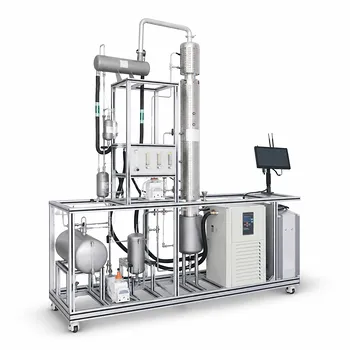
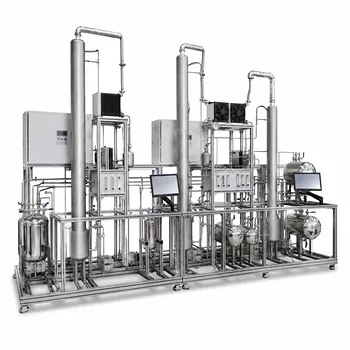
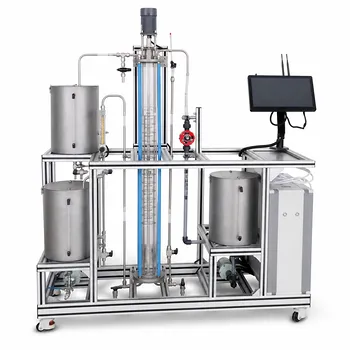
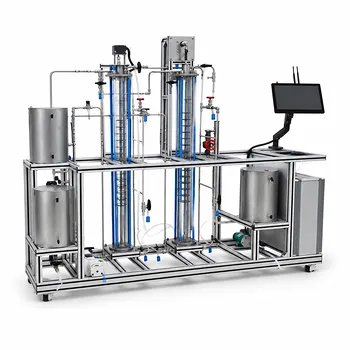
Precise control is not a luxury; it is the instructional backbone of the pilot plant.
In an educational setting, the ability to finely tune reflux ratio and heating power transforms a distillation column from a fixed piece of hardware into a dynamic learning instrument. These two variables are the primary knobs that directly govern the trade-off between separation performance (product purity and number of stages) and the energy consumed per unit of product. Only with responsive, measurable control can students map these relationships, perform real-time energy balances, and discover the narrow operating window where both efficiency and conservation are achieved.
The core insight: Reflux ratio controls the purity versus capital cost trade-off, while heating power determines the energy throughput and hydraulic limits of the column. Holding either variable loose masks the true operational envelope, preventing students from grasping the critical economic optimization—finding the lowest energy input that still meets purity specs. Precise, repeatable control turns pilot plant data into a defendable energy model.
The Reflux Ratio: The Master Lever of Separation and Energy
The reflux ratio is the central parameter that converts simple distillation into rectification. Adjusting it on a live column makes abstract Lewis-Sorel mathematics tangible.
How Reflux Ratio Dictates Theoretical Stages and Product Purity
The reflux ratio $R = L/D$ directly shapes the operating line slope $R/(R+1)$ in the rectifying section. A steeper slope brings the operating line closer to the 45° diagonal, reducing the number of theoretical plates required to hit a target distillate purity $x_D$.
When students increase $R$, they see the top temperature profile stabilize faster and the distillate composition climb. This is the distillation lesson in action: returning more liquid to the column creates richer counter-current contact, raising the effective driving force for mass transfer. The pilot plant’s flow meters and control valves make this slope-adjustment visual, linking pencil-and-paper McCabe-Thiele diagrams to a live temperature profile.
The Energy Trade-Off: Reboiler Duty and Condenser Load
Every unit of reflux creates an energy debt. A higher reflux ratio means a larger liquid return $L$, which forces a proportional increase in vapor boilup $V$. The relationship $V = L + D$ means that pushing $R$ from, say, 1.5 to 3.0 nearly doubles the vapor traffic.
This spike in internal traffic directly scales reboiler steam consumption and condenser cooling water demand. On a well-instrumented pilot plant, students log the simultaneous rise in reboiler electricity use and condenser duty. The lesson crystallizes: purity comes at a steep utility price. A reflux ratio set only 10% above the minimum (e.g., $R = 1.1 , R_{min}$) can slash energy use while still achieving separation—a powerful conservation insight.
Heating Power: Controlling the Driving Force of Vapor Flow
Heating power input to the reboiler is often treated as a background setting, but it is equally critical. It defines the column’s vapor velocity and shapes the stripping section’s operating line.
Vapor Boilup, Column Hydrodynamics, and Efficiency
Reboiler duty directly sets the molar vapor flowrate $V$ entering the base of the column. This velocity dictates plate or packing hydraulics—weep, entrainment, flooding—which in turn determine column efficiency (HETP). Too low a heating power leads to tray weeping and poor mass transfer; too high causes flooding and a sudden loss of separation.
In an educational pilot plant, a variable heating element with precise wattage control lets students exactly map the performance curve. They can deliberately induce weeping or flooding and measure the resulting drop in top-product purity, then throttle back to the optimum point. This teaches that energy conservation is not just about turning down the heat—it is about maintaining the hydraulically sweet spot where stage efficiency peaks without wasteful over-vaporization.
Energy Input and the Stripping Section Balance
While reflux ratio governs the rectifying section, heating power governs the stripping section’s boilup ratio. The same vapor $V$ that removes light ends from the top provides the stripping medium for the bottom. Changing the reboiler heat input shifts the stripping operating line, influencing bottoms purity and the overall column temperature profile.
By independently varying heating power at a fixed reflux ratio, students see the other half of the energy balance: how much heat must be supplied to meet a bottoms specification. Data acquisition reveals that excessive reboiler heat simply dumps energy into the condenser without improving separation—an eye-opening demonstration of avoidable energy waste.
Integrating Both Parameters for Energy Conservation Studies
Only when both reflux ratio and reboiler power are under precise, logged control can a pilot plant yield useful energy optimization data. Automation is key here: a reflux splitter or solenoid valve, paired with a thyristor-controlled heating element, allows students to implement two fundamental control strategies—constant reflux ratio and constant distillate composition.
In constant reflux ratio mode, energy consumption remains steady as the batch depletes, but purity falls unless the ratio is adjusted. In constant composition mode, the control system must ramp up $R$ continuously as the more volatile component is stripped from the pot. Running both strategies side by side lets students compare total energy consumed per litre of on-spec product. The result is an unambiguous lesson: tight, dynamic control of reflux and heat input is the only way to operate near the minimum reflux point—where conservation is maximized—without violating purity constraints.
Understanding the Trade-Offs
Every pedagogical narrative must include the pitfalls. Over-focusing on precision risks ignoring real-world limits.
- Process dynamics vs. steady state: In a small pilot plant, thermal inertia and sensor lag can mask the true relationship. A perfectly set reflux ratio can still yield scattered data if the column isn’t at equilibrium. Students must learn diagnostic patience.
- The hydraulic limit trap: Pushing heating power too high to speed up experiments often moves the column into the flood zone, destroying efficiency. The lesson is that energy conservation has a lower bound, but also an upper bound driven by physics.
- Overlooking variable interactions: Changing heating power independently of reflux ratio upsets both section balances simultaneously. Educational protocols must emphasize that these variables are coupled—altering one without accounting for the other leads to misunderstood efficiency numbers.
Making the Right Choice for Your Educational Goals
Whether you are configuring a new pilot plant or designing a lab exercise, align your control strategy with the principle you want to teach.
- If your primary focus is teaching the McCabe-Thiele method and theoretical stages: Start with a constant reflux ratio mode. Precise control of $R$ lets students draw accurate operating lines and count stages, with immediate experimental validation.
- If your primary focus is demonstrating energy-efficient operation and heat integration: Use a reboiler with adjustable, logged power and enforce a constant distillate composition policy. The continuous ramping of reflux ratio reveals exactly how much extra energy is needed as the batch depletes.
- If your primary focus is tying hydrodynamics to efficiency: Vary heating power across multiple runs at a fixed reflux ratio. Map pressure drop, HETP, and purity to find the flood and weep points, clearly illustrating why a narrow operating window saves energy.
Precision in reflux and heating power does more than generate good data—it turns the pilot plant into a truthful mirror of industrial trade-offs, showing that the cheapest energy is the joule you never needed to spend.
Summary Table:
| Parameter | Key Control Target | Hydraulic/Thermodynamic Effect | Pedagogical Lesson |
|---|---|---|---|
| Reflux Ratio ($R$) | Product Purity vs. Reboiler Duty | Shapes operating line slope; dictates internal vapor/liquid traffic | Teaches McCabe-Thiele modeling and energy-purity trade-offs |
| Heating Power ($Q$) | Vapor Velocity & Bottoms Purity | Dictates column hydraulics (weeping, flooding) and boilup ratio | Teaches hydraulic limits and locating the energy efficiency sweet spot |
Bring Industry-Grade Precision to Your Chemical Engineering Lab
Are you looking to equip your students and researchers with the practical skills needed to optimize real-world chemical processes?
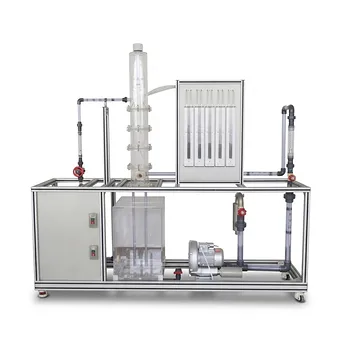
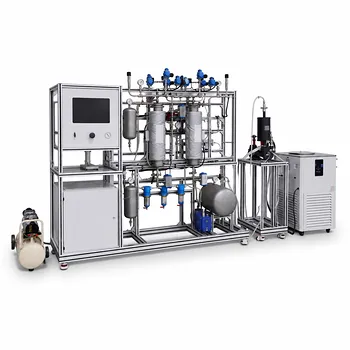
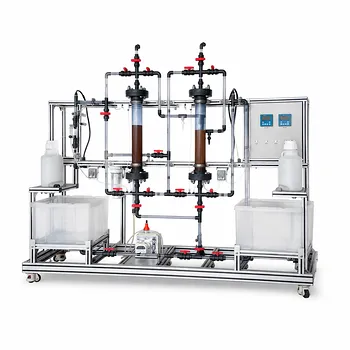
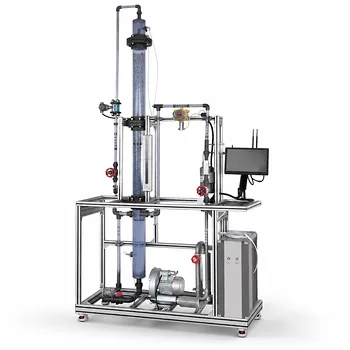
LABPARK provides advanced Educational and Vocational Unit Operations Pilot Plants in chemical engineering, bioprocess & biotech, and environmental & water treatment. Designed specifically for universities, research institutes, and enterprises, our distillation pilot plants feature precise, automated control of reflux ratios and heating power to make complex thermodynamics tangible.
Contact LABPARK today to discuss your curriculum requirements and get a customized pilot plant solution!
Related Products
- Continuous Sieve-Plate Distillation Pilot Plant for Unit Operations Laboratory Education
- Multi-Functional Special Distillation Educational Pilot Plant
- Multi-Modal Distillation Unit Operations Training Pilot Plant
- Continuous Batch Extractive Distillation Educational Pilot Plant
- Dual-Mode Rectification Pilot Plant for Practical Training Unit Operations
People Also Ask
- How can real-time carbon number prediction improve distillation pilot plants? Optimize control.
- What are the primary reflux ratio control strategies? Master Distillation Unit Operations
- Why is vacuum operation capability an essential feature for a distillation unit operations pilot plant? Unlock Efficiency
- How to select the right activity coefficient model (Wilson, NRTL, UNIQUAC) for distillation pilot plants?
- How does catalyst water concentration affect distillation pilot plant design? Key separation train choices.