The most dangerous reaction in a semi-batch reactor is often the one that isn't happening yet. Monitoring low initial or coolant temperatures is critical because an excessively cold start prevents the immediate consumption of fed reactants, causing them to accumulate as a highly concentrated, unreacted mass inside the vessel. If the temperature later rises to the reaction's activation threshold, this accumulated inventory can react all at once, releasing heat faster than any cooling system can absorb, resulting in a catastrophic thermal runaway.
The core hazard isn't the low temperature itself, but the hidden inventory it creates. A "too-cold" reactor acts as a trap, silently building up a potential energy bomb. When the reaction finally ignites, the heat generation rate can instantly overwhelm the system's cooling capacity, making a runaway inevitable.
The Hidden Danger of "Too Cold"
The Accumulation Trap
In a semi-batch operation, reactants are dosed into the reactor over time. For a safe and controlled process, they must react as soon as they are added. The dosing rate must be balanced by the consumption rate.
When the initial temperature or coolant is set too low, the reaction rate—highly sensitive to temperature—plummets. The fed reactants don't convert. Instead, they simply build up in the reactor, their concentration rising far beyond normal operating levels. This is a latent hazard.
Crossing the Activation Threshold
A chemical reaction's rate constant has an exponential relationship with temperature. A seemingly small temperature increase can trigger a massive surge in reaction speed.
As the accumulated reactants eventually warm up—perhaps due to a slow initiation reaction, external heat, or the very exotherm they are trying to start—they cross an activation energy threshold. The entire inventory, representing a massive chemical potential, then undergoes a sudden, highly exothermic decomposition or reaction. This is not a controlled process; it is a rapid burst of heat and pressure that becomes self-accelerating.
Connecting Theory to the Pilot Plant Console
Visualizing the Safety Balance
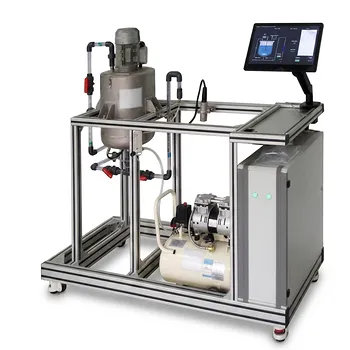
Educational pilot plants make this abstract kinetic hazard tangible. The control console lets students see the critical balance between response time and reaction speed. The primary reference correctly identifies the danger, and on a pilot plant’s interface, you can observe it directly: a low jacket temperature suppresses the reaction until the vessel is full of unreacted material. A slight rise in the internal temperature reading then reveals the runaway initiating—the heat of reaction parameter suddenly dominates as the heat transfer parameter fails.
The Micro-Reactor Advantage for Learning
Advanced pilot units, like microchannel reactors, are excellent tools for teaching this principle safely. They remove heat transfer limits, allowing students to instantly see how rapid heat removal prevents accumulation. By comparing a poorly controlled semi-batch reactor to a near-isothermal flow reactor, the direct link between temperature control and accumulation becomes obvious.
Understanding the Trade-offs
The Low-Temperature Start-Up Risk
A common mistake is assuming "colder is safer" for exothermic reactions. While cooling is essential, overcooling a semi-batch start-up is a classic process safety failure. The controlled risk of a slightly higher, but actively reacting, temperature is far preferable to the latent, uncontrolled risk of reactant accumulation. A reaction running steadily is a safe reaction.
Kinetics vs. Thermodynamics
There’s an inherent tension. Low temperatures may favor thermodynamic conversion in some reactions (like the Water-Gas Shift), but this must not be achieved by halting the kinetics entirely. The educational goal is to find the temperature that sustains a continuous reaction rate equal to the feed rate, ensuring zero accumulation.
Sensitivity of Energetic Systems
Particularly hazardous chemistries, like polymerizations or nitrations, magnify this risk. These reactions have enormous heat release potentials (e.g., an adiabatic temperature rise exceeding 1000 K). For these systems, the danger of accumulation is extreme. Starting a radical polymerization with a coolant that’s too cold is a well-known recipe for a runaway, as the initiator can be consumed without effectively linking monomers, creating a pool of unstable oligomers that violently polymerize later.
Making the Right Choice for Your Goal
How should you, as an operator or instructor, apply this knowledge on a unit operations pilot plant?
- If your primary focus is demonstrating process safety: Intentionally run a simulated start-up where the coolant is set too low. Show students how the reactor temperature initially stays flat while the level rises, then spike a hot fluid through the jacket to trigger the runaway simulation. This creates a powerful, visceral learning moment.
- If your primary focus is reaction optimization: Establish a start-up procedure that first brings the reactor contents to a minimum initiation temperature before beginning the reactant feed. Use the PID controller to maintain a constant, calibrated exotherm and dosing rate, proving that a stable, consuming reaction is the best defense against accumulation.
- If your primary focus is product quality: A runaway produces side products, off-spec polymers, and decomposition tars. Emphasize that precise temperature control at the active reaction threshold is not just a safety measure, but the primary driver of yield and purity.
Understanding this kinetic trap teaches a fundamental truth: in chemical process safety, a quiet reactor is not always a safe one.
Summary Table:
| Parameter | Low Coolant Temp (Overcooling) | Optimal Initial Temp (Safe) |
|---|---|---|
| Reaction Rate | Very slow / dormant | Active (matches feed rate) |
| Reactant Inventory | High accumulation (hidden risk) | Low / near zero accumulation |
| Runaway Risk | Extremely high (delayed ignition) | Minimal (controlled exotherm) |
| Process State | Latent danger (uncontrolled) | Steady state (controlled) |
Bring Process Safety to Life in Your Lab
Teaching complex chemical kinetics and thermal safety requires hands-on, reliable equipment. LABPARK provides advanced Educational and Vocational Unit Operations Pilot Plants across chemical engineering, bioprocess & biotech, and environmental & water treatment.
Specially designed for universities, research institutes, and enterprises, our pilot plants empower students and researchers to safely simulate, monitor, and master critical chemical processes.
Contact LABPARK today to explore our pilot plant solutions and upgrade your laboratory training systems!
Related Products
- Multi-Reactor Educational Pilot Plant for Reaction Engineering Unit Operations
- Multi-Functional Membrane Separation Educational Pilot Plant for Unit Operations Lab
- Electrolytic Hydrogen Production Educational Unit Operations Pilot Plant
- Comprehensive Fluid Mechanics Educational Unit Operations Pilot Plant
- Multi-Functional Drying Educational Unit Operations Pilot Plant
People Also Ask
- How do reactor pilot plants define QbD design space? Master chemical process scale-up.
- When configuring a reactor unit operations pilot plant for highly exothermic reactions, how to prevent thermal runaway?
- How do metal ion-catalyzed reaction mechanisms inform chemical engineering pilot plant design? From kinetics to scale-up
- What role do educational pilot plants play in scaling green chemistry? Bridging the Lab-to-Industry Gap
- What are the barriers to process intensification & how do pilot plants help?